Showing posts with label First Ladies. Show all posts

25 March 2016

First Ladies: Livia Drusilla of Rome


Who was Livia, first lady of Rome?

At seventeen, running through a burning forest in 41 BC, nearly betrayed by the cries of her baby son, Livia Drusilla fled through Sparta with her husband, a supporter of Mark Anthony. Pursued by Octavian’s forces during the two warlords’ bitter struggle, they barely made it to safety.

Livia carried the blood and prestige of both the Livii and the patrician Claudii, families long accustomed to power. Politics was in the very air she breathed. She’d married within her aristocratic circle to Tiberius Claudius Nero, whom Cicero described as ‘a nobly born, talented and self-controlling young man’ and who had risen to the rank of praetor, a senior magistrate. Unfortunately, he had backed the wrong side in the wars following Julius Caesar’s death.

During an amnesty between Octavian and Anthony, Livia and her husband were able to return to Rome in 39 BC, doubtless relieved after a life on the run. Stripped of three-quarters of their assets for their disloyalty, the patrician couple accepted this was the end of Tiberius’ political career. But 39 BC was the year Livia began as a political exile and ended as the consort of one of one of the most powerful men in the world at whose side she stayed for over fifty years.

Livia was introduced to Octavian in autumn 39 BC when she was six months pregnant with her second child, Nero Claudius Drusus. Legend says that Octavian fell immediately in love with her, despite the fact that he was still married. He divorced his wife, Scribonia, on the very day that she gave birth to his daughter, Julia. Livia’s husband, Tiberius, was ‘persuaded’ to divorce Livia and she then moved into Octavian’s house. On 14 January 38 BC her child was born; Octavian and Livia married on 17 January, waiving the traditional waiting period. Fantastically enough, Tiberius, her divorced husband, was present at the wedding, giving her in marriage ‘just as a father would’!

The importance of the patrician Claudii to Octavian's cause, and the Claudians’ own political survival provide more rational explanations. Octavian, a rising star but from a middle rank equestrian background, needed connections with aristocrats like Livia to provide an aura of Republican respectability to his growing power. As for Livia's feelings, at 20 years old she was probably content to be joined with a younger man of 25 with such overwhelming promise. The 47-year-old Tiberius, newly pardoned by Octavian, did not have a real choice, but he was aware that it did not hurt to bestow his wife on Rome's ascendant power. Everyone gained.

By all accounts, Livia played the role of a loving, dutiful and even old-fashioned wife. When Octavian rebranded himself as Augustus, Livia cooperated with his idea that upper-class women should behave in the austere fashion of earlier times, so she and other female members of his household spun and wove his clothing.

Livia's image appears in ancient visual media such as coins and portraits and evolved with different styles of portraiture that promoted imperial propaganda and the cult of Augustus. Becoming more than the "beautiful woman" described as in ancient texts, Livia served as a public image for idealised Roman feminine qualities and symbolised the renewal of the Republic with the female virtues of pietas and concordia that was supposed to set the public pattern for future imperial women.

She ignored Augustus’s notorious womanizing; Tacitus called her an "easy wife". But this was not unusual. The goal of a Roman marriage was the formation of a household and the production of children, not sexual gratification, which could be found elsewhere. Unfortunately, Livia never bore Augustus any living children. It demonstrated the strength of their relationship that Augustus did not divorce her because she failed to produce them. The two were a partnership; with her intelligence, connections and influence, she served him as a trusted confidante and advisor, even accompanying him abroad.

The perception that Livia schemed and was ambitious for Tiberius, her son with her first husband, fed the idea of her complicity in Augustus' death in AD 14. She supposedly smeared poison on figs, then guided him to pick one of these for himself while she selected untainted ones. Although implausible, the accusation shows how strongly she came to be perceived as championing her offspring at any cost.

Suetonius describes a loving and trusting relationship between Livia and Augustus at the end. The emperor's last words were 'Live mindful of our wedlock, Livia and farewell’; he died as he kissed her. This detail is probably no more accurate than the poisoned figs story, but it represents Livia’s double role: dutiful wife and ambitious schemer.

Livia remained an influential figure even after Augustus’s death. Gaius, her great-grandson who followed Tiberius in the principate as Caligula, lived with her when he was young. He called her Ulixes stolatus, (Ulysses in a matron's dress), a strong and manipulative woman.

Livia died in AD 29 at the advanced age of 86. She received a public funeral, although a relatively modest one, and was buried in the Mausoleum of Augustus. Gaius (the future Caligula) delivered the eulogy. When he became emperor, he paid the bequests that she had provided for in her will that her own son Tiberius had ignored. Her grandson Claudius would oversee her long-deferred deification in AD 42. Women were to name Diva Augusta in their oaths; she received an elephant-drawn chariot to convey her image to the games; a statue of her was set up in the temple of Augustus; races were held in her honour. The woman who played an important role in two principates joined the imperial pantheon at last. Tacitus' obituary calls her "An imperious mother and an amiable wife, she was a match for the diplomacy of her husband and the dissimulation of her son", a concise statement of the reputation that she left behind.

Further reading:
The First Ladies of Rome: The women behind the Caesars, Annelise Freisenbruch
  
Photos:
[Statue]
Livia Drusilla, Museo della Civita Romana, author’s photo

[Coin]
Dupondius depicting Livia as Pietas
By Classical Numismatic Group, Inc. http://www.cngcoins.com, CC BY-SA 3.0
-------------------------------
Alison Morton is the author of the acclaimed Roma Nova thrillers INCEPTIO, PERFIDITAS, SUCCESSIO and AURELIA (currently shortlisted for the 2016 Historical Novel Society Indie Award). Her fifth book, INSURRECTIO is out on 12 April. 

Connect with Alison on her Roma Nova site: http://alison-morton.com
Twitter https://twitter.com/alison_morton @alison-morton

Buying link for AURELIA, Alison’s latest book (multiple retailers/formats):


AURELIA book trailer: https://youtu.be/K5_hXzg0JWA

22 March 2016

First Ladies: Cuthburga, an Ex-Queen Who Founded an Influential Abbey

By Kim Rendfeld

Cuthburga’s greatness came after she left her royal husband.


The sister of King Ine of Wessex would go on to found Wimborne Minster in Dorset, a double monastery that would influence Christianity on the Continent. It became a training ground of female missionaries, burial place of royalty, and college of secular (nonmonastic) canons.


Wimborne
But we’re left with more questions than answers about the early medieval Saxon responsible for its existence. Her birth date is unknown, and she died August 31, perhaps in 725. She was married to Northumbrian King Aldfrith, who ruled a realm about 300 miles from her home.

Like almost all marriages in the Dark Ages, Aldfrith and Cuthburga would have wed for political reasons rather than love. Whether they parted before or after their marriage was consummated depends on whether we believe manuscripts written in the 12th and 14th centuries. In the latter manuscript, whose author took the creative liberties of a historical novelist, Cuthburga wanted Christ as her spouse, and on the night of her nuptials, she quoted Scripture to her husband to extol the virtues of virginity, a higher calling than wedlock. Although Aldfrith desired her, he released Cuthburga from her marital vows and even asked her to pray for him.

Such a scene is good for drama, but it’s highly unlikely. Medieval wedding nights were not private events. In a state of undress, the bride and groom accepted each other in front of witnesses.


A more plausible possibility is that Cuthburga became a nun after failing to produce an heir. The couple might have seen the lack of a child as a sign from God, especially if she was already drawn to a spiritual life. Her taking the veil proved mutually beneficial. As an abbess, Cuthburga would still have a position of wealth, importance, and power – plus the independence of not having a man telling her what to do.   Aldfrith would consent to letting his wife go because it would free him to marry a fertile woman.


Aldfrith had a son, Osred, around 696, but Cuthburga did not act like the boy’s mother. Osred was 8 when his father died around 704. In such cases, the widowed queen often was regent until the son came of age. Cuthburga did not play that influential role. In fact, she seemed to have nothing to with Northumbrian politics.


After leaving her husband, Cuthburga went to Barking, perhaps for a yearlong novitiate under Abbess Hildelith. By 705, she founded the double monastery at Wimborne and was joined by her sister and later successor Cwenburga. Her abbey became a center for teaching religious women. Later, Saint Boniface turned to Tetta, another of Cuthburga’s successors, when he needed nuns to serve as missionaries on the Continent.


If we are to believe Rudolf of Fulda in his ninth century hagiography about Saint Lioba, men and women at Wimborne lived on the grounds in their own houses and did not interact. The only time the women saw a man was when the priest celebrated Mass. Three centuries later, William of Malmesbury calls Cuthburga’s community “a full company of virgins, dead to earthly desires and breathing only aspirations towards heaven.”


Yet her fate in afterlife is uncertain. According to an eighth-century anonymous monk, the former queen is screaming in a penitential pit with a couple of other aristocrats, having their carnal sins thrown in their faces like boiling mud. Could the monk have meant a different Cuthburga? He mentions her once being a queen but nothing of her being an abbess.


However, she was canonized by the 14th century, and I prefer this entry from a manuscript of that era: “She was buried with fitting honour in the same church which she had built to the holy mother of God, where by her merits very many miracles were wrought and many benefits were bestowed on the sick; the power of walking was restored to the lame, hearing to the deaf, sight to the blind, through the tender mercy of Jesus our Christ, whose majesty and sway remain for ever and ever.”


Sources


A Dictionary of Saintly Women
, Volume 1, by Agnes Baillie Cuninghame Dunbar


William of Malmesbury's Chronicle of the Kings of England: From the Earliest Period to the Reign of King Stephen (12th century, 1866 translation)


Hell and Its Afterlife: Historical and Contemporary Perspectives, edited by Isabel Moreira and Margaret Toscano

Woman under Monasticism: Chapters on Saint-Lore and Convent Life between A.D. 500 and A.D. 1500, Lina Eckenstein

A Biographical Dictionary of Dark Age Britain: England, Scotland, and Wales, c. 500-c. 1050, Ann Williams, D. P. Kirby

The Collegiate Church of Wimborne Minster, Patricia Helen Coulstock

“The Marriage of St. Cuthburga, Who Was afterwards Foundress of the Monastery at Winiborne,” by the Rev. Canon J.M.J. Fletcher, Proceedings - Dorset Natural History and Archaeological Society, Vol. 27 [http://www.archive.org/stream/proceedingsdorse34dors/proceedingsdorse34dors_djvu.txt]

Medieval Sourcebook: Rudolph of Fulda: Life of Leoba [http://www.fordham.edu/halsall/basis/leoba.asp]

Kim Rendfeld was curious about Cuthburga because Wimborne trained female missionaries who played an influential role in medieval Francia, the setting for her novels, The Cross and the Dragon and The Ashes of Heaven’s Pillar, and her work in progress, Queen of the Darkest Hour.


21 March 2016

First Ladies: Antonia Minor


In Ancient Rome women rarely held official positions, but often wielded considerable power behind the scenes. One of the best examples of this is Antonia Minor: daughter, niece, wife, mother, aunt, and grandmother of powerful Roman men, and in her own right one of the most powerful women in Roman history.

the Juno Ludovisi,
a portrait of Antonia Minor
Antonia was born in 36 BCE, the younger of two daughters born to Marc Antony and Octavia Minor. She never knew her father, who left his family for his ill-fated affair with Queen Cleopatra when Antonia was a toddler; she was raised by her mother and her uncle Octavian (soon to be known as Caesar Augustus) as part of a collection of important children brought up within Augustus' oversight, the offspring of family, friends, and enemies. Growing up in such an environment, Antonia must have learned the ways of Rome from an early age. She learned them well indeed.

At age 20 she married her step-cousin Drusus, the darling of the Roman military world. For seven years they were the power couple of Rome, touted by the Princeps as models of conservative Roman family values; in a time when the government had to browbeat the upper class into having children, Antonia was pregnant at least 5 times in 7 years (though only 3 children lived). She accompanied her husband on campaign and was so beloved by his soldiers that they called her "Mother of the Legions". By all accounts they were truly in love – there are no stories of either party having affairs, which was nearly unheard of in aristocratic Roman society. I often wonder how Antonia’s life might have been if Drusus had succeeded Augustus and she had become the true first lady of Rome, living happily ever after with her husband and children. Alas, that was not to be. In 9BCE Drusus died at the age of 29, leaving Antonia a widow at 27.

Rather than shrinking into the background, Antonia remained influential – and single – for the rest of her life. The Senate recognized her with honors and offered her the title Augusta, a distinction that had only been given to one other woman (her equally formidable aunt Livia, wife of Augustus). She'd inherited a lot of property and money from her father and husband, and she managed it on her own, interacting with male associates on terms of equality as an independent businesswoman. She and her aunt Livia oversaw the Julio-Claudian dynasty with a steely authority that earned them both the enmity of Roman writers, who tended to view strong women as cold, ruthless, vain, and unnatural.

coin featuring Antonia's profile
and the title Antonia Augusta
It's true that when it came to running the family business, Antonia did not let maternal instincts get in the way. She showed disdain for her youngest child, the stammering Claudius, mocking him as stupid and even calling him a monster. Roman attitudes to physical impairment surely colored her judgment, but it could be she just didn't like him. Perhaps losing Drusus had hardened her beyond such tenderness. But she couldn’t have been entirely without feeling – like her uncle Augustus, she collected the offspring of dead relations and raised a household of other people's children. She outlived several of them, including two of her own children: her son Germanicus followed in his father's footsteps by dying young of mysterious circumstances, while her only daughter Livilla masterminded a plot to assassinate Tiberius in 31CE. Antonia administered swift and merciless punishment, locking her daughter away and possibly starving her to death. No matter what else, loyalty to the family must always come first. 

At the age of 73, Antonia Minor died the same way she had lived: on her own terms, and by her own strength. When her grandson Caligula refused to listen to her advice and showed himself entirely unconcerned with the family's honor, she committed suicide as an act of protest. If only she had waited a little longer and seen her youngest son come to power, she could have known that not everything in her life was destined to come to a tragic end. Her stupid little monster ended up becoming one of the greatest emperors in Roman history.


Heather Domin is the author of The Heirs of Fortune, set in Augustan Rome, in which Antonia Minor plays a small but important role. She has been a contributing member of Unusual Historicals since 2011.

16 March 2016

First Ladies: Ava de Ribagorza, a Traitor Countess?

By Jessica Knauss 


Mid-eleventh-century illumination from the
St. Sever Beatus

In the tenth century, so much definitive action took place in northern Spain that every historical person played a fascinating role. One of these historical persons was Ava de Ribagorza, Countess of Castile and wife of Count García Fernández. Although an epic poem about García’s wife circulated all over Iberia—The Traitor Countess—its storyline bears little relation to fact. I’m writing a novel with Count García and Countess Ava as central characters, and to write about her convincingly, I need to make crucial decisions based on little evidence. How to separate legend from history?

García Fernández was the second Count of Castile from his father’s death in 970 until his own passing in 995. At the time Castile was a territory on the fringes of the Kingdom of León and politically dependent on it. The Castilians’ location on the frontier with the Caliphate of Córdoba meant that by necessity, the political leaders were principally warlords. They had to be ready at any moment to defend their hard-won territory from brutal raids that terrified everyone from the haughtiest king to the lowliest laborer.

This is the era of Almanzor, a political opportunist and great military strategist whom everyone in the north of the peninsula assumed was the caliph because of his seemingly limitless power. The map shows Almanzor’s principal forays into León, Castile, Navarra, Ribagorza, and Barcelona (the “Christian kingdoms”) and the generous swath of territory he took back for his prosperous empire. The constant ebb and flow of conflict was only aggravated because the Christian kingdoms often had bloody spats amongst themselves.

The militarization of Castilian society was so extreme that it’s said that the men didn’t have time to take care of their own horses. That job, and other important ones, belonged to their tough-as-nails wives.

Count García in the Plaza Mayor
of Salamanca
Ava was born circa 945, the daughter of Count Ramón II of Ribagorza. The family name refers to the county between the France-dependent County of Barcelona and the independent Kingdom of Navarra. The Queen of Navarra may have helped arrange Ava’s marriage to Count García in 960 or 965. Ava’s prime age and noble birth made it a good match that became a fruitful union. Somehow, between battles and governance, the count and countess raised six children to adulthood. Four of the five daughters made advantageous marriages, one became a nun, and the son, Sancho, inherited the title and responsibilities of Count of Castile.

Not many other facts have survived about this woman, whom circumstance must have made extraordinary. It’s my job as a historical novelist to breathe life into Ava on the page, but I don’t have a lot to go on. Her death may even be more mysterious than her life.

I haven’t been able to find a record of when Ava died. There is no mention of her in the histories after García Fernández’s passing. This doesn’t necessarily mean she died around the same time. Because her husband’s death meant the end of her time as Countess of Castile, she might have taken on a lesser role at court, perhaps supporting the new count, her son, in ways no one valued enough to write down.

As I’ve written at Unusual Historicals before, the minstrels and then the historians who wrote down The Traitor Countess took Ava’s absence from the historical record and ran with it. They claimed that she wanted to elope to Córdoba with her Moorish lover, and they set Count García’s death squarely on her shoulders. She takes advantage of her role as horse husband by giving García’s steed food that makes it look bulky, but actually weakens it. As Ava has planned, the horse fails the count in battle, leading to his death on the frontier. She then attempts to poison her son so she can leave Castile, but Sancho turns the poison back on his mother in a scene reminiscent of Hamlet.

Presentation miniature from thirteenth-century Estoria de Espanna
It’s hard to imagine why Ava became the target of so much scorn. Perhaps something similar to this happened and became lost to history. Or, more likely, confronted with a vacuum in the record and well removed from the time period, the thirteenth-century historians preferred to write down scandalous material instead of nothing at all. A traitorous countess could explain two things that might have puzzled them: the death of the great warrior, Count García; and the curious fact that his youngest daughter, Oneca, was married to Almanzor soon after García’s death.

Yes, that Almanzor. In the tenth century, political strategy could easily have led to such a match. In the thirteenth century, however, historians were more concerned with presenting a coherent story of Castilian power and religious righteousness than with the complexity of history. If they read about Oneca’s marriage to Almanzor, terror of the north, they would have thought something had gone terribly wrong. What better way to explain a now unsavory alliance than by blaming a woman? The poor girl must have had a terrible mother, since her father was a proven example of knightly virtue.


Of course, this is impossible to prove, but I imagine a lot of drama in the scriptorium while the historians were coming up with their narratives. It looks as if I’ll have to use some of that imagination in the service of redeeming Ava—or further condemning her. I haven’t decided yet.


Jessica Knauss earned her PhD in Medieval Spanish with a dissertation on the portrayal of Alfonso X’s laws in the Cantigas de Santa Maria, which has been published as the five-star-rated Law and Order in Medieval Spain. A driven fiction writer, Jessica Knauss has edited many fine historical novels and is a bilingual freelance editor. Her historical novel, Seven Noble Knights, will be published December 11, 2020, by Encircle Publications. Find out more about her writing and bookish activities here or here. Follow her on Facebook and Twitter, too!

04 March 2016

First Ladies: Sultana Moraima of Muslim Granada

By Lisa J. Yarde


Moraima, as portrayed by Alba Garcia
in the Spanish TV series, Isabel
The last queen of Muslim Granada in the fifteenth century was the first to occupy a unique position in history. As the only official wife of Muhammad XI, the kingdom's last Sultan, she witnessed the collapse of more than two hundred years of Moorish rule in Europe. Moraima was the sole Sultana of Granada whose prominence as the wife of the monarch was eclipsed by the behavior of an elder queen. Lastly, she perhaps suffered as few of her royal predecessors ever had, as the prisoner of her father-in-law who sought to bring his rebellious son to heel, and as a mother who had her eldest son stolen away and converted by the Catholic Monarchs Isabella of Castile and Ferdinand of Aragon.

Life for Moraima did not begin with such difficulties. Born in approximately 1467, she was perhaps the youngest child of Ibrahim Ali al-Attar, the future governor of her birthplace in Loja, southern Spain. Her name isn't traditional Arabic of the period and could be diminutive of the more common Maryam. In earlier sources, Moraima was often referred to the honorific title used in Moorish documents for reference to women, "Mother of Victory" or Umm al-Fath. Her father gained his position during the reign of Sultan Abu'l-Hasan Ali (Muley Hacen in Spanish sources). Perhaps this contact with the royal family in Granada fostered the marriage of Moraima and Abu'l-Hasan Ali's eldest son, Muhammad, when the bride was 15. Legend purports that she was so poor that her wedding clothing and jewels were borrowed; unlikely for the daughter of a Muslim governor marrying into the last Moorish Dynasty, but perhaps, the suggestion alluded to the demure nature all sources agreed she possessed.  The young couple went on to have at least two sons, Ahmad and Yusuf. Moraima's happiness with her husband and children did not last long.


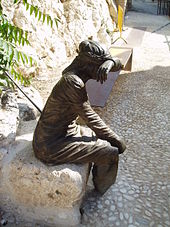
Statue of Moraima at her birthplace in Loja
Early within the marriage in 1482, Muhammad rebelled against his father's rule, spurred on by Abul-Hasan Ali's first wife and Muhammad's mother, Aisha. According to legend, Moraima endured a forced separation from her husband as a result. Likely a second coup also sponsored by Aisha occurred later in the summer of the same year because Abu'l-Hasan then withdrew to Malaga on the coast and his son ascended as Muhammad XI in Granada. The reign of Moraima's husband did not begin with success. In 1483, he attempted a raid, but instead found himself the prisoner of Ferdinand and Isabella's forces. Even worse for Moraima, her elderly father died in the defense of Muhammad. Her torment did not end there. She regained her husband, but his captors demanded bitter concessions; not only did Muhammad have to agree to eventually surrender Muslim Granada, he and Moraima would have to give up their eldest son, Ahmad. At two years old, he went to the Castilian court as a hostage. His young mother would not see him again until he was nine, a boy who knew nothing of Islam and could not speak a word of Arabic. 

The fall of Muhammad's kingdom occurred on January 2, 1492, the date by which Moraima left Granada with her husband's family. Through an agreement with the victorious Isabella and Ferdinand, the Moors were to settle in the mountainous region of the Alpujarras. By mid-1493 Muhammad crossed over to Morocco, but Moraima did not accompany him. She had died after an undetermined illness in Andarax and was buried in Mondujar, where Muhammad also re-interred the bones of at least twelve generations of his royal ancestors. A tragic end for the dynasty and the last queen of Muslim Spain. I hope readers will enjoy learning more about Moraima in the last novel of my Moorish Spain, Sultana: The White Mountains when it debuts later this year.   


Sources 

Islamic Spain 1250 to 1500 by L.P. Harvey

Las Sultanas de la Alhambra by Barbara Boloix Gallardo


Images from Wikipedia and the Spanish series, Isabel.


Lisa J. Yarde writes fiction inspired by the Middle Ages in Europe. She is the author of two historical novels set in medieval England and Normandy, The Burning Candle, based on the life of one of the first countesses of Leicester and Surrey, Isabel de Vermandois, and On Falcon's Wings, chronicling the star-crossed romance between Norman and Saxon lovers before the Battle of Hastings. Lisa has also written five novels in a six-part series set in Moorish Spain, Sultana, Sultana’s Legacy, Sultana: Two Sisters, Sultana: The Bride Price and Sultana: The Pomegranate Tree, where rivalries and ambitions threaten the fragile bonds between members of a powerful family. Her short story, The Legend Rises, which chronicles the Welsh princess Gwenllian of Gwynedd’s valiant fight against English invaders, is also available.