This month on Unusual Historicals, we're going to re-post some of our greatest hits, as chosen by each of our fantastic contributors. Since so many of us will be at Nationals and traveling in July, this is the perfect way to survive a busy month and to show off the posts and topics we're most proud of. First up...me!
***
.jpg) By Carrie Lofty
By Carrie Lofty
During WWII, as the majority of fit fighting men in the Allied countries joined the armed forces, women took an increasingly prominent role in occupations previously tended by their male counterparts. We've all seen posters of Rosie the Riveter and heard stories of women working in assembly plants and as code breakers. Actress and mathematics prodigy Hedy Lamarr even developed a type of airwave frequency transmission in 1941, one so advance that the US Army couldn't make use of it until engagements in Cuba in the early 1960s.
Another way women helped was by flying airplanes. The Air Transport Auxiliary in the UK employed men who were missing limbs, missing eyes, or perhaps a little over the hill--but who were still able to ferry repaired, new, and reserve aircraft to where they were needed all over the UK, and then into Allied territory on the mainland. Eventually, as ATA pilots began to transport troops and provide field ambulance flights, even these men did not meet demand. The ATA quickly opened their rolls to women.
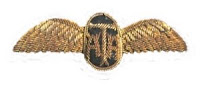 One in eight ATA pilots were women, and 15 lost their lives during the war. The ATA became the first organization within the British government to authorize equal pay for equal work, and thereby attracted women from around the world to participate. Pilots began with single-engine aircraft and worked their way up to larger, more difficult planes, including massive four-engine bombers. The only planes women were not permitted to fly was the flying boat. Together with the men, they delivered over 300,000 aircraft to their destinations.
 In the US, a similar civilian ferrying system was established in 1942, called the Women Airforce Service Pilots, or WASPs. Roald Dahl and Walt Disney conceived of their mascot, Fifinella the Gremlin, which eventually became their official shoulder patch.
But the WASPs' management was considerably less organized than the ATA. From Wikipedia, regarding conditions where WASPs trained outside Houston: "[They] had minimal medical care, no life insurance, no crash truck, no fire truck, a loaned ambulance from Ellington, insufficient administrative staff, and were trained with a hodgepodge of aircraft--23 types." In addition, they received as little as 35% of the pay civilian men received for the same operations, yet over 50% of aircraft ferrying in the USA was handled by the WASPs. Eventually, their duties were expanded to more dangerous roles, such as towing targets for aerial gunnery practice, simulated strafing, and running check of repaired planes. Some women went on to become flight instructors.
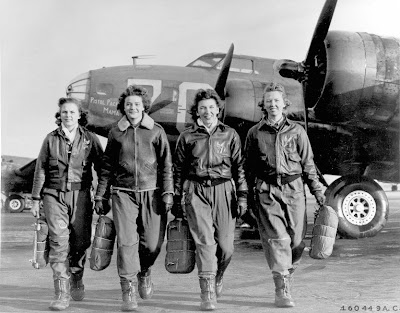
A bill introduced into the US House of Representatives to provide WASPs with the same military benefits as their male colleagues was defeated when male pilots protested--some because they'd rather stay in the US for ferrying work rather than be sent to the Pacific, where the war showed few signs of slowing. Thus instead of receiving their due, after delivering 12,650 aircraft, the WASPs were disbanded in December of 1944. Although 38 WASPs died in service to their country, records of the entire organization were sealed for 35 years, and it wasn't until the Carter Administration that they were awarded full military benefits and honors.
 Soviets were the only women in the war to became combat pilots. In 1941, Stalin ordered that all women without children who were not already employed in the war effort should join the military. Three all-women pilot units--fighters, bombers, and night bombers--were organized, although many women flew with male regiments. Valentina Grizodubova became commander of a 300-man long range bomber squadron, and when Marina Raskova (right), who organized the female fighter regiments, was shot down and killed in 1943, the Soviets held their first state funeral of the war.
***
By Carrie LoftyDuring WWII, as the majority of fit fighting men in the Allied countries joined the armed forces, women took an increasingly prominent role in occupations previously tended by their male counterparts. We've all seen posters of Rosie the Riveter and heard stories of women working in assembly plants and as code breakers. Actress and mathematics prodigy Hedy Lamarr even developed a type of airwave frequency transmission in 1941, one so advance that the US Army couldn't make use of it until engagements in Cuba in the early 1960s.
Another way women helped was by flying airplanes. The Air Transport Auxiliary in the UK employed men who were missing limbs, missing eyes, or perhaps a little over the hill--but who were still able to ferry repaired, new, and reserve aircraft to where they were needed all over the UK, and then into Allied territory on the mainland. Eventually, as ATA pilots began to transport troops and provide field ambulance flights, even these men did not meet demand. The ATA quickly opened their rolls to women.
 One in eight ATA pilots were women, and 15 lost their lives during the war. The ATA became the first organization within the British government to authorize equal pay for equal work, and thereby attracted women from around the world to participate. Pilots began with single-engine aircraft and worked their way up to larger, more difficult planes, including massive four-engine bombers. The only planes women were not permitted to fly was the flying boat. Together with the men, they delivered over 300,000 aircraft to their destinations.
 In the US, a similar civilian ferrying system was established in 1942, called the Women Airforce Service Pilots, or WASPs. Roald Dahl and Walt Disney conceived of their mascot, Fifinella the Gremlin, which eventually became their official shoulder patch.
 But the WASPs' management was considerably less organized than the ATA. From Wikipedia, regarding conditions where WASPs trained outside Houston: "[They] had minimal medical care, no life insurance, no crash truck, no fire truck, a loaned ambulance from Ellington, insufficient administrative staff, and were trained with a hodgepodge of aircraft--23 types." In addition, they received as little as 35% of the pay civilian men received for the same operations, yet over 50% of aircraft ferrying in the USA was handled by the WASPs. Eventually, their duties were expanded to more dangerous roles, such as towing targets for aerial gunnery practice, simulated strafing, and running check of repaired planes. Some women went on to become flight instructors.

A bill introduced into the US House of Representatives to provide WASPs with the same military benefits as their male colleagues was defeated when male pilots protested--some because they'd rather stay in the US for ferrying work rather than be sent to the Pacific, where the war showed few signs of slowing. Thus instead of receiving their due, after delivering 12,650 aircraft, the WASPs were disbanded in December of 1944. Although 38 WASPs died in service to their country, records of the entire organization were sealed for 35 years, and it wasn't until the Carter Administration that they were awarded full military benefits and honors.
 Soviets were the only women in the war to became combat pilots. In 1941, Stalin ordered that all women without children who were not already employed in the war effort should join the military. Three all-women pilot units--fighters, bombers, and night bombers--were organized, although many women flew with male regiments. Valentina Grizodubova became commander of a 300-man long range bomber squadron, and when Marina Raskova (right), who organized the female fighter regiments, was shot down and killed in 1943, the Soviets held their first state funeral of the war.