Showing posts with label humor. Show all posts

27 December 2010

Accidents: Vanishing Manuscript Syndrome

By Anna C. Bowling

One of the greatest disasters known to writerkind can happen in any number of ways. A power outage could do it, or a pet chewing on the extension cord. "Save" and "delete" are only a mouse click apart. There's the dreaded internet virus that brings the blue screen of death. Maybe the files from the old word processing program aren't compatible with the new one and the writer is now looking at a file full of incomprehensible symbols.

Vanishing Manuscript Syndrome has five unique stages (with apologies to Elisabeth Kübler-Ross):

Denial: This can't be real. All that work, all that research, all those characters and their world where the writer lived and breathed for all that time, gone in a blink.

Anger: Family members may rush in upon hearing the animalistic roar that comes from the writer's den. The writer may malign the internet in general, the computer, the computer's power source, or whatever has made off with the best book ever. This isn't fair.

Bargaining: The writer may make appeals to their deity of choice and/or resident techy family member, promising extravagant rewards if the file can be saved.

Depression: What's the use? The book stunk anyway. Maybe this is a sign from the universe. Maybe the writer should forget about writing and go back to alligator wrestling or something less stressful.

Acceptance: Okay, that version is gone and it's not coming back. The writer could give up, but the characters are still there and still want their stories told. The writer searches for backup copies, or requests them from critique partners. Deep breath, beverage of choice, and open a new document. This version will be even better.

Have you ever had Vanishing Manuscript Syndrome? If not, how do you prevent it? How do you deal with recovering from this sort of accident?

Writing historical romances allows Anna C. Bowling to travel through time on a daily basis and make the voices in her head pay rent. Her current release, ORPHANS IN THE STORM, is available from Awe-Struck E-books.

17 March 2010

Arts and Music: The Farting Man

By Jennifer Linforth

So. I was going to blog on opera until I added dates wrong in my third book and all hell broke loose. This led to the discovery of a major historical event that I now must write around. After much cussing and a husband who ran for the hills (for a dyscalculic author on a research rampage is never a pretty picture)I stumbled upon the farting man.

I will pause here to let that sink in.

Yes...the farting man. He was famous in 19th century Paris. So famous, he sold out the Moulin Rouge time and time again because of his unique--instrument.

Joseph Pujol was Le Petomane. He was an ordinary man, apprenticed to a baker at age 13, and owned his own business. While a young man in the national service, he entertained his friends by his unusual talent of inhaling water through his bum and shooting in out in a giant stream. Later he discovered he could do the same with just air.

If you can imagine for a moment a man headlining this act in a century where you didn't even speak of such things, let alone place them in print. But nonetheless, in 1892 Pujol convinced M. Vidler of the Moulin Rouge to put him on stage.

He wore a flamboyant costume of red and took the state prefacing each...act...with a description. Such as "this is a bride on her wedding night" (a small passing of air). Or..."this is a cannon" (loud thunderous...um...sound). Reports say the audience didn't know what to make of it until, once it settled in, they were rolling in the aisles in laughter. Women apparently had to be escorted outside for air. They were laughing so hard they were passing out in their corsets.

Pujol billed at the Moulin until 1914. Twenty-two years of farts. (Yes, I did that math right.) Upon his retirement, when he toured Europe and North Africa with his act, he settled in Toulon and opened a thriving biscuit factory.

You can't make this stuff up!

It all makes me wonder what the audience was thinking especially since this has been a important week for the stage. After all, Andrew Lloyd Webber's Phantom sequel Love Never Dies premiered in London to rather unsatisfactory reviews. I wonder what folks were tweeting about as they sat through that show.

I lay odds if the folks were tweeting in their seats at Pujol's performance they'd say: "It's a gas."

27 January 2010

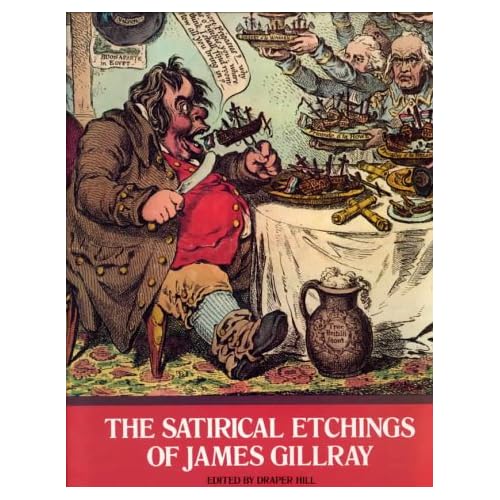
Humor: The Satirical Work of James Gillray

By Erastes

He was a withdrawn, silent and lonely man, greatly slandered in his lifetime, probably by his victims and their friends. He worked in such a fury of creative energy that even his acquaintances years before his breakdown, wondered if he might be part-demented. He was so popular that there were often queues at the print shop, above which he worked, waiting for his latest cartoons and caricatures. At once the most ferocious and most brilliant caricaturist of his time, Gillray had a genius for turning public figures into monsters that were yet recognizable, his wild exaggeration being itself a criticism of their personalities.*
Born in 1757, James Gillray was educated at the cheerless and funless Moravian Academy in Bedford and later apprenticed to Harry Ashby, an engraver in the printer's district in London.

When qualified, he broke away from the engraving business and studied at the Royal Academy. He set up his own studio and intended to paint portraits but he was not patronised and eventually he had to return to the money-spinning business of engraving.

A Little Music or the Delights of Harmony

After experimenting with social subjects, such as the etching above, he started to do political satire and his popularity flourished. No-one was safe from his earlier work, neither politician nor royal prince.

The Prince of Wales

He worked exclusively for Hannah Humphreys in Bond Street, and moved into the premises.

Towards the end of his career Gillray's primary target was Napoleon Bonaparte and as "Little Boney"s power and ambition increased so did Gillray's caricatures of him become ever more extreme.

He was eventually given a "pension" by the Tory government, after which his attacks concentrated less on the Tories, and more on the Whigs... Perhaps the Whigs should have given him a pension too...

When his eyesight began to fail, and he was no longer able to create the quality of work he had been used to do, he began to drink and sink into depression.

Sadly, in 1811, Gillray attempted suicide by throwing himself from the attic of Humphrey's shop, after which he was deemed insane. Hannah Humphreys tended to him until the day he died in June 1815.

* The Prince of Pleasure, J.B. Priestley.
James Gillray Online

26 January 2010

Humor: Wartime Laughs

By Carrie Lofty

WWII was a military, cultural, and humanitarian watershed, where just under 200,000 people died every week around the world. To say that citizens and soldiers everywhere needed a good laugh just to make it through the day is a big understatement.

New forms of popular culture had already started to flourish in the years leading up to the war. You'd think that the Great Depression would curtail spending on entertainment, but the exact opposite happened. Those who could afford it consumed music, films, plays, books, and periodicals in greater numbers than ever before. Even dirt poor families, like my dad's Okie farmer parents who migrated to California, found a way to keep smiling. His mother, my late grandmother, was considered the best storyteller in her family, so everyone would save money to send her--alone!--to the movie theater. She would then come home and retell the movie to her siblings, parents, aunts, uncles and cousins after supper.

Can you imagine? I get chills just thinking about it.

One of the best known venues for humor during the war were USO shows. The USO was established in 1941 with the motto "Until Everyone Comes Home," and served as a home away from home for Allied soldiers. The best entertainers of the day performed pro bono--probably grateful to do so because they weren't actually on the front lines! This is from Wikipedia:

At its high point in 1944, the USO had more than 3,000 clubs, and curtains were rising on USO shows 700 times a day. From 1941 to 1947, the USO presented more than 400,000 performances, featuring entertainers such as Bing Crosby, Judy Garland, Bette Davis, Humphrey Bogart, Lauren Bacall, Frank Sinatra, Marlene Dietrich, Laurel and Hardy, The Marx Brothers, Jack Benny, James Stewart, Gary Cooper, Danny Kaye, The Rockettes, Al Jolson, Fred Astaire, The Andrews Sisters, Lucille Ball, Glenn Miller, Mickey Rooney, Dinah Shore, and most famously, Bob Hope.
I love the following clip from Danny Kaye performing about an aircraft. His song is "Melody in 4F," which I saw in the National Museum of American History in DC this past July.


Radio was essential to those on the home front. One of the most famous radio programs of the war was The Kraft Music Hall, which Bing Crosby hosted from 1936-1946--straight through the key war years, when war bond drives were imperative. The program was most popular among people in their twenties, which was a key demographic for securing war support. Bing signed off one such performance with this:

In the meantime, if in any way any of us here this evening has given you a moment of relaxation, a laugh, or perhaps even an idea, how about paying us off for the half hour in war bonds? The invasion's on. Every $75 you invest now to join the attack will give you $100 of comfort, contentment, and peace when the job is done.
But don't think the radio programs were all serious appeals! Far from it! Comedian Alan Reed, as his persona Falstaff Openshaw, offered lines of "poetry" such as: "Gertrude looks three times as cute since the moths got into her bathing suit," and "Said the black widow spider to the little red ant, let's play tag in Hitler's pants."

And then, of course, movies were also key to keeping up wartime morale. I love this song, written by Irving Berlin, which shows how humorously the trials of Army life could be portrayed. It was probably a helluva lot more fun to laugh than to become morose about conditions. I think entertainers and even the War Department were in tune with morale issues to realize that blowing off a little steam was useful for the troops.


Because so many of the radio recordings, and certainly most of the USO shows, are lost to us now, movies are perhaps the most accessible form of comedy
from the era. But they were just a part of the massive effort to keep spirits afloat.

**Both radio show quotes are from the fabulous second disc of Bing Crosby's Those Great World War II Songs, which features two complete Kraft Music Hall programs.

25 January 2010

Humor: Too Many Ideas Spoil The Book

By Jennifer Linforth

A great many of writers work around distractions...mainly in the family form. These well meaning loved ones support us--and drive us nuts. Come, I challenge any author to claim this to be untrue. We've all had humorous encounters of the family kind while writing our books. In my household it comes in the form ideas for my series that expands The Phantom of the Opera, in particular. Keep in mind the Phantom is a very famous character and my husband...not so famous.

Below are some of his suggestions when I have had cases of writer's block.

When perplexed as to how to turn a scene around during the performance of an opera, he suggested the Phantom come out on stage carrying a violin case with a hidden machine gun inside so he could cause a distraction, a la The Godfather.

Trying to figure out a way for the hero and heroine to escape Paris unknown, he reminded me of Kansas and hot air balloons. No one looks up you know, and if it was good for Dorothy...

I needed to up my conflict. The solution? A fig famine! A huge fig famine across Europe is discovered when the Phantom slipped on a banana peel. It was even suggested to me that this event happened in 1848...

I asked for some insight on ABENDLIED's ARCs. My husband suggested showing off Erik's jewels when the ARC reviews came out. Can you imagine the look on my face with that double entendre? The Phantom with big...*ahems*. He clarified, and thought it would be cool if Erik's father and grandfather had hidden jewels that he inherited...big ones...

Now the author herself is not without her mistakes that make her do double takes. My husband is not the only one giving me whiplash. Take for instance my brain envisioning Raoul drinking scotch on the rocks, but writing it as iced burgundy. Yes...ice in red wine. Or the time I wrote about Erik's stomachs, seeing as he is a cow and has multiple stomachs to begin with! Or the amount of times I wrote grand duck instead of grand duke...

Care to share? I know you are out there and many of you have stories just like this. What are your most famous typos that made you spew latte on your computer screen? Post away!

20 January 2010

Humor: The Roman Comic Tradition

By Michelle Styles

Following on from Anna C Bowling's post, I wanted to talk about comedy in Roman theatre. It is the precursor of Commedia dell'Arte, and where Commedia dell'Arte draws most of its plot lines and stock characters from.

The two most famous Roman masters of comedy were Titus Maccius Plautus (it is thought that it is a stage name as a loose translation is Dick Bozo Flatfoot) and Publius Terentius Afer, a former slave possibly of African origins--near Carthage in Libya.

Plautus's plays were some of the first performed in the Renaissance and continue to be performed today. The hit musical comedy A Funny Thing Happened on the Way to the Forum was based heavily on a Plautine play. Indeed, the Plautine plots form the basis of much of Restoration comedy, and because she was heavily influenced by 18th century theatre, Georgette Heyer novels and thus the historical romance genre in general. It is popular rather than high literature and relies heavily on stock characters and familiar plot lines.

Unfortunately, not much of the original transcripts of the plays or more accurately musical comedies remain. Of the more than fifty plays Plautus wrote, only twenty survive in some form and none have a complete musical score. The best surviving source is an Augustine palimpsest where the monk worked with vigour in some places and not in others to scrub out Plautus's words. Thus far even with modern scanning techniques, not all of the words have been recovered. So it is like having the libretto for Mozart's The Marriage of Figaro and none of the music. The Marriage of Figaro has a definite Plautine storyline, in case anyone is interested. Pautus in turn was inspired by various Greek playwrights including Menander.

As opposed to the highly refined comedies of manners of the Greek playwright Menander, Plautus was more coarse and earthy. It was of the people and for the people. It is sometimes said that Menander wrote Pygmalion to Plautus' My Fair Lady. His works were of the people and meant to please the ordinary worker, rather than necessarily the patrician. They are normally set in a stylized Greek city rather than Rome. This is because the Roman authorities are thought to have been sensitive to criticism. Thus he was able to mock because the setting was in a different country.

Plautus is known as being a master at comic timing--knowing how far to take a joke or run a scene. He was supposed to be the master of the pun or double entendre. Like Shakespeare he was very fond of making up or changing the meaning of words. Many of the stock characters such as the cunning slave, the rapacious brothel owner, the prostitute with a heart of gold appear in his plays. Plautus was also interested in the nature of the father-son relationship, and there is often a young lover with his father or occasionally older male authority figure. It is thought that this may point to changes in Roman society at the time. The twists and turns were such that at the end of the play, the gods were called on to put things right and unite the lovers. Hence the term Deus ex machina.

Terence also drew heavily on the Greek tradition. He tended to use the familiar plots and to put them into the Roman vernacular. His plays are less earthy than Plautus and Martin Luther thought they could be used in the instruction of children.
But even after more than two thousand years, these works do continue to influence and provide the basis for much of theatre today.

Michelle Styles's latest North American release is SOLD & SEDUCED.

19 January 2010

Humor: Ribaldry in the Middle Ages

By Lisa Yarde

Ribaldry, or risqué humor has always existed, but some of the best examples of it originated in medieval times. Can you guess what's being referred to in these medieval riddles? It's not what you’re thinking.

1. I'm told a certain something grows in its pouch, swells and stands up, lifts its covering. A proud bride grasped that boneless wonder; the daughter of a king covered that swollen thing with clothing.

2. A strange thing hangs by a man's thigh, hidden by a garment. It has a hole in its head. It is stiff and strong and its firm bearing reaps a reward. When the man hitches his clothing high above his knee, he wants the head of that hanging thing to poke the old hole (of fitting length) it has often filled before.

3. I am a wondrous creature, a joy to women, useful to neighbors; not any citizens do I injure, except my slayer. Very high is my foundation. I stand in a bed, hair underneath somewhere. Sometimes ventures a fully beautiful churl's daughter, licentious maid, that she grabs onto me, rushes me to the redness, ravages my head, fixes me in confinement. She soon feels my meeting, she who forced me in, the curly-haired woman. Wet is her eye.

4. The young man came over to the corner where he knew she stood. He stepped up. Eager and agile, lifted his tunic. With hard hands, thrust through her girdle. Something stiff, worked on the standing. One his will. Both swayed and shook. The young man hurried, was sometimes useful, served well, but always tired sooner than she, weary of the work. Under her girdle began to grow. A hero's reward for laying on dough.

These examples of ribaldry, or risqué humor, date from the tenth century Exeter Book, during the Anglo-Saxon period. Monks in the service of Bishop Leofric of Exeter copied them. In the Middle Ages, humorists often used sex as a metaphor, implying sexual situations where none existed, particularly in the form of riddles like the examples above. We often think medieval people had no sense of humor, in part because of the supremacy of the Church in their lives, but humor has always been a part of medieval traditions. The Church couldn't have frowned too much on it, particularly if monks were transcribing salacious riddles.

And, the answers to the riddles above:

• Bread dough
• A key
• An onion
• Churning

13 January 2010

Humor: Commedia Dell Arte

By Anna C. Bowling

Barring time travel, how many of us can claim to have seen performances of sixteenth century Italian theater? Show of hands, please? Hm, I don't think that number is right. How many have seen the US or UK versions of Whose Line is It Anyway? Ah, more. UK friends, how about traditional pantomimes or a Punch and Judy show? More there, as well. How about Matt Groenig's cartoon series, Futurama? Thought so.

Wait a minute, what does Futurama have to do with sixteenth century Italian theater? I'll share the exact connection a bit later, but many traditions and stock characters found in the comedy that entertains us today was equally entertaining half a millennium ago.

Commedia Dell Arte, which can be translated as "comedy of craft" or "artist's comedy" originated as a form of professional theater in sixteenth century Italy. As we can recognize favorite characters today through images of their distinctive costumes audiences of the time could identify the players by the costumes and masks particular to the character. Though an audience member might not see the same troupe twice, as the players traveled, the characters stayed the same, and actors improvised from suggestions given by each particular audience.

The roster of characters could vary from locale to locale, but usually could be divided into: Inamorati, male and female lovers; vecchi, the older people, often parents of the lovers; and the zanni, who were servants or commoners, and from whom we get the word "zany." Other names used in commedia are still well known today: Rafael Sabatini's classic novel, Scaramouche, gets its title from the boastful swashbuckling character, and singers who perform the Queen song, "Bohemian Rhapsody" invoke Scaramouche as well. (It has yet to be determined if he will do the fandango.)

Arlecchino gives us Harlequin, which brings to mind not only a Renaissance clown and distinctive diamond pattern, but the largest publisher of romantic fiction in the world. Iconic as well are the images of Pierrot, the sad, white-faced clown whose tear-streaked face tops a huge white ruff. Then, as now, Isabella was a very popular choice for the name of the female lover. The absent-minded professor, crotchety miser and bumbling official all have their histories in commedia as well.

The usual plot of a commedia performance often revolved around the lovers wishing to marry but being kept apart by the machinations of one or more of their elders, until with the help of cunning servants, the obstacle is removed. This may sound familiar to readers of romance novels today. Of course, exactly how any of the above might come about would vary according to actors, audience, local political or religious climate. Working from a basic framework with characters needed to fill certain roles, one can imagine that provided enough variations that the same play was seldom performed twice unless the actors worked from a script. Actors frequently performed outside, with elaborate masks and costumes making up for the lack of setting or props. There was no fee to see the performances, and actors passed the hat afterward to collect what the audience could pay.

By the seventeenth century, commedia troupes began to work from scripts and the style became stricter and less improvisational, moving from outdoor performances to inside more traditional theaters. As time progressed and other forms of theater came into vogue, commedia took a back seat to more modern entertainments but true classics never die. In the nineteenth century, the likes of George Sand and Frederic Chopin constructed a theater for performances of commedia in France. Interest in the form revived through the twentieth century and into the twenty-first. True romance is, indeed timeless.

What about the Futurama connection? Visit the Commedia Dell Arte entry at TvTropes.Org and scroll down to the Western Animation section.

What commedia characters can you find in modern television, movies or books?

12 January 2010

Humor: Knife to a Gun fight?

By Lorelie Brown

Holy crap-a-doodle, am I late or what? But it's still Tuesday, so while Carrie will yell at me, she won't actually beat me up. In my defense, I've been pretty busy the last few days, putting the final touches on a manuscript that has to go out tomorrow. Then I got a super fabulous new idea for my next project. And I got the cover for JAZZ BABY today, which makes me so happy I am silly-goofy with it. My first cover! It should be shareable soon.

Ok, on to my funny-funny which will probably be ridiculously short:

John "Old Smoke" Morrisey was a gangster in late 1800s, but he got his start as a boxer (actually an unsurprising career move for someone who wanted to go into politics in NYC at the time). In addition, he sometimes ran a small gambling outfit, particularly faro.

In 1852, a man named Jim Hughes decided he'd been cheated. In the way of things, he challenged Morrisey to a duel. Morrisey agreed, but requested the right to choose the weapons.

The duel never happened.

Apparently seeing Old Smoke Morrisey arrive with two butcher knives in his hands was a little much for Mr. Hughes. I can't say as I blame him much.

11 January 2010

Humor: Sarcasm

By Isabel Roman

I recently tried to write a humorous story--100,000 words of ghostly, sexy humor. I plotted the story out, I broke it all down, I even wrote little snippets of humor. And then managed 750 words, scrapped the entire thing, rethought my premise, and went back to doing what I do best. Angst.

But it did teach me something. I'm more the sarcasm type than the sitcom type. On the other hand, I did realize something about sarcasm and my sarcasm. Too much is really annoying! I stopped watching Fringe because Peter Bishop's (Joshua Jackson) constant and inappropriate sarcasm grated on my very last nerve. I enjoy sarcasm as much as the next woman (probably more so), but his went above and beyond the need for it, was often used in unsuitable places and times, and was more rude than anything.

I wanted more examples of sarcasm in books and movies, but got sidetracked with this site, thereby proving that there really are too many websites out there!

How to Have a Sarcastic Sense of Humor
When you have a sarcastic sense of humor, people can find you a real curiosity.

It can be hard for some people to tell when you are really joking. You rarely
say exactly what you mean, and there's an edge to sarcastic humor that few
people can truly appreciate. Your straight-faced delivery and dry cynicism will
either leave everyone laughing or have them wondering what they missed.
With this step-by-step guide you, too, can be sarcastic.

And then there's the site "Movies on the Theme of Sarcasm." I kid you not. There's nothing there, the page is blank, but somewhere someone thought this would make a good heading.

CENTER FOR ADVANCED SARCASM...I just really love the title. The posts are eh, but the title of the blog is hysterical!

So we're all sarcastic. We all enjoy a one liner, or a Buffy quip, or one of those looks. But in the end, it's probably best to limit what you put in, it really does get old after a while.

06 January 2010

Humor: How come I'm the Only One Laughing?

By Delia DeLeest

"This potato masher sucks."

This statement is guaranteed to send my siblings and me into gales of laughter, but other people just don't get it. That's the problem is much of our humor: it's very situational.

Many things are funny because we can relate them to something that had happened previously in our lives. The trick to writing humor is to make sure that what you're writing is funny to someone besides yourself and/or others who’ve had a similar life experience. You want it to be funny to everyone--or at least to the majority of your readers.

I remember a writer friend lamenting on the fact that she wrote a scene she thought was hilarious, her sisters felt the same way, but nobody else thought it was funny. Finally, the writer realized that it was funny to her sisters and her because it related to an event that happened to them in their childhood. Nobody else thought it was funny because they hadn't lived through that experience. She had a sucky potato masher.

You Just Had To Be There

I could tell you the story about what makes the potato masher statement so funny, but it'll get lost in the translation. It was hilarious because of the time, place and person who said it, but if you weren't there, you're not going to get it. Frankly, when I tell someone the story, it doesn't even sound all that funny to me anymore, but I still giggle when someone in my family makes the infamous potato masher pronouncement. But I realize that if a character in one of my books would say it, no one but my family would think it was funny.

There's a scene I wrote where the heroine asks for directions. After a very detailed description of how to get there involving turning left where Anderson's barn used to be and right where that oak tree got struck by lightning ten years ago, she left just as confused as she arrived. This is funny because just about everyone has experienced getting bad directions at some time in their lives or, possibly, they recognize themselves in the direction giver. Either way, giving and receiving bad directions is something everyone can relate to.

I Get It. It Just Wasn't Funny

The worst scenario in writing humor is when what you write just isn't funny. Repeating the joke to force your audience to laugh isn't going to work either. If it wasn't funny the first time, it's not going to get any better the second--or third. Of course, the opposite of this can be true as well. One of the things I enjoy about reading the latest of Janet Evanovich's Stephanie Plum books is finding out which new way and hilarious way Stephanie's car is going to be blown up this time. It became an inside joke between the author and her readers--and who doesn't love to be on the inside of an inside joke?

Everyone doesn't find the same things funny, which is why there are so many different kinds of comedy out there. People become known for their comedic style--there's a difference between reading a Jennifer Crusie book and one by Katie MacAlister. They're both hilarious, but in different ways. The trick to writing comedy is to find out what you do best, make sure your reader can relate and have a good time.

04 January 2010

Humor: Will Rogers

By Elizabeth Lane

Will Rogers died before I was born. I never saw any of his movies or heard his voice on the radio. But I feel as if I knew him because he was my dad's favorite movie star. Dad talked about him a lot, especially on long car trips.

Most movie cowboys were city boys with pretty faces. Born in 1879 on the Dog Iron Ranch in Oklahoma's Indian Territory, Will was the real thing. Both his parents were part Cherokee (Will once quipped that his ancestors didn't come over on the Mayflower, but they met the boat). The youngest of eight children, Will quit school after the 10th grade. He was more interested in being a cowboy than in reading, writing and arithmetic.

A freed slave taught him how to use a lasso to work Texas Longhorn cattle on the family ranch. As he grew older, Will's roping skills were so remarkable that he was listed in the Guinness Book of Records for throwing three lassos at the same time: One rope caught the running horse's neck, the other would hoop around the rider and the third swooped up under the horse to loop all four legs. After some early adventures abroad, will returned to America and went into show business as "The Cherokee Kid." His skills won him jobs trick roping in wild west shows and on the vaudeville stages where, soon, he started telling small jokes.

Quickly, his wisecracks and folksy observations became more prized by audiences than his expert roping. He became known as an informed philosopher, telling the truth in simple words so that everyone could understand. Here are some examples:

"A fool and his money are soon elected."

"Advertising is the art of convincing people to spend money they don't have for something they don't need."

"Buy land. They ain't making any more of the stuff."

"Even if you're on the right track you'll get run over if you just sit there."

"If stupidity got us into this mess, then why can't it get us out?"

"Never let yesterday use up too much of today."

"We are all here for a spell. Get all the good laughs you can."

Will starred on Broadway and in 71 movies and was also a radio broadcaster. He wrote more than 4,000 newspaper columns and six books. Presidents, senators and kings sought his opinions. Inside himself, Will Rogers remained a simple Oklahoma cowboy. "I never met a man I didn't like," was his credo of genuine love and respect for humanity and all people everywhere. He gave his own money to disaster victims and raised thousands for the Red Cross and Salvation Army.

Will was also a devoted husband and father of four. He married Betty Blake in 1908 after an 8 year courtship. He would say, "When I roped her, that was the star performance of my life."

In 1935, at the age of 55, Will took off on a flight around the world with a legendary pilot named Wiley Post. The plane crashed in Alaska. Both men lost their lives. The outpouring of national grief over Will Rogers's passing is generally regarded to be the greatest such show of national mourning since the death of Lincoln some seventy years earlier. Will has been honored with postage stamps and monuments, including a statue in the U.S. Capitol building. And his wise, simple words are still with us.

My upcoming book is set at a time when Will Rogers was popular. THE HORSEMAN'S BRIDE is the third book of the series that began with THE BORROWED BRIDE and continued with HIS SUBSTITUTE BRIDE. Watch for it in March 2010.

26 May 2009

Literature & Education: Once Upon a Time About the Old West

By Anna C. Bowling

When I think of education and historicals, a lot of things come to mind. There's the one room schoolhouse in Bedford, NY, that fascinated me as a child and I still insist on at least walking by when we're in town. And I won't leave Old Sturbridge Village without a conversation with whoever is interpreting the role of schoolmaster/mistress there. Also fascinating is the life of the colonial schoolteacher, but colonial education has already been well covered here. There could be the case of private tutors in some of the periods I write in, and the world of British public (private, to us Americans) schools could be a universe of its own. I considered using friends' experience as homeschooling parents to explore how many pioneers taught their own children with whatever was at hand.

What comes most vividly to mind is one session of my own elementary education (which was not, I hasten to add, in a one room schoolhouse; we're only going back as far as the 1970s here). We were in a reading circle, and the topic of this unit was cowboys. Our teacher would read through the selection with us and then ask each student a question from her teacher's edition, which had the expected answers given in red. When it was my turn, the question was, "Did cowboys read a lot (for entertainment)?"

I said, "No."

This was not the answer in the teacher's edition. The teacher's edition quoted a passage that books were passed around until they fell apart. I did not contest that. What happened next is part of what sealed my fate as a lover of unusual historicals.

While the passage we'd read did say that about the books, it also said that a good number of men employed in that particular profession were black, Native American, Mexican or Chinese. Since at that time it was illegal to teach slaves to read, that eliminated a number of black cowboys from the ranks of readers. Next, assume that non-English speakers, or those for whom English is a second language, would be more likely to read in their own language, then that takes even more from the pool of readers, or at least divides it into smaller pools. Also factor that the work a cowboy was required to perform did not require a high level of education, so it can be assumed that a portion of the remaining pool of potential English-readers was not literate.

Working from the reduced pool of potential readers, I then took a look at the typical workday as outlined in our passage. If the cowboys rose as early as they did, were engaged in manual labor for much of the day and ended work after sundown, that wouldn't leave much time for reading. Plus it would be dark. Taking all that into account, I told the teacher, it could be true that some cowboys did read for pleasure, but probably not most. There was a moment of silence, a few "umm"s from the teacher, and she did call my parents later on, but the image of those hypothetical cowboys and their reading material stuck with me. Maybe one of them will make it into a story someday.

Yes, I know there are holes in the logic; I was nine. (Western fans, please feel free to chime in.) There were, of course, cowboys of many national origins and ethnicities who might be devoted to Dickens, or who gobbled any newspaper they could get their hands on, and we have letters and diaries written by cowboys to give us valuable insight into how these hardworking men really lived. The passage in that long-ago fifth grade reading group dealt with trail rides, so if I can read while walking, I'm sure there were cowboys who had a book in their saddlebags and could read a novel, text or Bible on the trail as well.

Until someone perfects time travel, we'll have to keep supposing, but who knows? Maybe a few of them had a romance novel stashed in their saddlebags as well.

24 October 2008

Expansion & Invasion: A Cunning Plan

By Anna C. Bowling

Setting: Unspecified location, long ago. Two historical personages survey the world beyond their borders and debate what must be done.

First Historical Personage: Hey, look at that place over there.

Second Historical Personage: Nice and roomy. Think they'd mind if a few hundred of us moved in with all our stuff?

First Historical Personage: They might. They have their own stuff already, and I'm fairly sure they're using their houses.

Second Historical Personage: We like some of their stuff. Think they'd share?

First Historical Personage: Given the right incentive, possibly. Got any ideas?

Second Historical Personage: We have things that make them go "ow" if used properly.

First Historical Personage: They have owie things, too.

Second Historical Personage: Hmm.

First Historical Personage: Hmm.

Second Historical Personage: What if we asked nicely?

First Historical Personage: That might work if any of them speak our language.

Second Historical Personage: Do they?

First Historical Personage: What do you think?

Second Historical Personage: Probably not the majority.

First Historical Personage: Probably not. What we'd need is a universal language.

Second Historical Personage: Good luck with that one. Are you sure you don't want to use the owie things?

First Historical Personage: If we use our owie things, they use their owie things, and that can't end well.

Second Historical Personage: True, true.

First Historical Personage: So, the question is, how do we get them to let us move in a few hundred of our nearest and dearest (or least desirable, depending on our motives) in a way that could end well? I mean, isn't the whole invasion thing not weighted in their favor? Except for the "them" that fight back and keep us out altogether. Which, I might point out, would not end well for us.

Second Historical Personage: Ending well is a must. They have comely wenches.

First Historical Personage: That's it!

Second Historical Personage: What's what?

First Historical Personage: They have comely wenches, we have strapping young men. I know it's a rather simplistic view, but that's the genius of the whole plan.

Second Historical Personage: We have a plan? I thought we'd send in the barbarians....

First Historical Personage: No. No barbarians. Maybe a few who look like barbarians, at least before a decent bath.

Second Historical Personage: Bath? I shudder at the thought.

First Historical Personage: That might be one of the reasons you were asked to leave in the first place. Work with me here. We send in some outwardly rough specimens, preferably with tortured pasts, and they will seek out the comely wenches. Or the wenches seek them out. It can go both ways. Keep them in close quarters, and given enough time, they'll get to know each other as individuals and nature will take its course. Which will cause the parties involved to cut through the preconceived notions and things can indeed end well. Or well-ish. Depends on who's in charge of actually writing things down.

Second Historical Personage: But surely there will be some collateral damage.

First Historical Personage: Sadly, yes, but that can depend on the writers again, and it does leave the door open for sequels. Which will also end well. Even in the darkest of times, love does find a way to turn things around.