Showing posts with label slavery. Show all posts

08 January 2017

Author Interview & Book Giveaway: Anna Lowenstein on THE STONE CITY - A CAPTIVE'S LIFE IN ROME

This week, we're pleased to welcome author ANNA LOWENSTEIN with her latest release,  THE STONE CITY. Be sure to leave your email address in the comments of today's author interview for a chance to win a FREE copy of the novel - this giveaway is open internationally, available in electronic or paperback format. Winner(s) are contacted privately by email. Here's the blurb.


Snatched from her peaceful homestead in Celtic Britain, Bivana is transported to the legendary city of Rome. Struggling to come to terms with the loss of everyone and everything she has ever known, but determined to survive, she slowly adapts to a life of slavery and to the alien culture which surrounds her. Her relationship with another slave brings her into contact with the Nazarenes, activists in a fanatical new religious movement. She had hopes of making a fresh start, but what are her chances of surviving a clash with the authorities?

Since its first publication in 1999, The Stone City has become well known and loved in its Esperanto translation, and has been translated by fans into French and Hungarian. The revised 2016 edition includes several additional scenes.

**Q&A with Anna Lowenstein**


What made you want to write your first novel The Stone City?

Rome in the 1st century was the New York of the ancient world, a gleaming city with temples, shops, bathhouses and bars, multi-storey buildings, paved streets and public fountains. It is thought to have had a million inhabitants from all over the empire, rivalling present-day cities like Birmingham (UK) or Rotterdam. What impression would this astonishing place have made on a barbarian newly arrived from the wilds of Britain or some equally remote part of the Roman empire? That was the question I wanted to explore when I started work on The Stone City. The novel tells the story of Bivana, who is captured during the conquest of Britain in AD 43 and brought to Rome as a slave.

So what impression does Rome make on Bivana when she arrives?

Bivana has come from the chalk downs and woodlands of southern Britain, where the largest buildings were wattle-and-daub thatched huts. She has rarely encountered a face that she did not recognize. But now she finds herself in a city surrounded by not only by countless strangers but by huge stone buildings, including apartment blocks several storeys high. She has never seen windows or stairs before, and the first time she is taken inside one of those gigantic buildings, she is confused to find herself in a small room instead of the vast hall she was expecting.
   Before I could understand how Bivana might have reacted to her new life in Rome, I needed to know where she was coming from. The first part of the book describes her life in a homestead in southern Britain. Although there is always a risk of raids by neighbouring tribes, her life is happy and relatively stable, and at the time of the Roman invasion she is looking forward to her marriage. To her, Rome is a mythical place, inconceivably distant. It seems impossible that the Roman army should ever cross the sea and attack her village.

Once she arrives in Rome, Bivana spends many years as a slave on a country estate. Slavery can’t be an easy thing to write about.

My aim in this novel was not to write about misery and suffering. I wanted Bivana to be able to look about her and to compare her new life and surroundings with those she knew before. She would not be able to do that if she was in fear and depression from constant mistreatment. For this reason I gave her to a family who treat their slaves reasonably well, and at least avoid deliberate cruelty. Even so, it is not easy for Bivana to adjust to this totally new setting and culture, the loss of her freedom, and the loss of everyone she knew and loved. The uglier face of slavery is shown indirectly through her occasional encounters with people who have been far less fortunate than she has.
Anna at the remains of the temple
in the ancient town of Palestrina,
which appears in her novel
under its Latin name Praeneste.

Through her relationship with one of the other slaves, Bivana comes into contact with the members of a new religious sect, the Nazarenes. Is this a religious book?

Bivana’s ideas are the ones she grew up with, and I can add that some aspects of ancient British religious life will be startling to modern readers! When she is transported to Rome, she finds it natural to seek help from the gods who reign in her new country. Like any good Roman, she is suspicious of the Nazarene’s rejection of all gods but their own.
   The Nazarenes are members of a young, idealistic sect, but as in all new movements people have different ideas about how to achieve their aims. This leads to disagreements and quarrels; this is a normal phase that every idealistic movement goes through at some point, whether its aims are religious, political or social. The Nazarenes are not saints but ordinary people, and that is how Bivana sees them.

Immediately after writing The Stone City you began to translate it into Esperanto – in fact the first editions of the book in English and Esperanto came out in the same year, 1999. What on earth gave you the idea of translating the book into Esperanto?

I learnt the international language Esperanto at the age of 13 from a book I borrowed from the library – it was far easier than French and Latin, which I was learning at school! Since then I have been active in the Esperanto movement and it is also the language I speak at home with my husband. So although I wrote my novel in English, it was a natural decision to translate it into Esperanto. The Esperanto version of the novel has been very successful, and has been translated into French and Hungarian. Bivana’s struggle to adapt to life in a different culture is just the sort of topic which appeals to Esperanto speakers – and of course, I hope it will also interest readers of Unusual Historicals!

About the author

Anna Lowenstein became interested in the Romans when she visited Italy over thirty years ago, and was awestruck by her first view of the Pantheon. She wondered what impression it must have made on a barbarian who had never seen a stone building before, let alone architecture as magnificent as the houses and temples of Rome. That was the moment when she had the idea for her first novel The Stone City. Not long afterwards she moved to Italy and came to live in the Roman countryside close to the ancient town of Palestrina, which appears in the novel under its Latin name Praeneste. Since then she has written a second novel, Death of an Artist, also set in Ancient Rome, and is now working on a third. Since 2015 she has been living in the UK.

Links:
Wikipedia entry: https://en.wikipedia.org/wiki/Anna_L%C3%B6wenstein
05 January 2017

Excerpt Thursday: THE STONE CITY - A CAPTIVE'S LIFE IN ROME by Anna Lowenstein

This week, we're pleased to welcome author ANNA LOWENSTEIN with her latest release,  THE STONE CITY. Join us again on Sunday for an author interview, with more details about the story behind the storyBe sure to leave your email address in the comments of today's post or Sunday's author interview for a chance to win a FREE copy of the novel - this giveaway is open internationally, available in electronic or paperback format. Winner(s) are contacted privately by email. Here's the blurb.


Snatched from her peaceful homestead in Celtic Britain, Bivana is transported to the legendary city of Rome. Struggling to come to terms with the loss of everyone and everything she has ever known, but determined to survive, she slowly adapts to a life of slavery and to the alien culture which surrounds her. Her relationship with another slave brings her into contact with the Nazarenes, activists in a fanatical new religious movement. She had hopes of making a fresh start, but what are her chances of surviving a clash with the authorities?

Since its first publication in 1999, The Stone City has become well known and loved in its Esperanto translation, and has been translated by fans into French and Hungarian. The revised 2016 edition includes several additional scenes.

**An Excerpt from The Stone City**

Morimanos was the best storyteller in the four villages. He didn’t often visit our homestead, but when he did, our hut was always packed. All my uncle’s family would crowd in to listen, and even some of my aunt’s people from the neighbouring homestead on the other side of the hill.
   I remember Morimanos coming to see us on one occasion when I was a small girl. It was a cold, dreary evening. It had been raining steadily for the past few days, and the two huts in our compound were hunched miserably beneath their round roofs of sodden thatch. We children were afraid that Morimanos would not turn up, but the rain eased off towards nightfall, and to our joy he arrived, picking his way across the muddy compound, which days of rain had churned into waterlogged ruts and holes.
   The air inside the hut was stuffy and smoky, apart from the biting draught from the door, which had been left open to let in what little moonlight there was. The cold air was cutting a swathe through the throng of people, who were huddled together in the warmer patches of the room, all except for my father who was sitting alone directly in the draught with his cloak tightly drawn around him. He never cared about the cold as long as he could breathe in good, fresh air. A moonbeam was shining onto the side of his face, and every movement of his head lit up a different feature: his bony nose at one moment, and next the long dangling end of his moustache.
   A hairy dog-skin had been spread out for Morimanos in the best spot, near the fire but out of the smoke, where everyone would be able to see him by the flickering light of the flames. Near him was my mother, outlined in black against the red glow of the fire. Most people were seated cross-legged on the ground, but she had chosen to sit on a low tree-stump so that she could get on with her spinning by firelight while she listened to the story. She was twirling the spindle and drawing out the thread with regular movements, pausing only to pull one of her long plaits back from her face or to attach my baby brother Tasgios more securely to the breast.
   I was lying on a pile of straw next to my favourite cousin Calliacos. We always chose one of the darker spots, well away from the open door, where we could play and whisper together under the low roof. Tonight, though, we were intent on Morimanos’s story. He was talking about Rome.
   The houses, he said, were as many and as numerous as the fish in the rivers, or the pebbles on the shore, or the waves of the sea, or the stars in the sky. They were taller than the treetops and so close together that if you were to see a pit full of grain, that grain would not be more tightly packed than those houses that were in Rome. The city stretched so far in every direction that if you took the whole of our people’s territory, it would not cover more than a single corner of the territory of Rome. And these houses had one great peculiarity: they had been built not only side by side but also one above the other, three or four deep in some places, so that the people in them were walking around over the heads of their neighbours.
   ‘And the fields, are they up in the air as well?’ asked my little sister Vinda. She was too young to know she shouldn’t interrupt the storyteller. Morimanos paused in his story. ‘There are no fields,’ he said. ‘The houses are pressed tighter together than the skin over your ribs, and not a single tree, not a twig, not a blade of grass can push its way up between them. There’s not a speck of green to be seen in all that city, even if it was only as big as your little fingernail. For in that city, everything is made of stone.’
   ‘But what do all the people eat?’ my sister persisted. My mother started to hush her, but Morimanos replied, ‘There are no fields in that city, and yet the Romans never go short of food. For they have buildings there so large that each one of them could cover the whole of this hillside from roots to hair. And every one of those buildings is filled with things to eat. The first contains nothing but grain, the second is full of meat, the third is stacked with pitchers of wine and ale. And there are other buildings as well, filled with all the things they might need. There is one full of buckets and pots and drinking vessels, another for all the precious jewels: rings and bracelets and golden treasures. But there are no torcs in that building, for no Roman, not even the king of all the Romans himself, wears a torc round his neck. Another building contains cloth, not just in short lengths, but in great rolls a hundred ells long. It comes in all colours: yellow, scarlet, bright green, purple, checked and striped and speckled. There are some types of cloth which are finer than a cobweb and shimmer when they catch the light, like the sun glinting on the tips of the waves. Then there is another type so thick and soft that the wearer of it will never feel the cold, even on days when the birds sit frozen to the branches, and the raindrops turn to ice before they touch the ground.’

About the author

Anna Lowenstein became interested in the Romans when she visited Italy over thirty years ago, and was awestruck by her first view of the Pantheon. She wondered what impression it must have made on a barbarian who had never seen a stone building before, let alone architecture as magnificent as the houses and temples of Rome. That was the moment when she had the idea for her first novel The Stone City. Not long afterwards she moved to Italy and came to live in the Roman countryside close to the ancient town of Palestrina, which appears in the novel under its Latin name Praeneste. Since then she has written a second novel, Death of an Artist, also set in Ancient Rome, and is now working on a third. Since 2015 she has been living in the UK.

Links:
Wikipedia entry: https://en.wikipedia.org/wiki/Anna_L%C3%B6wenstein

07 June 2016

Slaves, damnati and freedmen in ancient Rome

In 161 BC, the Roman jurist Gaius wrote:
Slavery is a human invention and not found in nature. Indeed, it was that other human invention, war, which provided the bulk of slaves, but they were also the bounty of piracy ... or the product of breeding.

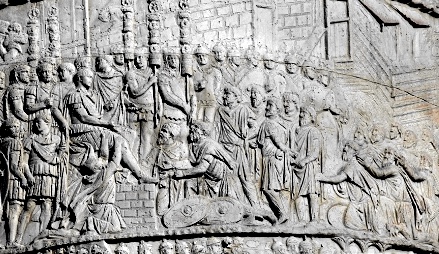
A cold, yet trenchant statement. As in many early societies, slavery in ancient Rome was a mixture of debt-slavery, slavery as a punishment for crime, born slavery and by far the enslavement of prisoners of war, especially during the Republican period. These concepts are a very long way from our modern experience and feelings; many of us find the notion of paid servants or even a hired cleaner uncomfortable. But enslavement was a standard practice from ancient to relatively modern societies.
Trajan accepting the surrender of the Dacians - many would go into slavery

An estimated 30 to 40% of the population of Italy were slaves in the 1st century BC, around two to three million people. For the Empire as a whole, slaves numbered just under five million, representing 8-10% of the total population of 50-60 million. Roman slavery was not based on race; slaves originated from all parts of Europe and the Mediterranean, including Gaul, Hispania, Germany, Britannia, North Africa, Syria, the Balkans and Greece.

Legal status
The Twelve Tables, Rome's oldest legal code, promulgated in 449 BC, makes brief references to slavery, indicating that the institution was of long standing.

Slaves were considered property under Roman law and had no legal personhood. Unlike Roman citizens, they could be subjected to corporal punishment, sexual exploitation (prostitutes were often slaves), torture, and summary execution. The testimony of a slave could not be accepted in a court of law unless the slave was tortured—a practice based on the belief that slaves in a position to be privy to their masters' affairs would be too virtuously loyal to reveal damaging evidence unless coerced. Over time, however, slaves gained increased legal protection.

Vernae were slaves born within a household (familia) or on a family farm. There was a stronger social obligation to care for vernae; many would have been the children of free males of the household. Often, but not always, they were freed on the master’s death along with their own children.

Roman slaves could hold property which, although technically it belonged to their masters, they were allowed to use as if it was their own. Skilled or educated slaves were permitted to earn their own money from commissions, tips, etc. occasionally saving enough to buy their freedom. Such slaves could often be freed in their master's will, or for services rendered. A notable example of a high-status slave was Cicero’s secretary, Tiro, who was freed before his master's death. Tiro was successful enough to retire on his own country estate, where he died at the age of 99.

Evolution of status
Several emperors began to grant more rights to slaves as the empire grew. Claudius announced that if a slave was abandoned by his master, he became free. Nero granted slaves the right to complain against their masters in a court. And under Antoninus Pius, a master who killed a slave without just cause could be tried for homicide. Legal protection of slaves continued to grow as the empire expanded. It became common throughout the mid to late 2nd century AD to allow slaves to complain of cruel or unfair treatment by their owners.

Work  - not all slaves were equal
Slaves worked in roughly five categories: household/domestic, imperial/public, urban crafts and services, agriculture, and mining.

Four female slaves dress the wife’s hair: 
relief from a family tomb from Neumagen
Household (familia): Epitaphs record at least fifty different jobs a household slave might perform including barber, butler, cook, hairdresser, handmaid (ancilla), wet nurse or nursery attendant, teacher, secretary, seamstress, accountant, and physician. A large elite household might be supported by a staff of hundreds. Although inferior to those of the free persons they served, the living conditions of slaves attached to an urban household were often superior to those of many free urban poor in Rome. Indoor household slaves likely enjoyed the highest standard of living among Roman slaves, next to publicly owned slaves. Imperial slaves were those attached to the emperor's household, the familia Caesaris. The senior male, the pater familias, held full rights over his slaves as over his family, and women slaves were frequently used for sexual services as a matter of course.

In urban workplaces, the occupations of slaves included fullers, engravers, shoemakers, bakers, seamstresses, mule drivers, and waitresses/prostitutes. Farm slaves (familia rustica) probably lived in healthier air, but their work was heavy and manual. The workforce of a farm would have been mostly slave, managed by a vilicus, who was often a slave himself.

Ploughman with a team of oxen, bronze
1st-3rdC Piercebridge, Durham (British Museum)
Tens of thousands of slaves condemned to work in the mines or quarries (damnati in metallum), worked in notoriously brutal conditions; they were convicts who lost their freedom as citizens (libertas), forfeited their property (bona) to the state, and became servi poenae, slaves by legal sanction. Their status was different from that of other slaves; they could not buy their freedom, be sold, or be set free. They were expected to live and die in the mines.

In the Late Republic, around half the gladiators who fought in Roman arenas were slaves, the remainder free volunteers. Successful slave gladiators were occasionally rewarded with freedom. However, trained gladiators with access to weapons were potentially the most dangerous slaves as demonstrated by Spartacus, who led the great slave rebellion of 73-71 BC.

A servus publicus was a slave owned not by a private individual, but by the Roman people. Public slaves worked in temples and other public buildings as servants to the College of Pontiffs, magistrates, and other officials. Some well-qualified public slaves carried out skilled office work such as accounting and secretarial services and were permitted to earn money for their personal use. During the Republic, a public slave could be freed by a magistrate's declaration with the prior authorisation of the senate; in the imperial era, liberty would be granted by the emperor.

Runaways and rebellion
"I have run away; hold me. 
When you shall have returned me to my master, 
Zoninus, you will receive a gold coin."
Romans were preoccupied, if not paranoid, by the thought of slave revolts which had more than once seriously threatened the republic; in 135–132 BCE (the First Servile War), in 104-100 BCE (the Second Servile War), and in 73-71 BCE (the Third Servile War).

Rome forbade harbouring fugitive slaves; professional slave-catchers were hired to hunt down runaways. Owners or hired slave-catchers would post advertisements with precise descriptions of escaped slaves, and offered rewards.

If caught, fugitives could be whipped, burnt with iron, or killed. Those who lived were branded on the forehead with the letters FUG, for fugitivus and sometimes had a metal collar with the owner’s name riveted around the neck.

Manumission
Masters could manumit, or free, slaves and in many cases such freedmen went on to rise to positions of power and accumulate great wealth. Manumissio, which literally means 'sending out from the hand', could be a public ceremony performed before a public official, usually a judge. The owner touched the slave on the head with a staff and he or she was free to go. Simpler methods were sometimes used, with the owner proclaiming a slave's freedom in front of friends and family, or just a simple invitation to recline with the family at dinner.

Slaves were freed for a variety of reasons; for a particularly good deed done towards the slave's owner, or out of friendship or respect. Sometimes, a slave had earned and saved enough money could buy his freedom and the freedom of a fellow slave, frequently a spouse. However, few slaves had enough money to do so, and many slaves were not allowed to hold money. Slaves could also freed by a provision in an owner's will at his death. Augustus restricted such manumissions to a maximum of  a hundred slaves, and proportionately fewer in a small household. Educated and skilled slaves were regularly freed and the practice became so common that Augustus decreed that no Roman slave could be freed under the age of 30.

Freedmen
Rome differed from Greek city-states in allowing freed slaves to become Roman citizens. After manumission, a former slave enjoyed political and public freedom (libertas), including the right to vote, though he could not hold public office, state priesthoods, nor attain senatorial rank. A freed slave who had acquired libertas became a libertus (feminine liberta) in relation to his former master, who then became his patron (patronus).

Marble cinerary urn provided by Vitalis, a former slave of the Emperor and 
Scribe of the Bedchamber, for his wife Vernasia Cyclas,. 
On the last line, AUG.L denotes he was a former imperial slave (British Museum)
Children born to former slaves enjoyed the full privileges of Roman citizenship, for example, the Latin poet Horace was the son of a freedman, and served as an officer in the army of Marcus Junius Brutus.

Freedmen of the imperial families often filled key positions in the Roman government bureaucracy. Some rose to positions of great influence, such as Narcissus, a former slave of the Emperor Claudius.

Other freedmen became wealthy. The brothers who owned House of the Vettii, one of the biggest and most magnificent houses in Pompeii, are thought to have been freedmen. A freedman is recorded with having designed the amphitheatre in Pompeii. But a freedman who became rich and influential might still be looked down on by the traditional aristocracy as a vulgar nouveau riche as shown by Trimalchio, a caricature of such a freedman in the Satyricon.

For an excellent historical fiction around household slaves  in the first century AD you can do no better than Lindsey Davis’s Enemies at Home; an impeccably researched mystery which is clever and poignant at the same time.


25 August 2010

Tragic Tales: Chinese Slave Girls of the Barbary Coast

By Jacquie Rogers

The California gold rush of 1849 brought men from all over the world, including China, to find their fortune. The next gold rush was of a different nature--those who provided services to the miners...for a pinch or two of gold dust.

Barbary Coast was the section of San Francisco that harbored the red light district. It was rife with gambling, prostitution, pickpockets, and violent crime. The streets were crowded with brothels, gambling houses, saloons--this was where the rowdiest of the rowdy men went to kick up their heels. The Barbary Coast was also home to the cribs--low-class prostitution housing--and small Chinese girls pleading for the men walking by to use her services.

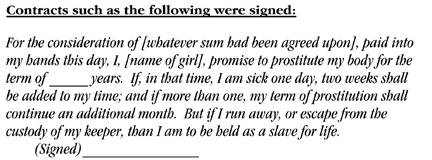
In China girls weren't valued, and many girls, even babies, were sold to "entrepreneurs" who took them to America to be used as sex slaves. In San Francisco, girls were bought and sold--a baby sold for a little over $100. These girls were raised to prostitute themselves.

This is from The Virtual Museum of the City of San Francisco, quoted from A la California: Sketch of Life in the Golden State by Albert S. Evans:
These poor creatures are all slaves, bought with a price in China, and imported by degraded men of their own race, who, despite our laws, contrive to hold them to a life-long servitude, which is a thousand times more hopeless and terrible than the negro slavery of Louisiana or Cuba could ever be. They have been reared to a life of shame from infancy, and have not a single trace of the native modesty of women left. They are, as we have said, mere children in point of intellect, having no education whatever, and no experience of the world outside of the narrow alleys in which they have always lived, and the emigrant ship in which they were brought over to this country...

The girls cost $40 each in Canton, but are valued here at about $400, if passably good-looking, young and healthy, and readily sell at that figure in cash, or approved paper. Each colony of half a dozen girls is under the immediate control of an "old mother," herself a retired prostitute, who jealously watches over each, and receives from them the wages of their shame as fast as earned.
Officials looked the other way for two reasons. First, they were paid off by the Chinese merchants, and second, they didn't consider the Chinese all the way human. Chinese girls were no more significant, and less valuable, than a horse. Once a girl was sold into slavery, there was no help for her.

These girls were also called sing-song girls and worked in small rooms lining the cribs alleyways. The girls would bare their breasts to passers-by. If they didn't attract enough customers, they were often physically punished. During their periods, if they had any, they were considered sick and that missed time was added to her contract.

This is from http://www.foundsf.org/:

Opium was administered to them for every ailment, and many girls were addicted. Once a girl's looks had faded and/or her health deteriorated, usually before age 20, she was placed in a room with a vial of narcotics. She could either take the overdose, starve, or if she wasn't dead when they came for her corpse, she was murdered. These murders weren't reported or even noted by the authorities.

One white woman who didn't look the other way was Donaldine Cameron, the Angry Angel of Chinatown. She was born in New Zealand and came to California with her parents when she was a child. At 18 she was engaged, but no one seems to know why she never married. In 1895 she took a position as a sewing teacher at the Occidental Mission Home for Girls and became a crusader for these abused girls no one else cared about. Over a period of 40 years, she was instrumental in the rescue and education of over 3,000 Chinese girls. Miss Cameron used sledgehammers and axes to get to the girls, and learned early on to find more girls in hidden in walls and under the floor boards. Of course the slavers hated her, calling her Fahn Quai--white devil.

History books teach that slavery ended in the United States with the Civil War, but that wasn't so for the sing-song girls of the Barbary Coast, who, in many cases, worked in worse circumstances than the slaves of the South, with a far shorter life expectancy. Finally, 75 years after the Emancipation Proclamation, the Chinese slave trade ended. It's a blight on American history that we should never forget.

Jacquie

Down Home Ever Lovin' Mule Blues (See the Book Video featuring Justin Saragueta)
Jacquie's Website * 1st Turning Point * Myspace * Twitter * Facebook
Faery Special Romances (Book Video) * Royalties go to Children's Tumor Foundation, ending Neurofibromatosis through Research


Read a book by Jacquie Rogers