Showing posts with label actress. Show all posts

23 February 2010

Love Affairs: Doug & Mary

By Delia DeLeest

Before there was Brad and Angelina, or Brad and Jen, or Angelina and Billy Bob or any other Hollywood couple known only by their first names, there was Doug and Mary, the very first king and queen of Hollywood. American royalty.

Mary Pickford's star rose in 1913 and she soon became the most popular actress in the world, she stayed at that pinnacle until 1930. She wasn't just popular, she was the epitome of stardom for seventeen years. There has never been an actress able to duplicate her accomplishment and in today's world where actors are old news after five years, there probably never will be. She was known as America's Sweetheart and made millions playing "the girl with the golden curls".

Douglas Fairbanks was the action hero of his day. If there was a swashbuckling pirate or a mythical hero to be played, Fairbanks was there. He was the man all the ladies loved and all the men wanted to be. When Doug and Mary met in 1916, the sparks flew. Because they each had other spouses at the time, they didn't become free to marry each other until 1920, about two weeks after Mary's divorce became final.

They set up housekeeping in a Hollywood mansion they called Pickfair and it soon became the place to go when dignitaries visited America. An invitation to Pickfair was your ticket into the world of Hollywood's, and America's, elite.

Shortly before their marriage, Doug and Mary also went into business together. Along with fellow actor, Charlie Chaplin and prominent director, D.W. Griffith, they formed United Artists motion picture studio. This not only enabled these four luminaries to choose which pictures they wanted to make, but gave them the means to write, produce and direct in addition to acting.

United Artists became very successful and Doug and Mary became even richer and more powerful than they'd been before. What makes Doug and Mary so unusual in their world of money and success was that they had a deep love for each other, one that could not be faked for the benefit of their fans and the movie cameras. What Doug and Mary had was real.

Anyone who's seen Singing in the Rain knows of the upset talking pictures created in silent era Hollywood. Though they were both wonderful, competent actors, talkies threw Doug and Mary both off their game and neither ever recovered.

With a lot of energy and no way to expend it now that his movie making was greatly reduced, Douglas took to world travel, something Mary despised. She was content to spend her time quietly at Pickfair, ruling her kingdom from behind the high walls of her castle. In 1930, Doug met Lady Sylvia Ashley and began an affair that, three years later, resulted in his and Mary's divorce. Hollywood's golden couple was done.

Doug went on to marry Sylvia and a year later, Mary married band leader Buddy Rogers. In 1939, Doug died in his sleep of a heart attack. Though Mary died many years later (1979) after being married to Rogers for 40 years, it was believed that they both still loved each other till the end, always regretting their inability to reconcile.

Of course, this could also just be wishful thinking on behalf of their fans and of those who want to believe in Hollywood happily-ever-afters, I know that's where my sentiments lie.

30 September 2008

Women: Keira, Eliza and Ascot Opening Day

By Evangeline Holland

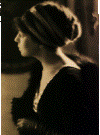
On the heels of the news that costume drama aficionado Keira Knightley was tapped to star in a remake of the 1965 musical, My Fair Lady, I delved back in history, past Audrey Hepburn, Julie Andrews and Wendy Hiller, to the original 'Liza Doolittle--Mrs Patrick Campbell.

In fact, George Bernard Shaw wrote the play Pygmalion specifically for the celebrated Anglo-Italian actress, with whom he'd become involved in one of his many romantically platonic affairs. Born Beatrice Stella Tanner to a sensitive Italian mother and an adventurous English father who spent most of Stella's childhood attempting to make his fortune in America, Stella--as she was known to her family--was headstrong, passionate and willful, and determined to fight her way out of the dingy impoverishment of her childhood.

A shot-gun marriage to the father of her eldest child, Beo, gave her a first taste of independence, though Patrick Campbell was as ill-fated and poor as her father. They produced another child, Stella, before Pat traveled to South Africa to make his fortune. In his absence, Stella began acting for both an outlet and for money, and by 1888 had become a competent enough actress to make a debut at the Adelphi Theatre in London two years later. With her dark beauty, deep-set eyes and tall, statuesque figure, Stella, who chose to act under the name "Mrs Patrick Campbell" fit the mold of the typical heroine of the "problem play," which characterized the theatre of the 1890s.

The problem play emerged during the 19th century and reached its pinnacle in the last decade of the 19th century, as seen in the witty, urbane plays of Oscar Wilde, and the penetrating realism of Henrik Ibsen. It dealt with social issues through debates between the characters on stage, who typically represent conflicting points of view within a realistic social context. Heroines of problem plays were no longer the typical shrinking violets, many of them adulterous wives, former prostitutes, and disappointed mothers. Mrs Patrick Campbell wowed audiences as Paula Tanqueray, in Pinero's The Second Mrs. Tanqueray, in 1893, and never looked back.

Accordingly, George Bernard Shaw, a fussy, self-educated playwright trapped in a sexless marriage, was bowled over by Stella as well. They engaged in a passionate, teasing correspondence, and Shaw was determined to write a play specifically for her. By the 1910s, Shaw was an established playwright and from this success and his infatuation with Stella, Pygmalion was born. Though written in 1912, the first English production finally opened at His Majesty's Theatre, London on April 11, 1914 and starred Mrs Campbell as Eliza and Sir Herbert Beerbohm Tree as Henry Higgins; it was directed by Shaw himself. The play was a rousing success, though Eliza's use of the word "bloody" was shocking, and could have ruined Stella's career.

The story of Pygmalion could have ended here, as Shaw forbade any musical adaptation of his works based on his hatred of the musical adaptation of Arms and the Man (1894), entitled The Chocolate Soldier (1908). It was only after his death in 1950, that the Broadway musical My Fair Lady could be produced, which introduced not only the marvelous Julie Andrews, but gave us an iconic performance from Audrey Hepburn (and Rex Harrison), and the Ascot Gavotte musical sequence, where Cecil Beaton nearly outdid himself with the sumptuous black and white costumes.

09 July 2008

Famous People: Mae West

By Jacquie Rogers

American stage and film actress Mae West was not only the first woman to make a million dollars in the entertainment business, her work rescued Paramount Studios from oblivion and debt. She was a formidable financial force and made a lot of money for a lot of people.

"Any time you've got nothing to do and lots of time to do it, come on up." ~ Mae West

This amazing woman was born in 1892 and by 1895 was already performing on the vaudeville stage. When she was fifteen, she was a "coltish shimmy dancer" billed as a "sex clown," so her beauty and wit were bankable early on.

"Anything worth doing is worth doing slowly." ~ Mae West

In 1918, she made it to Broadway and appeared in a musical called Sometime. She was tremendously successful as a stage actress. Miss West's early years in vaudeville and stage gave her a venue in which to hone her writing skills. She wrote nearly all her best hits, including five film credits, and her creative talent was noticeably missing on the later films that bombed at the box office.

She wrote a play called Sex and staged it in 1926. This earned her some morals charges and she was arrested twice.

"I believe in censorship. I made a fortune out of it." ~ Mae West

The real fascination with Mae West over the years probably has more to do with the time she lived. She was born in the Victorian era of corsets but society was evolving--not as radically as Miss West, for sure, but her humor certainly reflected the changing values of the day. The Roaring 20s brought a huge social revolution and Miss West was right there to promote pleasure and have fun. Maybe she gave the Depression-weary masses permission to have a good time. Who knows. But her humor struck a cord, and even though she was the first commercially successful blonde bombshell, her humor was appreciated by women as well as men.

"A woman in love can't be reasonable--or she probably wouldn't be in love." ~ Mae West

She starred in her first Hollywood film in Night After Night (1932). She held her own with Cary Grant, WC Fields, and many other leading men of the day. She was a box office hit until . . .

Will Hays of the Production Code Administration (the censors) took a special interest in suppressing her bawdy nature (purely for the good of the country and our families, of course).
...The initial screening of "Klondike Annie" elicited rigorous monitoring from the PCA (Production Code Administration) for its implications of interracial sex, representations of torture and unpunished murder [which undermined the Code's principle of "compensating moral values"], and for casting West as a prostitute...."

Source: (Archive of Cases)
With the censors watching her every move (and not in a good way), Miss West finally gave up on films and went back to the stage. Her humor could not survive the censor's red pen, and we have to surmise that she wasn't having much fun, either.

Mae West lived out her life in and out of show business, but she never quit writing. In the 50s, she wrote the review of brawny men with herself as star, and some say she singlehandedly started the bodybuilder popularity boom. To this day, we love her sometimes wise but always witty one-liners. And she even has a live jacket named after her!

"His mother should have thrown him out and kept the stork." ~ Mae West

Jacquie

Princess Keely, Star of Faery Special RomancesDown Home Ever Lovin' Mule Blues

Myspace *** Bebo *** Faery World

Faery Special Romances *** See the book video
Royalties go to Children's Tumor Foundation, ending Neurofibromatosis through Research

Coming soon: Down Home Ever Lovin' Mule Blues