
Showing posts with label Prostitution. Show all posts

25 August 2010

Tragic Tales: Chinese Slave Girls of the Barbary Coast

By Jacquie Rogers

The California gold rush of 1849 brought men from all over the world, including China, to find their fortune. The next gold rush was of a different nature--those who provided services to the miners...for a pinch or two of gold dust.

Barbary Coast was the section of San Francisco that harbored the red light district. It was rife with gambling, prostitution, pickpockets, and violent crime. The streets were crowded with brothels, gambling houses, saloons--this was where the rowdiest of the rowdy men went to kick up their heels. The Barbary Coast was also home to the cribs--low-class prostitution housing--and small Chinese girls pleading for the men walking by to use her services.

In China girls weren't valued, and many girls, even babies, were sold to "entrepreneurs" who took them to America to be used as sex slaves. In San Francisco, girls were bought and sold--a baby sold for a little over $100. These girls were raised to prostitute themselves.

This is from The Virtual Museum of the City of San Francisco, quoted from A la California: Sketch of Life in the Golden State by Albert S. Evans:
These poor creatures are all slaves, bought with a price in China, and imported by degraded men of their own race, who, despite our laws, contrive to hold them to a life-long servitude, which is a thousand times more hopeless and terrible than the negro slavery of Louisiana or Cuba could ever be. They have been reared to a life of shame from infancy, and have not a single trace of the native modesty of women left. They are, as we have said, mere children in point of intellect, having no education whatever, and no experience of the world outside of the narrow alleys in which they have always lived, and the emigrant ship in which they were brought over to this country...

The girls cost $40 each in Canton, but are valued here at about $400, if passably good-looking, young and healthy, and readily sell at that figure in cash, or approved paper. Each colony of half a dozen girls is under the immediate control of an "old mother," herself a retired prostitute, who jealously watches over each, and receives from them the wages of their shame as fast as earned.
Officials looked the other way for two reasons. First, they were paid off by the Chinese merchants, and second, they didn't consider the Chinese all the way human. Chinese girls were no more significant, and less valuable, than a horse. Once a girl was sold into slavery, there was no help for her.

These girls were also called sing-song girls and worked in small rooms lining the cribs alleyways. The girls would bare their breasts to passers-by. If they didn't attract enough customers, they were often physically punished. During their periods, if they had any, they were considered sick and that missed time was added to her contract.

This is from http://www.foundsf.org/:
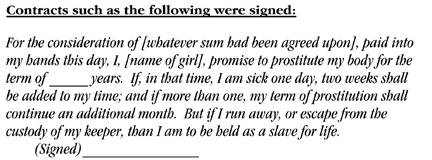
Opium was administered to them for every ailment, and many girls were addicted. Once a girl's looks had faded and/or her health deteriorated, usually before age 20, she was placed in a room with a vial of narcotics. She could either take the overdose, starve, or if she wasn't dead when they came for her corpse, she was murdered. These murders weren't reported or even noted by the authorities.

One white woman who didn't look the other way was Donaldine Cameron, the Angry Angel of Chinatown. She was born in New Zealand and came to California with her parents when she was a child. At 18 she was engaged, but no one seems to know why she never married. In 1895 she took a position as a sewing teacher at the Occidental Mission Home for Girls and became a crusader for these abused girls no one else cared about. Over a period of 40 years, she was instrumental in the rescue and education of over 3,000 Chinese girls. Miss Cameron used sledgehammers and axes to get to the girls, and learned early on to find more girls in hidden in walls and under the floor boards. Of course the slavers hated her, calling her Fahn Quai--white devil.

History books teach that slavery ended in the United States with the Civil War, but that wasn't so for the sing-song girls of the Barbary Coast, who, in many cases, worked in worse circumstances than the slaves of the South, with a far shorter life expectancy. Finally, 75 years after the Emancipation Proclamation, the Chinese slave trade ended. It's a blight on American history that we should never forget.

Jacquie

Down Home Ever Lovin' Mule Blues (See the Book Video featuring Justin Saragueta)
Jacquie's Website * 1st Turning Point * Myspace * Twitter * Facebook
Faery Special Romances (Book Video) * Royalties go to Children's Tumor Foundation, ending Neurofibromatosis through Research



Read a book by Jacquie Rogers

16 June 2010

What Surprised Me: Ancient & Medieval Prostitution

By Lisa Yarde

Prostitution has existed for so long that it's often call the world's oldest profession. The sale of sexual services is considered taboo in most societies, but this view was not always held in the past.

One of the projects that I'm currently working on is The Rule of Love, about the origins of the Kama Sutra. How's that for an unusual historical? In fifth century India, my protagonist learns lessons of sensuality, life, and love at an exclusive brothel run by his aunt. The Kama Sutra is more than a manual of sexual positions. It teaches proper behavior, and instructs the reader on how attain fulfillment of every goal in life, including sexual ones. A large portion of the text discusses the role of prostitutes in society.

Illustration from Kama Sutra

Centuries of Muslim leadership and the puritanical British Raj have influenced the modern India republic's conservative views of sensuality, but the country's past is very different. I was genuinely surprised by the unabashed view of prostitution the Kama Sutra takes. The sixth part of the Kama Sutra is devoted to their proper conduct; a how-to guide on the ways by which they could attract and keep lovers. The author considered prostitution a natural part of civilized society, which prevented marital affairs, with prostitutes providing their services for the general good.

At the time of the Kama Sutra, prostitutes at every level played an important role in society, as its artisans and used their wealth to fund social and religious projects. The text notes, "Having temples and reservoirs built, setting up altars on raised platforms to Agni, the fire good, giving Brahmans herds of cows and covered vessels, arranging...offerings to the gods, bearing the expenses involved in the money they earn, this is the concern of high-ranking courtesans who reap large profits."

The early Catholic Church struggled with the role of prostitutes. In the fourth century, St. Augustine, one of its most important figures, stated "If you do away with harlots, the world will be convulsed with lust." He took the view that would influence society up through the Middle Ages, that prostitution was a necessary evil. Having had a mistress for most of his youth, St. Augustine understood the power of lust.

Eight centuries later, his thoughts on prostitutes would influence the opinions of St. Thomas Aquinas. In his Summa Theologiae, Aquinas argued for the toleration of prostitutes in society, as in the state should allow fornication and prostitution for the sake of the common good. "Prostitution is like a sewer in a palace. Take away the sewer and you will fill the palace with pollution."

St. Thomas Aquinas

When I have written in medieval settings, the constant influence of the Church in my characters' lives placed constraints on their actions. It was strange to find that in an age typified by priests preaching sexual abstinence, even in marriage, St. Thomas Aquinas took a practical approach to prostitution: it was "...filthy and against the law of God," but that a prostitute should always be fairly paid for her services. "It is lawful for her to keep it and also to give it to charity even though it is acquired by an unlawful action...." But he also stipulated that prostitutes were bound to pay their tithes to the Church, "...only after the individuals in question have done penance."

Brothels soon flourished in every major city. In Paris, le roi des ribauds (the king of the ribalds) regulated the services of the city's prostitutes. Queen Joanna of Avignon established a town brothel rather than allow wholesale prostitution to go unregulated. In twelfth century London, King Henry II brought the "stews" or public baths used for meeting prostitutes, under government regulation. The London streets where prostitutes could be found were known by names like, "Lovelane, Cokkeslane, Gropec*nt Lane, and Codpiece Alley." Later, the Bishop of Winchester owned most of the brothels that developed along Southwark, leading to "Winchester geese" as a common reference for the prostitutes there.

09 August 2009

Guest Author: Mingmei Yip

This week we're welcoming Kensington author Mingmei Yip as she discusses her debut novel, PEACH BLOSSOM PAVILION, available now. She is joining us to answer questions and give away a copy of this remarkable novel.

In a sunny California apartment, a young woman and her finance arrive to record her great-grandmother's reminiscences. The story that unfolds of Precious Orchid’s life in China, where she rises from a childhood of shame to become one of the most successful courtesans in the land, is unlike any they've heard before....
"Yip's English-language debut is beautiful and evocative. The relationships between these characters are real and heart-wrenching...rendered insightfully and memorably." -- RT Book Reviews

"A riveting account of mysterious lifestyles in pre-Communist China, PEACH BLOSSOM PAVILION is filled with amazing characters and unique stories. Brilliantly portrayed...stunningly presented novel. Beautifully written, readers will not be able to put this book down until the last page is turned." -- Romance Reviews Today

"Just as Arthur Golden's novel Memoirs of a Geisha introduced readers to the Japanese geisha tradition, PEACH BLOSSOM PAVILION provides a vivid account of a forgotten history, by transporting us to another place and time where prostitutes were glamorous and elegant..." -- Asiance Magazine

***

Congratulations on your successful debut novel PEACH BLOSSOM PAVILION. Can you tell us what it is about?

Thank you! PEACH BLOSSOM PAVILION is the story of the last Chinese courtesan, or Geisha, set in the 1920s Shanghai. I am pleased to report that it has generated many good reviews and is now in its fourth printing.

When the novel begins, the protagonist Xiang Xiang, now ninety-eight, is telling her great-granddaughter about her life as a famous prostitute more than seventy years ago. Her story began when at thirteen, Xiang Xiang was tricked into a prostitution house after her father had been executed for a crime he did not commit. Her mother, now destitute, leaves her daughter to enter a Buddhist Nunnery.

This beginning grabs attention, but it sounds like a pretty miserable story, right?

It does seem that way in the beginning. But Xiang Xiang is determined to escape from the prostitution house so as to find her mother and avenge her father's death. On her quest to achieve these seemingly impossible goals, she endures many hardships. She also has two poignant love affairs, one with a handsome monk, and another people will have to read the book to find out.

I like the title PEACH BLOSSOM PAVILION. It evokes such a beautiful and poetic image. Can you tell us more about it?

High class prostitution houses in traditional China had many elegant sounding names, such as Sleeping Flowers Pavilion, Jade Gate Pavilion, Plum Blossom Garden , and Welcoming Spring Pavilion. The women who worked there were not mere prostitutes, but cultured, artistically accomplished courtesans, or Geisha, patronized by powerful government officials, learned scholars, or wealthy merchants.

Were Chinese Geisha similar to the Japanese ones?

Yes, both were elegant, artistically talented women, who, due to cruel fates such as overnight loss of family fortune, untimely demise of their parents, or kidnapping by bandits, ended up in prostitution houses.

While Japanese Geisha still exist, though in a less racy context, their Chinese counterparts passed into history when China became Communist.

What made you decide to write a novel on Chinese Geishas, and are there comparisons of PEACH BLOSSOM PAVILION to MEMOIRS OF A GEISHA?

I came about this indirectly. I play professionally a very ancient Chinese stringed instrument called the guqin, a kind of zither. While doing research on women who played this instrument, I found out that many were courtesans. This was a surprise to me because the guqin has always been presented as an instrument only for the respectable elite.

I decided to go to China to research this Chinese courtesan culture because I found these women's lives and their arts both intriguing and inspiring. Despite what had to have been a mostly miserable life, some were able to rise above their fates by practicing the arts of poetry, painting and music. Their determination deeply touched me. A few even escaped prostitution. A famous one, named Golden Flower, rose from a prostitution house to marry an ambassador and later became the mistress of the most powerful European general stationed in China . She used her influence to stop pillage by European soldiers and even, it is said, saved the life of the Empress.

Another reason is that when I talked to Americans, almost all had heard of Japanese Geishas, but no one even knew that Chinese Geishas existed. So I wanted to give these courageous and talented women the voice they had long been deprived of.

There is much more about Chinese Geishas, as well as my performance of some of their music on my website.

Yes, a few people compared my novel to Arthur Golden's MEMOIRS OF A GEISHA. I can assure the readers that my story is completely different. The only similar thing is the Asian setting which is inevitable, since both are about geishas and their culture.

Now can you tell us how do you write a novel from beginning to end? Do you have an outline and have all the details work out first?

I'll always have an idea first, then throw in plot and sub-plots together with characters. Since I'm somewhat of a free spirit, I never write a whole outline or set down the details for each chapter. Once I have started a story, it takes on a life of its own and the characters lead me where the story wants to go. I don't try to write out the plot ahead of time because it always changes while I am writing.

It seems that you have lots of ideas--how do you get them?

They come from all sorts of places: reading, watching people, my dreams, Hong Kong newspapers, experiences of my friends. Often I don't know where ideas come from--they just pop into my head. When I take the subway, I don't read or listen to music; I just watch the other passengers, one of my favorite pastimes. If I see an interesting face, then I'll make up a story for it. A beautiful, older woman may be an opera singer on her way to meet her poor, young lover--behind the back of her husband, who is also her manager. An old man maybe going home, just to heat up and eat his frozen dinner, watch sports on his twenty-year-old TV, then go to sleep in his solitary bed. Because he never married, and never had the chance to know the only child he might have had from a one-night stand on one cold winter night years ago.

If I have an interesting dream, I try to jot it down quickly the moment I wake up, otherwise it will fade.

What are your writing habits?

After I have an initial idea for a story, I'll finish my first draft as quickly as possible, so I'll have the entire novel set down. Then I get to work trying to fine tune everything--narration, characterization, voices, dialogue, and so on. Then I slow down for the third draft to make sure everything is correct, especially in an historical novel when it's important to be accurate. When I wrote PEACH BLOSSOM PAVILION, I spent a lot of time checking and double-checking to make sure not only the dates but the more interesting details such as locations, architecture, clothing, even hair styles were all accurate. Then I keep re-reading to catch any remaining glitches. I feel an author is obligated to the reader to be sure that the book is a good read, not only entertaining but providing something more, insights or new experiences.

Many who have reviewed PEACH BLOSSOM PAVILION found it to be a real page-turner. How do you make your writing interesting?

Interest is in the details. Plot is critical but it is what you do with it that makes a story come alive. I am a very curious person and find interest in almost anything. My reading materials range from academic papers to entertainment magazines to politics. In politics, much of human nature is revealed so it provides great raw material for character depictions. The many different strategies used in politics are also excellent for plots. The same is true of the entertainment world.

Reading is important too. There's a famous Chinese saying, "If you have read ten thousand books and traveled ten thousand miles, your writing will feel like it's aided by the highest spirits."

Do you have any advice for writers, especially beginners?

I think it is still essential to master the basics. Not only voice, characterization, dialogue, plot, but also sentence structure, its rhythm and music. I always try to vary the length of my sentences and start each one with a different subject. It's essential to spent whatever time it takes to find the right word. Sometimes, it is a single word that brightens a whole paragraph.

There is a Chinese saying "Slap on the thigh and exclaim." That's how the readers will react to a good choice of word. Readers may not be aware of the meticulous hard work behind a smooth sentence, but if you don't pay attention, they will soon become bored. I also think it's good for authors to attend other cultural activities such as movies, concerts, art exhibitions. Have as diverse a background as you can cultivate, that really helps.

Would you tell us what is your next project?

My next novel is an inter-racial Buddhist love story about a young Chinese woman who wants to be a nun but falls in love with an American doctor against the wish of her nun mentor. This will come out in April of 2010 from Kensington Books.

My third novel, scheduled for 2011, is also a love story, this one set along the Silk Road. A Chinese woman is sent on a quest by her supposed aunt where she meets a younger American man. The reward is three million dollars. To attain it, amidst the distractions of her love affair she must carry out the ordeals decreed by her aunt along the treacherous Taklamakan desert, whose name means, "Go In, Never Come Out."

I'm sure all our readers are anxiously looking forward to reading both of your forthcoming novels!

Thank you, Carrie, for inviting me to guest blog. I've really enjoyed it.

***

Mingmei is giving away a copy of this beautiful book! For your chance to win, leave a comment or question. I'll draw the winner next Sunday. Good luck!

06 August 2009

Thursday Excerpt: Mingmei Yip

This week on Unusual Historicals we're featuring an excerpt from Kensington author Mingmei Yip. Her exotic debut, PEACH BLOSSOM PAVILION, the story of China's last concubine, is already in its fourth printing. We're looking forward to speaking with Mingmei when she stops by on Sunday to answer questions and give away a copy. Tune in then! Here's the blurb:

In a sunny California apartment, a young woman and her finance arrive to record her great-grandmother's reminiscences. The story that unfolds of Precious Orchid's life in China, where she rises from a childhood of shame to become one of the most successful courtesans in the land, is unlike any they've heard before...
***

To be a prostitute was my fate.

After all, no murderer's daughter would be accepted into a decent household to be a wife whose children would be smeared with crime even before they were born. The only other choice was my mother's--to take refuge as a nun, for the only other society which would accept a criminal's relatives lay within the empty gate.

I had just turned thirteen when I exchanged the quiet life of a family for the tumult of a prostitution house. But not like the others, whose parents had been too poor to feed them, or who had been kidnapped and sold by bandits.

It all happened because my father was convicted of a crime--one he'd never committed.

"That was the mistake your father should never have made," my mother told me over and over, "trying to be righteous, and," she added bitterly, "meddling in rich men's business."

True. For that "business" cost him his own life, and fatefully changed the life of his wife and daughter.

Baba had been a Peking opera performer and a musician. Trained as a martial arts actor, he played acrobats and warriors. During one performance, while fighting with four pennants strapped to his thirty-pound suit of armor, he jumped down from four stacked chairs in his high-soled boots and broke his leg. Unable to perform on stage anymore, he played the two-stringed fiddle in the troupe's orchestra. After several years, he became even more famous for his fiddle playing, and an amateur Peking opera group led by the wife of a Shanghai warlord hired him as its accompanist. Every month the wife would hold a big party in the house's lavish garden. It was an incident in that garden that completely changed our family's destiny.

One moonlit evening amidst the cheerful tunes of the fiddle and the falsetto voices of the silk-clad and heavily jeweled tai tai--society ladies--the drunken warlord raped his teenage daughter.

The girl grabbed her father's gun and fled to the garden where the guests were gathered. The warlord ran behind her, puffing and pants falling. Suddenly his daughter stopped and turned to him. Tears streaming down her cheeks, she slowly pointed the gun to her head. "Beast! If you dare come an inch closer, I'll shoot myself!"

Baba threw down his precious fiddle and ran to the source of the tumult. He pushed away the gaping guests, leaped forward, and tried to seize the gun. But it went off. The hapless girl fell dead to the ground in a pool of blood surrounded by the stunned guests and servants.

The warlord turned to grab Baba's throat till his tongue protruded. Eyes blurred and face as red as her daughter's splattered blood, he spat on Baba. "Animal! You raped my daughter and killed her!"

Although all the members in the household knew it was a false accusation, nobody was willing to right the wrong. The servants were scared and powerless. The rich guests couldn't have cared less.

One general meditatively stroked his beard, sneering, "Big deal, it's just a fiddle player." And that ended the whole event.

Indeed, it was a big deal for us. For Baba was executed. Mother took refuge as a Buddhist nun in a temple in Peking . I was taken away to a prostitution house.

This all happened in 1918.

Thereafter, during the tender years of my youth, while my mother was strenuously cultivating desirelessness in the Pure Lotus Nunnery in Peking, I was busy stirring up desire within the Peach Blossom Pavilion.

That was the mistake he should never have made--trying to be righteous and meddling in rich men's business.

Mother's saying kept knocking around in my head until one day I swore, kneeling before Guan Yin--the Goddess of Mercy--that I would never be merciful in this life. But not meddle in rich men's business? It was precisely the rich and powerful at whom I aimed my arts of pleasing. Like Guan Yin with a thousand arms holding a thousand amulets to charm, I was determined to cultivate myself to be a woman with a thousand scheming hearts to lure a thousand men into my arms.

But of course this kind of cultivation started later, when I had become aware of the realm of the wind and moon. When I'd first entered the prostitution house, I was but a little girl with a heart split into two: one half light with innocence, the other heavy with sorrow....

13 July 2009

Greatest Hits: Covent Garden Ladies

By Anita Davison

In Georgian England, for a man about town to enlist the services of a prostitute was an accepted part of life. London in1797 contained a total of 50,000 'Ladies of the Night,' which was around one in ten of the total female population. Covent Garden theatres were built with 'retiring rooms' connected to the boxes in order for the entertainment of clients while they enjoyed an evening out at the theatre. Even the vocabulary used to describe them was colourful.

-- Prostitutes who waited outside theatres for the plays to finish were called 'spells.'
-- Lower class streetwalkers were 'flash mollishers.'
-- Covent Garden Ague was a term for venereal disease.
-- Covent Garden Nun was another name for a prostitute.
-- Covent Garden Abbess was a bawd (madam) most of whom started out as whores themselves.

Between the years of 1757 and 1795, a publication was produced each Christmas entitled Harris's List of Covent Garden Ladies. This book was handwritten to begin with, but soon went into print and sold a quarter of a million copies during the thirty eight years it was produced. The List, priced at two shillings and sixpence, was a catalogue of around eighty up-market prostitutes. It included biographical details of each lady, together with a description of her appearance, personality and her sexual specialties, together with their charges.

Jack Got Safe into Port with His Prize
The name "Harris' referred to a Jack Harris, the head waiter at the Shakespeare's Head, a Covent Garden tavern frequented by sea captains and the directors of the East India Company. Harris christened himself the "Pimp General of All England," but in 1757, he was in Newgate prison for debt. He gave an impoverished, heavy drinking Irish poet by the name of Samuel Derrick, permission to use his name for the book.

A 'common whore' could be purchased in London for a shilling, perhaps two or three shillings to enjoy her company in a bedroom in a local tavern or lodging house. The average wage at the time was around a pound a week, and two pounds was a fairly large sum of money. With some of the ladies on Harris's Lists charging a guinea a time, the lists represented the top end of the market.

Jack Oakham Throwing Out a Signal for an Engagement
An account of one young woman from the 1773 edition reads:
Miss M__tague is a well-shaped girl, about twenty-three, good-natured and said to be thoroughly experienced in the whole art and mysterie of Venus's tactics and as soon reduce a perpendicular to less than the curve of a parabola. She is rather generous and you may sometimes find your way in there free of expence.
From the 1780 edition, the entry for a Miss B____rn. of No. l8 Old Compton Street, Soho:
This accomplished nymph has just attained her eighteenth year, and fraught with every perfection, enters a volunteer in the field of Venus. She plays on the pianofort, sings, dances, and is mistress of every Maneuver in the amorous contest that can enhance the coming pleasure; is of the middle stature, fine auburn hair, dark eyes and very inviting countenance, which ever seems to beam delight and love. In bed she is all the heart can wish, or eyes admires every limb is symmetry, every action under cover truly amorous; her price two pounds.
The list also alerted its readers to those women who were best avoided, a Pol Forestor was reported as having "breath worse than a Welch bagpipe" and warned against the "contaminated carcase" of a certain Miss Young from the Turk's Head Bagnio. And warning them off Miss Robinson, at the Jelly Shops, "a slim and genteel made girl--but rather too flat."

A review of one resident of Drury Lane reads, "Very impudent and very ugly; chiefly a dealer with old fellows. It is reported that she uses more birch rods in a week than Westminster school in a twelvemonth."

And another:
Known in this quarter for her immense sized breasts, which she alternately makes use of with the rest of her parts, to indulge those who are particularly fond of a certain amusement. She is what you may call, at all; backwards and forwards, all are equal to her, posteriors not excepted, nay indeed, by her own account she has most pleasure in the latter. Very fit for a foreign Macaroni - entrance at the front door tolerably reasonable, but nothing less than two pound for the back way.
A Mrs. Crosby of 24 George Street, for example, "being particularly attached to the sons of Neptune," (sailors) had married an elderly sea captain. When he died he left her a small annuity. This was enough to keep her off the streets, but not enough to live on--so she worked as a part-time prostitute. Harris's List says, "Mrs. Crosby could be contacted at home during the day or in the theatre at night. She has dark hair flowing in ringlets down her back, languishing grey eyes and a tolerable complexion." She charged one guinea (£1.05).

Men of War Bound for the Port of Pleasure
Of a Mrs. Grafton of Wapping, her "...best customers are sea officers, who she particularly liked, as they do not stay long at home, and always return fraught with love and presents." At 40 years old, the lady "...could give more pleasure than a dozen girls half her age. Her price was 5 shillings (25p). Most naval officers could afford that, as a day's pay for most captains in this period was about 20 shillings (£1.00).

Harris often used nautical terminology when describing the charms of the women. Miss Devonshire of Queen Ann Street had "...fair complexion, cerulean eyes and fine teeth," and "...many a man of war hath been her willing prisoner, and paid a proper ransom…she is so brave, that she is ever ready for an engagement, cares not how soon she comes to close quarters, and loves to fight yard arm and yard arm, and be briskly boarded."

The mood turned against such 'immorality' when a Mr. Aitken was convicted at the Kings Bench for the offence of publishing Harris's List in November 1795, which hereafter went out of print.

A copy of the 1790 edition was sold for £5,170 at auction in March 2008.

26 November 2008

Social Taboos: Brothels

By Jennifer Linforth

The brothel of the 19th century was place of relaxation--ordinary and commonplace. Though not blatantly labeled on any maps, their locations were well known. Controlled and efficient, the brothels of Paris were a well organized business venture both for the clients and the employees.

(Image: 1894, Toulouse-Latrec)

Brothel tokens jingled among coins in the pockets of many noblemen--young and old alike. Historically they catered to the rich, until all classes became involved and a department store attitude was developed. The quality of brothels differed to suit their clientele. The luxury brothels served the bourgeois offering plush and elaborate settings and equally exotic sexual experiences. These cost up to 100 franc a night. Opposite this was the common whorehouse. For 5-10 francs a gentleman could have his encounter and be on his way, perhaps even to the lowest of brothels--the low class whorehouse that cost a mere franc.

Running it like any well oiled business, the mistress of the brothel was the head of household. Meeting and greeting the clients, she chose the correct prostitute for those filling her pocket. These prostitutes were above their unregistered sisters—the mere streetwalkers--for they were treated far better. All those working in the brothels were registered with the Gendarmerie Royal and the prefecture of police. In 1850 Paris was estimated to have 34,000 prostitutes. The official brothel numbers in Paris: 1810=180; 1840=200; 1870=145; 1881=125; 1892=59; between 1871-1903 155,000 women were registered as prostitutes.

The public started to frown upon brothels and this social outcry resulted in the brothel being a scar on the landscape of society. Therefore the brothel, once obviously flaunted in Paris, was required to be inconspicuous come mid 1820s.

By the latter half of the century, while there was still sexual freedom, views of the moral standing on promiscuity became more prevalent. In a study in 1883 by Pierre Veron, adultery after marriage was inevitable. Men placed fidelity first as a quality sought in a wife, but 84% thought it was possible to deceive one's wife without ceasing to love her. Eighteen percent of women agreed. "I make love to my wife when I want a child... the rest of the time I make love with my mistresses," one industrialist was quoted in 1880. "Wives are to produce heirs. For pleasure men seek mistresses...

...and therefore seek the brothel...."

16 September 2008

Women: Harris's List of Covent Garden Ladies

By Anita Davison

In Georgian England, for a man about town to enlist the services of a prostitute was an accepted part of life. London in1797 contained a total of 50,000 'Ladies of the Night,' which was around one in ten of the total female population. Covent Garden theatres were built with 'retiring rooms' connected to the boxes in order for the entertainment of clients while they enjoyed an evening out at the theatre. Even the vocabulary used to describe them was colourful.

-- Prostitutes who waited outside theatres for the plays to finish were called 'spells.'
-- Lower class streetwalkers were 'flash mollishers.'
-- Covent Garden Ague was a term for venereal disease.
-- Covent Garden Nun was another name for a prostitute.
-- Covent Garden Abbess was a bawd (madam) most of whom started out as whores themselves.

Between the years of 1757 and 1795, a publication was produced each Christmas entitled Harris's List of Covent Garden Ladies. This book was handwritten to begin with, but soon went into print and sold a quarter of a million copies during the thirty eight years it was produced. The List, priced at two shillings and sixpence, was a catalogue of around eighty up-market prostitutes. It included biographical details of each lady, together with a description of her appearance, personality and her sexual specialties, together with their charges.

Jack Got Safe into Port with His Prize
The name "Harris' referred to a Jack Harris, the head waiter at the Shakespeare's Head, a Covent Garden tavern frequented by sea captains and the directors of the East India Company. Harris christened himself the "Pimp General of All England," but in 1757, he was in Newgate prison for debt. He gave an impoverished, heavy drinking Irish poet by the name of Samuel Derrick, permission to use his name for the book.

A 'common whore' could be purchased in London for a shilling, perhaps two or three shillings to enjoy her company in a bedroom in a local tavern or lodging house. The average wage at the time was around a pound a week, and two pounds was a fairly large sum of money. With some of the ladies on Harris's Lists charging a guinea a time, the lists represented the top end of the market.

Jack Oakham Throwing Out a Signal for an Engagement
An account of one young woman from the 1773 edition reads:
Miss M__tague is a well-shaped girl, about twenty-three, good-natured and said to be thoroughly experienced in the whole art and mysterie of Venus's tactics and as soon reduce a perpendicular to less than the curve of a parabola. She is rather generous and you may sometimes find your way in there free of expence.
From the 1780 edition, the entry for a Miss B____rn. of No. l8 Old Compton Street, Soho:
This accomplished nymph has just attained her eighteenth year, and fraught with every perfection, enters a volunteer in the field of Venus. She plays on the pianofort, sings, dances, and is mistress of every Maneuver in the amorous contest that can enhance the coming pleasure; is of the middle stature, fine auburn hair, dark eyes and very inviting countenance, which ever seems to beam delight and love. In bed she is all the heart can wish, or eyes admires every limb is symmetry, every action under cover truly amorous; her price two pounds.
The list also alerted its readers to those women who were best avoided, a Pol Forestor was reported as having "breath worse than a Welch bagpipe" and warned against the "contaminated carcase" of a certain Miss Young from the Turk's Head Bagnio. And warning them off Miss Robinson, at the Jelly Shops, "a slim and genteel made girl--but rather too flat."

A review of one resident of Drury Lane reads, "Very impudent and very ugly; chiefly a dealer with old fellows. It is reported that she uses more birch rods in a week than Westminster school in a twelvemonth."

And another:
Known in this quarter for her immense sized breasts, which she alternately makes use of with the rest of her parts, to indulge those who are particularly fond of a certain amusement. She is what you may call, at all; backwards and forwards, all are equal to her, posteriors not excepted, nay indeed, by her own account she has most pleasure in the latter. Very fit for a foreign Macaroni - entrance at the front door tolerably reasonable, but nothing less than two pound for the back way.
A Mrs. Crosby of 24 George Street, for example, "being particularly attached to the sons of Neptune," (sailors) had married an elderly sea captain. When he died he left her a small annuity. This was enough to keep her off the streets, but not enough to live on--so she worked as a part-time prostitute. Harris's List says, "Mrs. Crosby could be contacted at home during the day or in the theatre at night. She has dark hair flowing in ringlets down her back, languishing grey eyes and a tolerable complexion." She charged one guinea (£1.05).

Men of War Bound for the Port of Pleasure
Of a Mrs. Grafton of Wapping, her "...best customers are sea officers, who she particularly liked, as they do not stay long at home, and always return fraught with love and presents." At 40 years old, the lady "...could give more pleasure than a dozen girls half her age. Her price was 5 shillings (25p). Most naval officers could afford that, as a day's pay for most captains in this period was about 20 shillings (£1.00).

Harris often used nautical terminology when describing the charms of the women. Miss Devonshire of Queen Ann Street had "...fair complexion, cerulean eyes and fine teeth," and "...many a man of war hath been her willing prisoner, and paid a proper ransom…she is so brave, that she is ever ready for an engagement, cares not how soon she comes to close quarters, and loves to fight yard arm and yard arm, and be briskly boarded."

The mood turned against such 'immorality' when a Mr. Aitken was convicted at the Kings Bench for the offence of publishing Harris's List in November 1795, which hereafter went out of print.

A copy of the 1790 edition was sold for £5,170 at auction in March 2008.