Showing posts with label Freedom Fighters. Show all posts

30 April 2014

Freedom Fighters: The Inspirations for Zorro

By Jessica Knauss
From the 1990's series Zorro, the most colorful,
cheesy incarnation of the legend
(and my guilty pleasure)
I feared it would be difficult to think of freedom fighters I would enjoy writing about. I focus on medieval Spain, and records for actual freedom fighters in that time and place are few, and none of them successful.

Then I remembered that one of my favorite characters of all time is a Hispanic freedom fighter. A fictional compilation of several stirring figures, Zorro successfully fights for freedom in my home state of California, and is well educated, skillful, and charming in all his many incarnations.

Wikimedia Commons.
Three historical personages may have inspired Johnston McCulley’s 1919 serialized novel The Curse of Capistrano, which spawned all the movies, series, and later books.
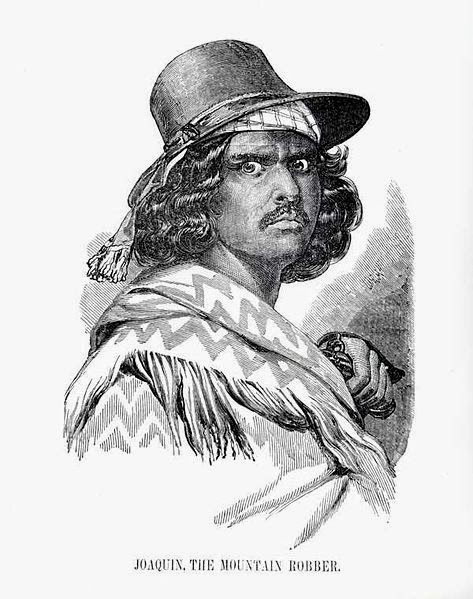
Terrifying portrait of Joaquín Murrieta
that appeared posthumously in the Sacramento
newspaper. Wikimedia Commons.
Joaquín Murrieta (c. 1829 - c. 1853) was a Mexican national who came to California during the gold rush. Legends and dime novels sprouted up after his death, making it difficult to discern the truth about his life. The most certain fact is that his actions (“outlawry”) made the new State of California very upset and spurred the incorporation of the California rangers. They hunted down and killed three men, one of whom may have been Murrieta. Murrieta’s presumed head then became part of a strange continuation of medieval relic worship. After serving as proof of Murrieta’s death so the rangers could receive the reward money, the head was preserved in brine and displayed for paying customers. Today, some people interpret Murrieta’s bandidos and their alleged marauding as resistance to Anglo dominance in California and an attempt to recuperate for Mexico the territories lost via the Treaty of Guadalupe Hidalgo. The 1998 movie The Mask of Zorro pays tribute to Murrieta’s contribution to the Zorro legend by naming the main character Alejandro Murrieta.

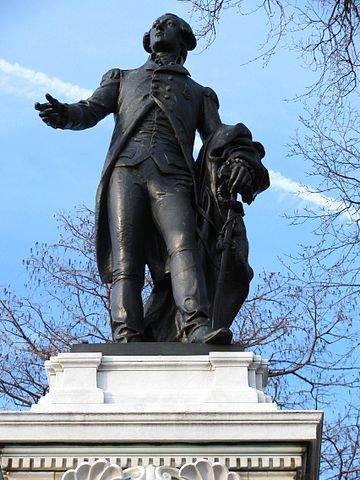
Statue of Hidalgo in
Coyoacán (D. F.), México.
Wikimedia Commons.
An earlier (and less likely) possibility for inspiration for the Zorro character is Father Manuel Hidalgo y Costilla (1753 – 1811). The most widely recognized freedom fighter in this group, Hidalgo gave the speech known as the Grito de Dolores during Mass on September 16, 1810, calling on the people to overthrow the Napoleonic government and restore the Spanish monarchy in Mexico. A national hero, he needs no more explanation, but in this context, it’s worth noting that his sharp wit merited him the nickname El Zorro (the Fox) and, like our fictional character, he supported the Spanish monarchy against perceived foreign encroachment in Mexican (or former Mexican) territory.

The most fascinating possible real-life Zorro is William Lamport (1615 - 1659), an Irishman who fought for indigenous rights in Mexico. Vicente Riva Palacio wrote a novel about Lamport in 1872 that could easily have influenced McCulley’s first Zorro book. The Irish Zorro by Gerard Ronan is the 2004 biography of this unique figure. What is it about the seventeenth century that it produced such learned swashbucklers? Always clever (like a fox), Lamport is said to have spoken at least fourteen languages fluently, but never seemed to know when to keep his mouth shut. He fled the British Isles, where he had been sowing sedition and his wild oats, to spend some time as a pirate and end up at the Spanish court. The Conde-Duque de Olivares, the most powerful man in Spain at the time, sent Lamport to Mexico as a spy. While there, he took at least one noble lover and came to sympathize with the enslaved Indians. He’s said to have written the first declaration of independence in the Indies. This document promised land reform, equality of opportunity, racial equality and a democratically elected monarch more than a century before the French Revolution. Lamport was imprisoned for plotting against Spain and escaped for two days, during which he plastered Mexico City with anti-Inquisition pamphlets. The Inquisition later burned him at the stake as a heretic, but it’s said he resisted to the end, strangling himself before the flames could take him.

In spite of my consuming interest in history related to Spain, I might never have known about these extraordinary freedom fighters if it hadn’t been for the fictional character they (could have) inspired. I doubt Johnston McCulley had anything on his mind beyond profiting from writing, but inadvertently, he ensured the legacies of Murrieta, Hidalgo, and Lamport would live on.

A driven fiction writer, Jessica Knauss has edited many fine historical novels and is currently a bilingual proofreader at an educational publisher. Find out more about her historical novel, Seven Noble Knights, and her other writing and bookish activities here. Follow her on Facebook and Twitter, too!


22 April 2014

Freedom Fighters: The French in the American Revolution

By Ginger Myrick

In my latest novel, Marie Antoinette’s main love interest, Axel von Fersen, enlists in the French army to participate in the American Revolutionary War. It is common knowledge that the French held a significant role in helping us win our freedom. There are monuments in many U.S. cities to several well known French generals—La Fayette, Rochambeau, de Grasse—but until I started my research, I never realized how large a part they played. From simple foot soldiers all the way up to their King, the French contributions were crucial to our cause.

Bitter over the loss of North American territories during the Seven Years’ War, France was anxious for the chance to strike back at England and contain the expansion of their empire. In the early years of the American War for Independence, France made covert contributions of firearms, ammunition, and gunpowder. Louis XVI was unwilling to openly declare his support, because he questioned the wisdom of aiding a people in direct opposition to their sovereign. It would look bad for him—an anointed monarch—to take the side of the rebels, especially if their effort was destined to fail and put their supporters on the losing side, yet again.

But there were many who believed in independence as a cause. In 1777, La Fayette was one of the first French nationals to lend his assistance to the Americans. A true adherent to the ideal of freedom, he was eager to join the struggle, even going so far as to defy a direct order from Louis XVI to remain in France and train under a regiment in Marseille. La Fayette was so dedicated, in fact, that at twenty years of age, he said goodbye to his pregnant wife, dressed as a woman to avoid arrest, and purchased the cargo of the ship he traveled on to prevent his being discovered. After arriving in America, he offered his services for free to prove his sincerity. With a letter of recommendation from Benjamin Franklin, he started his tour as aide-de-camp to George Washington, although his position as a commander remained unclear. He participated in many of the deciding battles even before France had openly acknowledged their own involvement.

After the Americans had captured British forces in the Battles of Saratoga and it appeared that their cause had a decent chance of success, Louis decided it was worth the risk to harry the English. France officially entered into the conflict in 1778 after signing the Treaty of Alliance, a pact negotiated by Benjamin Franklin, an American ambassador to France since two years before. The British retaliated by declaring war on France, and the first campaign—largely naval—began, rendering mixed results. The second campaign was much more successful.

Rochambeau soon arrived in Rhode Island with his Expédition Particulière in July of 1780. The bulk of his forces remained there, but some of them moved on to the Ohio Valley where they fought side by side with Native Americans against their common enemy. A year later with six thousand French troops under his command, Rochambeau marched south to join the Continental army under George Washington for their planned attack on New York.

And this is where Axel von Fersen, Marie Antoinette’s favorite comes in. Fersen was not French but Swedish with a long history of military service in his background. He spent his formative years in military academies, and his father served Louis XV of France in the Seven Years’ War. He was a staunch idealist, and believed in the concept of freedom for all, although he came from a noble family and his father was one of the richest men in all of Sweden. There was a longtime connection to the French court, and it was as aide-de-camp to General Rochambeau that he was assigned.

Fersen’s duties encompassed many tasks for which he was well equipped. He filled the role of interpreter, secretary, and courier, and played a key role in organizing the objective at Yorktown that eventually led to the defeat of Cornwallis. It was here that La Fayette and de Grasse made their final contributions to the American cause. De Grasse defeated the British naval force at the Battle of the Chesapeake in September 1781, blockading their fleet at sea, and La Fayette completed the containment on land, compelling the British to surrender a little over a month later, ensuring the American victory.

Fersen was awarded the Order of Cincinnatus by Washington himself, although his own sovereign, King Gustavus of Sweden, censured the wearing of an honor earned in a people’s revolt against their overlord, the exact reason Louis XVI had originally refrained from openly joining the fight.

Louis XVI’s fears proved grounded. The debt incurred by French involvement, however well intended, led directly to the fall of the very monarch who financed it. The aid to the Americans was tendered at the expense of the French people who were crushed under the taxes implemented to recoup the expenditure. Their failing economy and dire living conditions caused them to rise against their ruling house in protest, culminating in the downfall of the Ancien Régime in France. Louis XVI was imprisoned and eventually executed, giving birth to the French revolution and resulting in their own struggle for independence.


Ginger Myrick was born and raised in Southern California. She is a self-described wife, mother, animal lover, and avid reader. Along with the promotion for BUT FOR THE GRACE OF GOD, WORK OF ART, THE WELSH HEALER, and EL REY, she is currently putting the finishing touches on novel #5. She is a Christian who writes meticulously researched historical fiction with a ‘clean’ love story at the core. She hopes to persevere and show the reading community that a romance need not include graphic details to convey deep love and passion. Look for Insatiable: AMacabre History of France ~ L’Amour: Marie Antoinette live now at Amazon!

14 April 2014

Freedom Fighters: Widukind, Charlemagne’s Foe


“Widukind? A freedom fighter?” my Frankish characters say. “Are you mad? He’s burned churches. His murderers killed indiscriminately.”

“Widukind is a hero,” my Saxon characters reply. “He will rid us of these foreign invaders who destroyed our sacred pillar and stole our territory. When we promise to follow their odd religion, they demand money.”

So, whose side is right? Both.

To eighth-century Saxons, the Westphalian nobleman was a freedom fighter. As a 21st century tolerant American, I cannot condone his burning of churches or slaughter of war captives. Nor can I condone the Franks’ destruction of a sacred monument, coerced baptism, or shaking down anyone for tithes.

A statue of Widukind that used to stand
in Enger, Germany, circa 1900
When events are seen though medieval eyes, however, the reality becomes even more complicated. When a vanquished party swore an oath of loyalty, he invoked the divine. To a medieval Christian, there was only one true God to make the vow valid. Pagan deities were devils, and they would only need to point out the human sacrifices.

In the pagans’ minds, those sacrifices of war captives were a thanksgiving for victory. Instead of enslaving the captives, the victors offered them to the war god. And the churches they burned were symbols of foreign oppression.

Most factual information about Widukind comes from the Franks and their Christian allies. We have no way of knowing what eighth-century Continental Saxons thought. They did not have a written language as we know it. But we can glean a couple of insights:

·         The Saxon must have seen the Franks as oppressors. As his contemporaries complain of Saxons breaking their vows of loyalty to God and king, Alcuin of York, a scholar in Charlemagne’s court, writes letters pleading with fellow Christians to educate the Saxons before baptizing them and to stop demanding tithes – better to lose the money than the souls.

·         Widukind must have been charismatic. Between 777 and 785, Widukind repeatedly led Saxons to battle and inflicted damage. But then the Franks would come and chase away his forces, and Widukind would escape. Even after Charles ordered the execution of 4,500 Saxon men [http://unusualhistoricals.blogspot.com/2012/10/executed-day-river-ran-red.html] – revenge and justice for a disastrous Frankish defeat – Widukind was still an influence.

In late 784, Charles made the bold move to attack Saxony in winter at a time when most wars were fought in spring and summer. With unpredictable weather, no grass in the fields for the horses to graze, and no crops to raid for warriors’ food, the cold, dark months were bad for fighting. Charles spent Christmas at a villa in Saxony and eventually moved to Eresburg, captured almost 13 years before. He used the fortress as a base in the spring and summer then held an assembly in Paderborn.

1840 paint by Ary Scheffer of Widukind's submission
to Charlemange
That is when things changed. As Charles gained more territory, perhaps Widukind realized his enemy was relentless. Maybe he was losing support among his own people. Whatever the reason, he decided to negotiate.

The Franks see Widukind’s baptism in 785 as a victory, but it might be more accurate to see it as a bargain.

Before Widukind traveled to Attigny to go through the rite, he and Charles exchanged hostages, something two peers did to ensure their adversary behaved themselves. When Widukind made his vow, Charles was his godfather and presented him with gifts. In essence, Widukind had Charles’s protection against the monarch’s own Frankish subjects.

Perhaps the deal was for Widukind to convert to Christianity, pay tribute to Charles, and quit burning churches so that he could return to his land. The annals don’t mention Widukind after 785, but he may have founded a few abbeys, a typical penance for a nobleman.

Even after his conversion, Widukind was still revered by Saxons. A 10th century historian bears his name. That scholar, Widukind of Corvey, dedicated the history of his people to Matilda, a royal woman who claimed the eighth-century Westphalian leader as an ancestor.

Public domain images via Wikimedia Commons.

Widukind has a presence as both a hero and a villain in Kim Rendfeld’s books. The Franks in The Cross and the Dragon (2012, Fireship Press), a tale of love amid wars and blood feuds, loathe him. The Saxons in The Ashes of Heaven’s Pillar (August 28, 2014, Fireship Press), a story of the lengths a mother will go to protect her children after she’s lost everything else, admire him. For more about Kim, visit her website, http://kimrendfeld.com or her blog, Outtakes of a Historical Novelists, http://kimrendfeld.wordpress.com

07 April 2014

Freedom Fighters: The Welsh Wars

By Lisa J. Yarde

Almost from the moment the Normans took England in 1066 and attempted to subdue the whole of the British Isles, they faced resistance in the west from people who would not be subdued: the Welsh. After 1070, a series of Anglo-Norman castles rose along the English-Welsh border, which for centuries had long been the setting of numerous Welsh battles with the Anglo-Saxons. The frontier came under the lordship of men whom the Welsh despised. The names of Earl Hugh Lupus of Chester and Earl Roger de Montgomery of Shrewsbury were synonymous with cruelty and treachery. Their motte-and-bailey castles in the Welsh Marches represented symbols of oppression; more of them rose across the landscape of Wales than in any other territory the Anglo-Normans sought to control. The Marcher lords of these medieval strongholds pushed the borders of their king’s newly conquered country as far into Wales as they could, but not without resistance from the native people. They refused to accept the conquest of their lands.

Map of medieval Wales
Up to two centuries after King Edward I imposed his rule over Wales and heirs to the English crown thereafter took the title, Prince of Wales, the Welsh fought on. Not until the ascension of King Henry VII, who originated the English Tudor dynasty and descended from 11th century Prince Rhys ap Tewdwr of Deheubarth in southwest Wales, did the Welsh acknowledge English rule. The late 11th century saw a series of conflicts unfold, starting in the year after the conquest. In 1067, Prince Caradog ap Gruffydd’s Gwent in southwest Wales came under attack. The invaders subsequently divided the region into five Marcher lordships at Abergavenny, Caerleon, Monmouth, Striguil, and Usk. Before a new century dawned, Gwent no longer existed outside the dominion of its new lords. Next came invasions of Gwynedd and Powys in the north, followed by the death in battle of Prince Rhys ap Tewdwr, who resisted the Norman invasion into Brycheiniog. Subsequent Welsh counter attacks turned back the tide and brought about the destruction of castles within Ceredigion and Dyfed in the extreme west of the country, but this was a temporary respite.

Monument at Maes Gwenllian
England’s nobles had their own internal squabbles to overcome with the ascension of King Henry I after the dubious circumstances of his brother William Rufus’ death. Once the Battle of Tinchebrai resolved Henry’s right to rule England from 1106 onward, the Welsh suffered a new round of brutal occupation. The interests of Gwynedd and Deheubarth united through the marriage of Gwynedd’s princess Gwenllian to Gruffydd ap Rhys of Deheubarth. When Gwenllian died fighting the Normans near Kidwelly Castle, “Maes Gwenllian” became the rallying cry of her husband and her famous brother Owain as they achieved crushing victories over the English. In 1136, the Welsh drove the English out of the Marcher lordships except at Carmarthen, which then fell into Welsh hands a year later. The death of Gruffydd ap Rhys prevented the Welsh from capitalizing on the momentum of their resistance and soon the English dominated the territory around their Marcher lordships again. Gwenllian and Gruffydd’s son Rhys rose to prominence and fought alongside his uncle Owain against the English, and despite a humiliating capture by the forces of Henry II and an oath of homage to him, Rhys continued the fight for his country. He captured Cardigan Castle in the west and Owain took Rhuddlan Castle in the north.

Llywelyn the Great
Of all the Welsh principalities, Gwynedd emerged as the strongest and most capable of resistance in the 13th century. As more of the surrounding countryside became lost to the English, Gwynedd’s rulers after Owain began to make concessions to keep their gains, sometimes to the detriment of other regions. Owain’s grandson Llywelyn Fawr (the Great) made a treaty with King John of England in 1200 and married John’s daughter Princess Joan. Llywelyn became the dominant power in Wales, warring with the English and their Marcher lords in one instance and making alliances with them in the next, particularly siding with the barons who forced John to sign the Magna Carta in 1215. During his reign of more than 40 years, the Welsh took Cardigan, Carmarthen and Kidwelly. No longer content with his title, he styled himself as Prince of North Wales. His death preceded significant losses by the Welsh under his son Dafydd and his grandson Llywelyn ap Gruffydd, when they faced their most determined enemy, King Edward I.

Edward, an ambitious and ruthless king, used the tendencies of the Welsh to fight among themselves against the people he intended to conquer. He had arranged for a marriage by proxy between Llywelyn ap Gruffydd and Eleanor de Montfort who was Edward’s first cousin. Then Edward welcomed Llywelyn’s rivals into England, for which Llywelyn refused to do him homage. In 1276, when Edward declared war, thousands of Welshmen fought with him to destroy Llywelyn’s power. Faced with defeat, Llywelyn accepted a humiliating treaty at Aberconwy, which restricted his power to his family’s ancient base of Gwynedd, but he finally united with his wife Eleanor. His brother Dafydd, who had sheltered with Edward in earlier years, reunited with him. Revolts against the English continued under Dafydd’s prompting. Although Llywelyn felt some fraternal duty to join the latest revolt, it proved disastrous for him and the English killed him during battle in 1282. After the capture of Dafydd, Edward ordered him executed within the following year. The Statute of Rhuddlan in 1284 established Edward’s rule over Wales, as did his castles at Beaumaris, Caernarfon, Conwy, and Harlech.

Owain Glyndwr
Before the new century, Madog ap Llywelyn, related to the last princes of Gwynedd, attacked Caernarfon and Harlech. His men held out against the English by turning their own battle tactics against them, but by 1295, Madog had surrendered and spent the rest of his life in prison. It may have seemed as if the flames of Welsh revolt were finally subdued, but the last major war for Welsh independence flared to life in 1400 under the rule of Owain Glyndwr. Owain’s descent stretched back to the rulers of Deheubarth, Gwynedd, and Powys, but also incorporated the line of Marcher lords. He spent his youth in England, where he studied law. Upon his return to Wales, he married Margaret Hanmer, the daughter of his teacher. In 1399, a long-running land dispute between Owain and Reginald de Grey over territory in the northern Marches became resolved in Owain’s favor. When Henry of Bolingbroke seized power in England and became King Henry IV in the stead of Richard II, Reginald reclaimed the land. Owain appealed, but Henry IV rejected his claim and sided with Reginald, a member of the king’s council. Further, Henry IV also demanded the annual levy of Welsh soldiers to serve in England’s wars against the Scots, which Reginald interfered with and made it appear as if Owain had refused the summons, a treasonous offense.

By September of 1400, bolstered by the unfairness and illegality he had endured, Owain rose up against the English and claimed the ancestral title Prince of Powys. He and his family burned Reginald’s holdings. Offers of amnesty came for all rebels, except Owain and his cousins Rhys and Gwilym ap Twedwr, part of the line that would culminate in the future Henry VII of England. Owain captured Reginald in 1402 and held him until he received a ransom from Henry IV. No matter how desperate the English became to capture Owain or the coercive or brutal methods they adopted, his people rallied and protected their prince. The scope of the revolt grew and thousands of Welsh supported Owain. However, in 1406 with an invasion at Anglesey, the English made significant strides and began to cut off supply lines to the castles in Welsh control. In 1409, Harlech, where Owain’s wife, daughters and their children lived, fell to the English. The women entered the Tower of London, where the daughters perished with the children. Owain continued the struggle, but as the English relentlessly hunted him, he disappeared into history. Rumors of his life and death abounded for years afterward. Within a few years, his rebellion had died with him.

The Welsh were not cowed just because of English tactics. Rather, the inability of various principalities across Wales in the early medieval period to unite as one nation against their foes ensured the end to the Welsh wars. An important and contradictory factor in the lives of those who called themselves the Cymry, which in their language has invariably meant friend, companion, or brotherhood.

Sources: The Battles of Wales by Dilys Gater, Gwenllian: The Welsh Warrior Princess by Peter Newton, The Scottish and Welsh Wars 1250-1400 by Christopher Rothero, and Owain Glyndwr by Terry Breverton.

Images: Wikimedia Commons, public domain.

Lisa J. Yarde writes fiction inspired by the medieval period. She is the author of historical novels set in medieval England and Normandy, The Burning Candle, based on the life of Isabel de Vermandois, and On Falcon's Wings, chronicling the star-crossed romance between Norman and Saxon lovers. Lisa has also written four novels in a six-part series set in Moorish Spain, Sultana,  Sultana’s LegacySultana: Two Sisters, and Sultana: The Bride Price where rivalries and ambitions threaten the fragile bonds between members of a powerful family. Her short story, The Legend Rises, a tale of Gwenllian of Gwynedd, appears in the 2013 HerStory anthology.