Showing posts with label Holidays and Celebrations. Show all posts

06 July 2010

Good Times: Independence Day on the Oregon Trail

By Jennifer Mueller

By as early as 1800, Independence Day celebrations were common. Traveling across the wilderness with little to call their own, celebrating the day on the Oregon Trail was a reason to escape the drudgery of five to six months of constant travel. Independence Rock was looked for eagerly, starting the trail in the early spring, the emigrants hoped to reach Independence Rock by July 4. If they had not arrived by then, they knew they were behind schedule. Many scribed their names in the rock as a memento. It was a day to rest, with a feast the most likely indulgence. Diaries often mentioned the events.

Emigrant James Nesmith: "Had the pleasure of waiting on five or six young ladies to pay a visit to Independence Rock. I had the satisfaction of putting the names of Miss Mary Zachary and Miss Jane Mills on the southeast point of the rocks."

Emigrant Margaret Hecox: "Being the fourth of July, we concluded to lay by and celebrate the day. The children had no fireworks, but we all joined in singing patriotic songs and shared in a picnic lunch."

But for an unpublished story of my own, I created a trail diary of a fictional crossing with a little more detail...

July the 4th
We lay abed this morning. All had a go as you please. Some hunted and fished, others lounged, while the children played games. Flags hung from several wagons. Another train pulled up and joined us for the celebration of our country's independence. A salute to our grand country was fired from 150 guns. All up and down the river we can hear similar salutes from those that left before and after us.

With so many women with us the feast that followed was immense. Roast antelope, roast sage hen, roast rabbit, antelope stew, sage hen stew, jack rabbit stew, antelope pot pie, sage hen fried, jack rabbit fried, fish fried. Irish potatoes brought from Ohio, Boston baked beans, rice, pickles, white bread, graham bread, warm rolls, biscuits, pound cake, fruit cake, jelly cake, Sweetwater mountain cake, peach pie, apple pie, strawberry pie, custard pie. Our two from New Orleans even introduced us to something called dirty rice made with the innards of the fowl we had killed. I don't know that I have ever eaten so much in my life.

After dinner as much brandy as could be found was rounded up and a great many toasts to our fair country were had. No one could forget the rash of Stewart weddings that took place, Alexander Stewart and Helen Vandeveer, Daniel Stewart and Charlotte Houlton, Duncan Stewart and Delia Drake.

30 December 2009

The Seasons: The Mummers' Plays

By Sandra Schwab

In comes I, Old Father Christmas,
Am I welcome or am I not?
Sometimes I'm cold, sometimes I'm hot,
I hope that Old Father Christmas will never be forgot.

Room, ladies and gentlemen, room I pray,
While I lead St. George and all his noble men this way.
Walk in St. George and act thy part,
And shew the ladies and gentlemen thy valiant art.
Walk in, St. George.
This is the opening of the "Sussex Tipteerers' Play," a mummers' play which was recorded by Frederick E. Sawyer in 1884. Mummers' plays are seasonal folk plays which were performed by local men or young boys on specific times of the year, typically around Christmas and New Year, but in some places also on All Souls' Day or at Easter. They emerged in the early eighteenth century as a working class custom. In rural areas there was usually only one group of mummers and one play per village, while in urban areas there were often several different groups.

Traditionally, the members of a team of mummers wore costumes which made them appear all the same. The men sometimes heightened this effect by blackening their faces. Over time, the uniformity of the costumes diminished, with characters like Father Christmas or the Doctor being the first to appear in distinct costumes. Some of the Souling plays also feature a Wild Horse character (sometimes called Dick) with a rather elaborate costume consisting of a painted horse skull with snapping jaws on a pole.

Mumming was a visiting custom: the teams went from house to house and from pub to pub in their areas to perform their plays. In the early days of mumming, they (or only a presenter like Old Father Christmas) would simply burst into the house and start with the play. This explains why Old Father Christmas in the quotation above asks for room (to perform). There is strong evidence to suggest that by the nineteenth century, the mummers only visited houses where they were sure of their welcome (and reward!).

World War I marks a decisive cut in the history of mumming. Many of the performers didn't return from the war, and those who did often didn't have the heart to continue with the custom without their dead team members. Consequently, after 1918 the numbers of teams rapidly declined until in 2002 there were only six teams left whose history extended beyond the 1940s. Most of the groups active today were formed in the wake of the folk revival movement in the second half of the nineteenth century.

Here's a modern day example of a Souling play (don't you just love the Wild Horse character?):

29 December 2009

The Seasons: Bringing In A New Year

By Jennifer Linforth

Not a single season can turn without first turning over a new year. With 2010 fast upon us, why not have some fun visiting New Years traditions around the globe?

New Years Eve in Austria is known as Sylvesterbend, or the Eve of Saint Sylvester. Homes, taverns, and inns are decorated with garlands of evergreen and a punch of cinnamon, sugar, and red wine is traditionally served. Dinner is usually a suckling pig to symbolize good luck, and dozens of tiny marzipan pigs decorate the tables. Four leaf clovers are popular and often a dessert of peppermint ice cream fashioned into a clover is served. To ward off the evil spirits of the previous year, mortars are fired, and during midnight masses trumpets may be blown from church towers. The now famous Strauss concert is performed by the Vienna Philharmonic and watched by millions worldwide.

In neighboring Germany, folks would often drop molten lead into cold water in an attempt to predict the future. Dinner plates were rarely cleared as bits of food were left upon them until after midnight to ensure a well-stock larder in the new year. Carp was a popular food as it symbolized wealth.

Traveling to Denmark? Don't forget your dishes--pile broken ones at the door of your friends. Eat boiled cod, stewed kale and cured pork. End your meal with a famous ring cake of marzipan consumed at midnight.

In Ireland girls head to bed with sprigs of mistletoe, holly, or ivy leaves under their pillows to summon dreams of their future husbands. A simple chant of "Oh ivy green and holly red, tell me, tell me whom I shall wed" was often recited. An odd custom was to take a large loaf of Christmas bread outside and hammer it against closed doors and windows to drive out misfortune and let in happiness.

Happy New Year!

21 December 2009

The Seasons: Duanwu and the Dragon Boat Festival

By Jeannie Lin

The fifth day of the fifth month on the lunar calendar is celebrated as both the Duanwu summer solstice festival, as well as the Dragon Boat festival. Also known as "double fifth," the celebration usually falls between late May and mid-June on the western Gregorian calendar.

Dragon boat racing originated in China over 2000 years ago and is most known for the colorful, canoe-like boats powered by 40 to 50 paddlers to the rhythmic beat of a drum. Today, dragon boat racing is regulated by the International Dragon Boat Federation and has become a popular competitive sport.

The summer Duanwu festival celebrates health and renewal. In Chinese mythology, the number five is a sacred number representing, of many things, the five elements: earth, fire, water, wood, and metal. On the summer solstice, people would throw food and offerings into the rivers to appease the dragon kings. They would also drink wine and hang herbs in their households to restore balance and case away sickness. Nowadays, people celebrate by eating triangular wrapped rice cakes called zongzi, drinking wine, and racing boats carved to resemble dragons.

This early practice was combined with the commemoration of the drowning of famous poet, Qu Yuan. In 277 BC, the poet wrote a lament about the fall of the imperial capital and then committed suicide by walking into the river. According to the legend, villagers raced out in boats to try to save him and threw rice and offerings into the river to ward the fish away from his body. Later versions of the legend embellished his death and claimed that he was consumed by a river dragon, merging it with the earlier folklore surrounding Duanwu.

In a final fascinating twist, the "double fifth" is also believed to be the day when all demons must reveal their true selves, making the Duanwu celebration a fascinating blend of Chinese numerology, folklore, and history.

16 December 2009

The Seasons: Chinese Moon Festival

By Jacquie Rogers

The Chinese Moon Festival is an ancient festival over 3,000 years old, and is celebrated in autumn, the 15th moon day of the month of the Chicken. It's the night of the full moon, of abundance, the festival to honor family ties and romantic relationships. Families, even those divided by oceans, try to come together during this time. But if a family or a couple is unable to unite, separated by hundreds or thousands of miles, they can still share the moon on that night and be together.

Legends

There are four legends primarily associated with the Moon Festival: the story of the lady, Chang Er (or Chang'e); of the man, Wu Kang; of the hare, Jade Rabbit; and of the Moon Cake.

Chang Er was the wife of Hou Yi, who shot down nine of the ten suns that were scorching the earth. As a reward, Hou Yi was given the elixir of immortality for himself and his wife. When villains tried to steal it, they killed Hou Yi, and Chang Er swallowed the elixir so the bad guys wouldn't get it. Turned immortal, she flew to the moon, where she lives to this day. There are many versions of this story, one of the nicest told on Laputan Logic, where links to several other versions are given as well.

Wu Kang's story is also about immortality. He was a man who sought challenges, and hopped from job to job to find new adventures, until he decided the greatest adventure of all would be immortality. He headed for the mountains to study under an immortal. Not one area of study could hold Wu Kang's interest, though, so the immortal got frustrated and told Wu Kang to chop down the cassie tree, and he couldn't return to earth until he did. But the cassie tree grew back to its full size if it wasn't felled by sundown. Since the job couldn't hold his attention, Wu Kang never did keep on task to fell the tree in one day, so to this day, he's still on the moon, chopping on the cassie tree.

The Hare didn't fare so well, but is well-remembered. A hungry old man needs food. A monkey, an otter, and a fox, hoping to do a good deed, each offer the man some food, but the hare, knowing he has nothing to offer but himself, throws himself into the fire and cooks himself. The old man was really a monk, and in gratitude, gave the Jade Rabbit immortality on the moon, where he serves Chang Er even now.

Moon Cakes are the newest legend of the Moon Festival. It is said that in the 14th Century, when the Chinese were ruled by the Mongols and assembly was illegal, that those who fomented revolution passed their plans and instructions to the people inside moon cakes. On the night of the festival, the people revolted and thus began the Ming Dynasty.

Celebration

The festival is at harvest time, a time of bounty, and celebrated by a family feast similar in spirit to the modern Thanksgivings of Canada and the USA. Moon cakes, filled with bean paste, meat, lotus seeds, or a few other popular foods, are both given and traded. It's a time filled with joy. and the children love getting to stay up until the wee hours during the lantern parade--and are especially delighted if they get to carry a lantern in it.

I'm using the Chinese Moon Festival as a ticking clock in my novella, "Faery Hot Dragon." It's a time for lovers to sit on hilltops gazing a the moon. And perhaps other things. A perfect opportunity for a romance novel!

Whatever the season, have a happy one!

Jacquie

Down Home Ever Lovin' Mule Blues (See the Book Video featuring Justin Saragueta) * Jacquie Rogers * 1st Turning Point * Myspace * Twitter * Facebook * Faery Special Romances Book Video * Royalties go to Children's Tumor Foundation, ending Neurofibromatosis through research.

08 December 2009

The Seasons: Viking Jul

By Michelle Styles

Jul--or, as it is sometimes spelt, Yule--may come from the Old Norse Jol. Jol blot was a mid winter festival associated with sacrifice and the rebirth of the sun. Blot means "sacrifice," often of blood.

When Scandinavia became Christian around 1000 AD, King Haakon moved the festival of Jol to coincide with Christmas. The two have been intertwined ever since. Of course Christmas was originally developed to counteract Roman Saturnalia, and celebrations started about 200 years after Christ. There is a tradition in Coptic Christian Church of celebrating Christ's birth in May.

Where they could, the new religion incorporated the older traditions. However since Christ had sacrificed himself for everyone, the blood sacrifices died out. But very little is known of the actual meaning and celebration of Jul. Some believe that it was the time of Odin leading the Wild Hunt and that the veil between the world of the dead and the world of the living was very thin. Scholars are divided on the length of the festival. Some say three days, others twelve. In Iceland there is a tradition of Yule boys bringing presents in the 13 days before Christmas. The one thing that everyone agrees on is that it was a multi-day feast.

There are a few references in the sagas about Jul being broken or a berserk withholding a fight as he did not want to break Jul, so some believe that this period was a time of peace or truce. It was also a time of promises, unbreakable oaths and resolutions. These were often conducted over a boar sacrificed in Freyr's honour. Freyr was a god of the harvest and fertility.

Things like the Boar's Head Carol (English), where a Boar's head is bedecked with bay and rosemary or even the tradition of a Yule Ham, are thought to be related back to Viking tradition. It remains a popular tradition in Norway to give a marzipan pig at Christmas for good luck and prosperity.

Because the goat was special to Thor--another god honoured at this time of year--people would go around dressed in goatskins, singing and making merry. It is from here that some believe wassailing developed.

In Norway, there is a tradition of a Jul beer or a specially brewed beer for the Yule season. This beer was not brewed at other times.

The Yule log was important because it kept fire in the world and helped to ensure the next harvest would be good. Today it is more likely to be a cake eaten for good luck.

While the religion that inspired the traditions has long since vanished, the rituals remain. However you celebrate, may this season bring peace, joy and prosperity to all.

Michelle Styles's latest romance, THE VIKING'S CAPTIVE PRINCESS, is out now!

24 June 2008

Religious Beliefs: We Die Three Deaths

By Jennifer Linforth

We die three deaths.

First when our bodies die, second when our bodies are swallowed by the ground and are out of sight, and third when our loved ones forget us.


That is a popular Mexican saying, one that is forestalled by a special day set by the Catholic faith to remember those that left us. The tradition of a feast for All Souls dates back to 998 when St. Odilo of Cluny first began the remembrance. From there it spread to other monasteries and orders throughout Europe. The day follows All Saint's Day to shift the focus from those in heave to those that might still be in purgatory. Masses and festivities honor the dead and the traditions are vast. Many think of the Mexican day of the day with its rich symbolism and colorful celebrations. But for this blog we lean to the unusual...

The curtain that divides the living and the dead thins during Seelenwoche--at least that is the belief of many Austrians. All Souls Day is a part of the Seelenwoche, or All Souls Week (October 30-November 1) in Austria, and is the Catholic remembrance of Saint Martyrs. When many think of All Souls Day the most popular images are that of the Mexican traditions for this day of the dead, but Austria's tradition is as rich as it is lovely.

Imagine graveyards, centuries old, glimmering solely by the light of candles and lanterns. Many Austrian villages especially during the Franz-Josef years, hosted the gerstemesse. This is a family celebration of lighting graveyards with luminaries in order to create a bridge between the living and the dead. The light provided a means for departed loved ones to find their way home to their families more easily. Often the cemeteries were guarded at night with hired hands instructed to keep the candles and lanterns lit at all costs. The graves are traditionally decorated with chrysanthemums and marigolds usually formed into a wreath.

At the Zentralfriedhof, the largest Viennese cemetery, the graves are decorated to reflect the Garden of Eden. Here, thousands will gather for picnics and music in celebration of the family unit. Children are given small gifts as they stroll villages in the tradition of heischemuzugen, which means 'asking for a small gift.' They do this in honor of the dead in exchange for a song.

At noon on All Souls Day the church bells would ring signaling the hour of Seelenauslauten, when the souls are released. Austrians believe the souls of the living can be anywhere. The bells are to help guide them beyond the living world and cross over into heaven.

And finally, food which is a central part of Austrian life has its role too. Symbolic meals set aside for departed loved ones on All Souls Day does not go wasted. It is traditionally dispersed to the poor.

This blogger has always found All Souls Day to be a unique part of religious observations. Personally on the day I always think of this quote:

Remember me with smiles and laughter, for that is how I will remember you all. If you can only remember me with tears, the don't remember me at all....

Images: All Souls' Day by Aladar Korosfoi-Kriesch (1910), oil on canvas, Hungarian National Gallery, Budapest

All Souls' Day by Franz Skarbina (1896), Old National Gallery, Berlin

24 December 2007

Holidays & Celebrations:
Bethlehem

By Penny Ash

She knew it would be soon, the whisper soft sound of voices offered encouragement. In her heart she knew that everything would be alright, still she couldn't help feeling just a little fearful. After all this was something she had never done before. She watched the throngs of people crowding the streets and filling up the small square around her while she waited for her husband.

When he came out she knew right away he'd had no success. He lifted his eyes to hers and there was an apology in his smile. A cold breeze ruffled the hem of her dress and she pulled the blanket closer. The stars blazed brighter for a brief moment and she grimaced at the discomfort. She would be glad to get off the donkey and feel solid ground beneath her feet.

Her husband tugged on the rope and the donkey obediently plodded forward. They entered the small stable. "I'm sorry, it was all they had," he said.

"It is shelter. It will be alright," she said as he lifted her down.

The donkey promptly shuffled over to the hay filled manger and snatched a mouthful.

"Wake up," Simon gave his brother a sharp nudge. "Something strange is happening."

"Wolves? What?" Benjamin struggled up and looked around himself for any danger to their sheep.

"No, look at the sky," Simon shivered and clutched his staff tighter.

The two shepherds watched the stars slowly growing brighter and then dimming. A sound began to grow with the pulsing of the heavens. It was a multitude of voices, a joyful sound like the rushing of the wind.

Suddenly an angel stood before them and a brilliant light surrounded them. They held onto each other in their fear.

And the angel said, "Fear not: for behold I bring you good tidings of great joy, which shall be to all people. For unto you is born today in the city of David a Saviour, which is Christ the Lord." He was joined by a great number of angels singing, "Glory to God in the highest, and on earth peace, good will towards men," and as quickly as they had appeared they were gone.

The shepherds looked at each other for a moment. "Let's go into Bethlehem and see this miracle that the Lord has made known to us," they said and hurried into the town.

When they had found the child and seen him they told all they encountered of the words the angel had told them concerning the child. They returned to their flock at last, glorifying God for all they had seen.

"For God so loved the world that he gave his only begotten son, that whosoever believeth on him should not perish, but have everlasting life." John 3:16 (King James Version)

Lest we forget that the real meaning of the Christmas season is not the tinsel and tree.

20 December 2007

Thursday 13: Winter Solstice

By Vicki Gaia

Winter Solstice is December 21st or the 22nd, depending on the time zone!

"The winter solstice--the moment when the sun's apparent path is farthest south from the Equator--is used to officially mark winter's beginning." ~ Library of Congress

It's been celebrated for hundreds of years in all cultures across the globe. Many ancient sites were built to celebrate the solstices and equinoxes, one of the more famous: Stonehenge.

I found these thirteen fun facts/theories on the net:

1. Christmas was transplanted onto winter solstice some 1,600 years ago, centuries before the English language emerged from its Germanic roots. ~ Candlegrove Solstice Page

2. For the first time, the 2007 Winter Solstice illumination at Newgrange in Ireland will be available live on the Internet, weather conditions permitting. See the Newgrange page. The passage and chamber at Newgrange will be illuminated by the rising sun on 2007-DEC-21 between 08:58 and 09:15 GMT.

3. ANCIENT EGYPT: The god-man/savior Osiris died and was entombed on DEC-21. "At midnight, the priests emerged from an inner shrine crying 'The Virgin has brought forth! The light is waxing,' and showing the image of a baby to the worshipers." ~ Religious Tolerance; the Solstice

4. A solstice occurs twice a year, whenever Earth's axis tilts the most toward or away from the Sun, causing the Sun to be farthest north or south at noon. The name is derived from Latin sol (sun) and sistere (to stand still), because at the solstice, the Sun stands still in declination, that is, its movement north or south is minimal. ~ Wikipedia

The ancients used Christmas holly for their winter solstice rituals:

5. Sprigs from Christmas holly trees were worn in the hair during the mistletoe rituals performed by the priests of the Celts, the Druids, at the summer and winter solstice observances. The pointy leaves of holly trees were thought to afford magical protection against evil spirits. Holly tree sprigs were also brought into their dwellings during the cold-weather months in the belief that they afforded shelter to the fairies, those tiny spirits of the forest. ~ Source: Mara Freeman; Winter Landscaping

6. For the Romans, "Holly was used to honor Saturn, god of agriculture, during their Saturnalia festival held near the time of the winter solstice. The Romans gave one another holly wreaths, carried it in processions, and decked images of Saturn with it," according to the Kentucky Cooperative Extension (the Saturnalia was the festival upon which the Christmas holiday was directly modeled).

7. There's a movie titled "Winter Solstice" made in 2004:
Landscape gardener Jim Winters is a quiet craftsman, a soft-spoken man who prefers an orderly life. His family, however, is anything but orderly. Older son Gabe is planning his escape to Florida, leaving behind any shot at a stable future with his girlfriend. Younger son Pete has retreated into a private world of anger, drift and disappointment. Jim struggles watching his sons make choices he views as disastrous compromises. It is only when he meets his new neighbor, Molly, that Jim finds a way to deal with his own life and his family's future. Written by Sujit R. Varma
8. Sacred plants of winter solstice: mistletoe, holly, evergreen, oak, ivy, wheat, frankincense, myrrh, silver fir, birch, yew. ~ Circle Sanctuary - Yule Plants

9. Drink of the solstice: Wassail is a centuries old English ceremonial cider used as an apple tree spirit offering during the Yuletide season to bless orchards and increase their yields. The word Wassail is from the Saxon for "Good Health" and a traditional toast is to hold high a cup of Wassail while exclaiming "Waes Heal!" Making and serving Wassail has been one of my favorite Winter holiday traditions.

10. Musician, Paul Winters, puts on a winter solstice event in New York. For eleven years, Winter has gathered musicians from around the world in the Cathedral Church of St. John the Divine in New York to create inspired, spontaneous music at the spiritually charged moment of the summer solstice. ~ Living Music

It can be heard on NPR radio...

Or if this isn't music to your liking...

11. Winter Solstice, a 5 piece hardcore influenced thrash metal outfit located in Lynchburg, VA, began their journey as a band in the fall of 2000. ~ Metal Blade

12. On December 21, 1928, President Calvin Coolidge signed the Boulder Canyon Project Act intended to dam the fourteen hundred mile Colorado River and distribute its water for use in Arizona, California, Colorado, Nevada, New Mexico, Utah, and Wyoming. Hoover Dam, considered a wonder of civil engineering, was constructed in Black Canyon, on the Arizona-Nevada border. Often referred to as Boulder Dam, the site was officially named after Herbert Hoover, an engineer actively engaged in the dam's development and distribution of its water rights, and president-elect on this day in 1928. ~ Library of Congress

13. China and the winter solstice: As ancient Chinese thought, the yang, or muscular, positive things will become stronger and stronger after this day, so it should be celebrated. The Winter Solstice became a festival during the Han Dynasty (206 BC-220 AD) and thrived in the Tang and Song dynasties (618-1279). The Han people regarded Winter Solstice as a "Winter Festival", so officials would organize celebrating activities. On this day, both officials and common people would have a rest. The army was stationed in, frontier fortresses closed and business and traveling stopped. Relatives and friends presented to each other delicious food.

In the Tang and Song dynasties, the Winter Solstice was a day to offer scarifies to Heaven and ancestors. Emperors would go to suburbs to worship the Heaven; while common people offered sacrifices to their deceased parents or other relatives. The Qing Dynasty (1644-1911) even had the record that "Winter Solstice is as formal as the Spring Festival," showing the great importance attached to this day. ~ China.Org

Wishing everyone a very joyful and beautiful holiday season!

Happy Reading!

19 December 2007

Holidays & Celebrations:
O Tannenbaum

By Jennifer Linforth

Charlie Brown? Real? Fake? As a child of the eighties, dare I ask aluminum...?

Once indulged as a custom in royal courts of the 19th century, the Christmas tree is now a widespread icon of holiday festivities. But as varied as Christmas trees are so is its history.

The modern tradition is traced to 16th century Germany. Small fir trees were decorated with edible ornaments like apples, pretzels, dates and nuts and set outside guild houses and churches. Originally, for early Germanic tribes, the tree was symbolic of the trinity due to its triangular shape. By the 17th century the custom moved into homes. It usage spread by the Protestant majority in the 18th century, but did not increase across the Germanic regions until the wake of the Congress of Vienna, when Prussian officials began to spread its usage.

Trees ranged as far as England, coming from the Georgian Kings who hailed from Germany. But the German monarchy was not a favorable one in England at the time. The tradition remained a part of the royal courts. Usually isolated to those who had some form of German influence or had an image to upkeep in the eyes of the German monarchy.

All changed in 1846 with the 'Albert Tree.' Queen Victorian and her husband, German cousin Prince Albert, were depicted in the London news standing around a Christmas tree. Though Victoria's family used the tree to a degree in her childhood, Albert is credited with bringing the tree to life in the royal family. Like many today, he wanted to celebrate a tradition of his youth. Queen Victoria was a popular monarch. What she did... England did! And thus the Christmas tree spread like wildfire and not just in England, but worldwide.

Decorations were still homemade at this time until 1850, when fancy glass beads and tinsel made of pure silver (a German creation again, first produced in 1610) started to creep onto the branches. The Rauschgoldengel, angels dressed in gilded tin, became a common sight. Small gifts started to be hung on the branches as well as scattered beneath the tree.

By 1880 the tree became a hodgepodge of designs, from fanciful decorations to the aesthetic trees that were delicately balanced in design. Come 1900, theme trees emerged. Single colored ribbons or balls, musical trees, or trees depicting other countries were fashionable. With the death of Victoria in 1901, so died the Christmas tree. Few still had the huge parlor trees strewn with shining tinsel, but most families opted for the smaller table top tree. (The first sort of tree she was familiar with in her youth.) It was not until Charles Dickens returned the nostalgia of the tree to his books did the tradition pick up again in the 1930s.

Wartime Europe saw dip in the use of the Christmas tree. Many families were hesitant to display the beloved ornaments and heirlooms with air raids being a constant threat. Public trees were still a sight--and a much needed morale booster. Fast forward thirty years to 1960 America and the iconic silver aluminum trees. Patented in 1950, the 'Silver Pine Tree' was designed to have a revolving light source at its base. Colored gelatin windows over the lights would give the tree a different shade with each rotating pass. No need for decorations.

By 1970, the good old Victorian nostalgia was back and it has held fast. However enter the '90s and fiber optic trees...

This writer grew up in an Italian family. My mother was German, my father Italian. For some reason I always identified more with my German heritage. But to this day I always think of my Italian Aunt's tree when Christmas rolls around. The perfectly triangular, totally blue Christmas tree. Blue branches, blue garland, blue ornaments. It gave a whole new meaning to 'I'll Have A Blue Christmas.' I swears she pressed a button and the tree rose from a hole in the floor decorated in the exact manner. Every. Single. Year. Those who grew up in Italian families will understand...

But I hold fast my German roots. With snowshoes on and ax in hand an entire afternoon is spent hiking my tweleve acres looking for a balsam fir to fulfill its Christmas destiny. And I do look at it that way. No need to tell the tree its fate... Once inside we wrap it with handmade ornaments, wooden beads and flags proclaiming my German heritage and my husband's Danish roots. Go ahead, share with us. What is your favorite type of tree? What is your favorite decoration? And fess up... who remembers an aluminum tree?

18 December 2007

Holidays & Celebrations:
Holly, Ivy & Mistletoe Rraditions

By Erastes

The holly and the ivy,
When they are both full grown,
Of all the trees that are in the wood,
The holly bears the crown.

Oh, the rising of the sun
And the running of the deer
The shining of the winter stars
As the longer days draw near.

The holly bears a blossom
As white as any flower
As our Mother bears the infant Sun
In the winter's darkest hour.

The holly bears a berry
As red as any blood
As our Father bears the hunter's spear
for His hungry children's good.

The holly bears a prickle
As sharp as any thorn
As we shall bear our song of hope
On triumphant Yuletide morn.


The Christian festival of Christmas has overtaken the Pagan feasts that commemorated the Winter Solstice, where the darkening nights finally turned lighter and people celebrated the Sun God's return, who made the skies lighter in morning and evening. Ancient beliefs held that bringing the eternal life of evergreens kept away the seemingly death bringing evil spirits and since time immemorial people have been bringing holly, ivy and mistletoe into their houses, and now it has blended into the Christian tradition. Today we still hang a wreath on our front doors.

Pre-Christian

The Romans used holly during their Solstice celebration, known as Saturnalia and it had a close association with the God Dionysus.

Holly boughs were given as gifts during Saturnalia as it was believed to protect against lightning strikes and ward off evil spirits.

The Romans used Ivy as part of celebrations related to the god Bacchus, whose worshippers were thought to have worn Ivy crowns.

The Holly and Ivy represented the unity between the dual halves of divinity the Holly was the Goddess and was feminine while the Ivy was the eternal consort to the goddess and there fore was masculine in nature.

Folk Lore

In Germany, it is traditional that Ivy is only used outside and a piece tied to the outside of a Church was supposed to protect it from lightning!

Holly was thought to be a male plant and Ivy a female plant. An old tradition from the Midlands in England says that whatever one brought into the house first over winter, tells you whether the man or woman of the house would rule that year!! It is considered unlucky to bring either into a house before Christmas Eve, as it contained sprites which were unkind at any other time of year.

For hundreds of years before the birth of Christ the ancient Druids used mistletoe to celebrate the winter solstice.

Mistletoe: The druids regarded the mistletoe as the most sacred of plants. They made certain that it never touched the ground and it was dedicated to the Goddess of Love which is the Druid explanation of kissing under it.

Originally, when a boy kissed a girl, he plucked a berry from the cluster and presented it to her. When there were no more berries, there were no more kisses. The custom of kissing under the mistletoe originally was a belief that the evergreen plant increases your sexual power or promotes fertility.

Another source of the love/mistletoe tradition comes from the Norse myths. Balder was son of Frigga, goddess of love and beauty. She loved her son to such a degree that she had the four elements: Fire, Water, Air, and Earth- promise that they would not harm her son. However, Loki, an evil spirit, found the one thing that could defy this promise - mistletoe. He made an arrow from its wood, which was shot at Balder's heart, and he fell dead, and Frigga's tears became the mistletoe's white berries. Balder is however, restored to life, and Frigga is so grateful that she reverses the reputation of the offending plant--making it a symbol of love and promising to bestow a kiss upon anyone who passes under it.

Christian

Holly: The prickly leaves are said to represent the crown of thorns that Jesus wore when he was crucified. The berries are the drops of blood that were shed by Jesus because of the thorns. In Scandinavia it is known as the Christ Thorn.

Ivy: Ivy has to cling to something to support itself as it grows. This reminds Christians that they need to cling to God for support in their lives.

Mistletoe: Not so much Christian, but following on from the folkloric tradition, it still gains kisses at Christmas parties!

Merry Christmas to everyone!

17 December 2007

Holidays & Celebrations:
November 11, 1918

By Eliza Tucker

On November 11, 1918, the Allied Forces and Germany signed an armistice agreement that signaled the ceasefire on the Western Front. This marked the end of World War I, even though fighting continued in other regions, such as Russia and the Ottoman Empire.

In the United States, the truce was met with great celebrations, even though the country's involvement in the war had only lasted a little over a year and a half. A year later Americans were still feeling the effects of the war, and a good number of soldiers who had not been reported dead had been left behind. New York City, with the rest of the country, planned elaborate meetings and parades to remember the day the truce was made, and no social leader gave up the opportunity to remind his audience of Patriotism and to preach against the continuing threats of anarchy and communism. The following quotes are pulled from a November 12, 1919 article that ran in the New York Times.

With a note of solemnity that contrasted sharply with the delirious joy with which the singing of the armistice was greeted a year ago, city, Sate, and nation yesterday observed the second Armistice Day with tributes to the memory of the heroic dead.

Combined with the eulogies of heroism that rises supreme in the history of the conflict were warnings from clergymen, from soldiers, and from statesmen to make swift action against Bolshevism and other forces of disintegration so "that these dead shall not have died in vain."

In all the exercises in observance of the first anniversary of the signing of armistice which brought to a close the world's greatest war to the most impressive moment was when audiences stood with bowed heads in a moment of silent prayer for those who perished on the fields of battle. None of the speakers failed to point out, and none of the audiences failed to recognize, that those who paid most dearly for victory were the soldiers whose names were missing from the muster rolls when the guns were hushed.

More than 100 separate meetings and memorial services were held in this city yesterday under the auspices of the American-Legion and the veterans of the regiments and military organizations which took their part in the war. In the schools the pupils heard tales of new heroes whose bravery rivals that of the outstanding figures of other wars. In many sections of the city these pupils joined the veterans in impressive pageants of victory.

Throughout the city the joyous celebration of the signing of the armistice was forgotten. Remembered only was the feeling that every citizen felt when he saw that immense field of gold stars borne past in tribute to the dead.

In cities throughout the country the same note of solemnity prevailed, and in none was the ceremony of paying tribute to the fallen a minor part of he exercises. Six States had set aside the day as an official holiday, and in their proclamations the Governors had expressed a desire that the Armistice Day should be observed in the same manner as Memorial Day had been observed since the idea was adopted, in tribute to the veterans of the civil war.

In twenty-two other states, where no holiday had been proclaimed, exercises were held under the auspices of the State Governments and the State military forces took part in the ceremonies. In the State, the New York Guard turned out to aid in the membership drive of the American Red Cross, which had set aside this day to make a special effort in memory of those who were killed or wounded on the battlefields.
The rest of the article is available here (.pdf file)

The 1919 push to make Armistice Day a national holiday succeeded. America isn't the only country to recognize the truce annually. In Australia, Canada, and the UK, it's called Remembrance Day; in South Africa and Malta it's Poppy Day per the red poppies worn in recognition of the poppies that bloomed in many of the Belgium burial grounds, as referenced in John McCrae's famous poem, "In Flanders Field." On November 11, Poland celebrates Independence Day, per its reinstatement of sovereignty after 120+ years of foreign rule. In New Zealand and France it's still called Armistice Day. After World War II, the US renamed Armistice Day "Veteran's Day."

As for me? I celebrate the day as the advent of the holiday season by remembering the celebrations for peace that took place nearly ninety years ago.

Here's hoping for peace on earth, and good will toward men. May these things begin in your home and spread into your community.

13 December 2007

Thursday 13: The Holiday Season

By Morag McKendrick Pippin

Thirteen Things I love about the Holiday Season:

1) Christmas is my birthday so I get a cake all to myself with lots of butter cream frosting!
2) The wonderful holiday spirit
3) Christmas carols
4) Christmas movies
5) Attending holiday parties
6) Shopping the merchandise that comes in only for the holidays
7) Staying in touch with family and friends
8) Sending and receiving cards
9) Indulging in candies rarely eaten outside of the holiday season
10) Choosing special gifts for special people
11) Decorating the house
12) Remembering Christmas past
13) Spending time with loved ones

What are your favorite things about this time of year?

12 December 2007

Holidays & Celebrations:
"Stille Nacht" - A Christmas Carol Travels the World

By Sandra Schwab

One of the most popular and most widely known Christmas carols is "Silent Night, Holy Night", or rather "Stille Nacht, heilige Nacht," for the text and the melody originated from Austria. Since its first performance in 1818 the carol has been translated into over 300 different languages and dialects.


The German version sung by the famous St. Thomas Boys' Choir (Leipzig)

The text of the song was written by Joseph Mohr in 1816 as a Christmas poem. Two years later, when he was temporary priest of St. Nicola's Church in Oberndorf near Salzburg (Salzburg--remember The Sound of Music? *g*). He asked Franz Xaver Gruber, the organist and headmaster of Oberndorf, to set his poem to music. Gruber finished the melody just in time for Christmas, and because Mohr liked the new song so much the two of them performed it during the Christmas Mass on 24 December, with Mohr accompanying them on the guitar. (According to another version of the story, the organ of St. Nicola's was broken therefore they needed a song for guitar accompaniment.)

In the following years, the carol became apparently well known throughout the Salzburg area, even though the names of the men who had written the text and music were forgotten. Gruber eventually felt compelled to write down the history of the carol in his Authentische Veranlassung zur Composition (Authentic Motive for the Composition, 1854).

But it was an organ builder who inadvertently caused the international popularity of "Stille Nacht": in the Authentische Veranlassung Gruber describes how Carl Mauracher brought the carol to Tyrol. And there it was picked up by two family choirs: by the Rainers and the Strassers. Both families toured Europe in the 1820s and 30s and "Stille Nacht" eventually became part of their repertoire: a Leipziger newspaper of 1832 reports that the Strassers performed "Stille Nacht" at their concert on 15 December. The Rainer Singers in turn brought the carol to the New World: from 1839 to 1843 they toured the USA, and on Christmas Day 1839 they gave "Stille Nacht" in New York.

English translations of the carol appeared in print as soon as the mid-19th century, and around 1900 Protestant and Catholic missionaries made "Stille Nacht" popular on all continents of the earth.


Enya sings "Silent Night" in Irish

"Stille Nacht" / "Silent Night" was one of the carols sung by German and British soldiers in the trenches of Belgium during the Christmas Truce of World War 1.

~~*~~~*~~~*~~

Unfortunately, the original church St. Nicola no longer exists: it was torn down about 100 ago. In its place a smaller "Stille Nacht Memorial Chapel" was erected. Each year on Christmas Eve a mass is held there in memory of Mohr and Gruber. In 2002 a webcam has been installed to allow people worldwide to catch a glimpse of the chapel and to follow the mass on 24 December.

11 December 2007

Holidays & Celebrations:
The Feast of the Cross


By Karen Mercury

Maskal, the commemoration of the Finding of the True Cross, is celebrated in Ethiopia on the 26th of September. Maskal daisies bloom in the central highlands, giving hope for prosperity. The stories of the finding of the True Cross vary, and most accept that the Byzantine Queen Helena, mother of Constantine the Great, set off for Jerusalem to find the cross on which Jesus was crucified. She found the cross by burning incense and following the smoke under the hill of Golgotha. She had bonfires lit on Palestinian hills which could be seen by those in Constantinople.

As for how the cross came to Ethiopia, the 15th c. Tefut manuscript details that the Christian Kings of Ethiopia were often asked to protect Egyptian Copts from Egyptian Muslims. In return, the Ethiopian Emperor Dawit asked for four pieces of the True Cross that were guarded by torchbearers on their journey, then placed in a church in Wollo. Since then, Ethiopian Christians celebrate the occasion with flaming torches and giant bonfires.

Criers start the day by running about chanting "Ahho Akhoy! Awake from idleness! Awake from darkness! Maskal is coming!" Children rush around gathering wood or offerings to purchase firewood for the damera bonfires. My historical The Four Quarters of the World described the scene in Gondar in 1868:
For it sounded like a band of children, raising their voice in a cherubic wavering song, down in the street below. They chattered and clamored, and Delphine rose and went to the balcony. She smiled widely to see a crowd of Abyssinian children, standing in the darkening twilight, bundles of wood at their feet, their upturned faces entreating her for fagots of wood.

"Oh, they're darling!" Even the infirm on her portico had forgotten their troubles, and the crippled were walking, the mute were howling, the insane were serene.

Behind her, Kaspar grunted. "Those squalling ruffians! They are saying--if you can't understand--that they need the wood to contribute to the illumination, and that in honor of your visit they will encircle Qudus Gabriel--that's a local church--with a belt of fire that will blaze to the heavens and eclipse the very stars in the firmament."

"They're saying all that, then?"

"Of course! They're saying that such a flaming demonstration in your honor requires a substantial acknowledgement in return, so they want money--you confounded children!--to donate to the saints, of course, and--Stop that! You're not giving them any money!"
An hour past midnight, quite a party gets going. Debterah priests would get elevated, make open-air chants in praise of the Cross, and joust with sticks. The Rev. Henry Aaron Stern wrote: "Their voices, which are a torture when heard in the church, were not devoid of harmony on the hills, in the perfect stillness of the night. Roused from their slumbers by the strains of the singers, the whole population quitted their lairs, and in pious fervor mingled their own execrable screams with the voices of the trained choristers of the capital."

Delphine made out some figures standing atop a knoll not thirty feet distant, but all men looked alike, nearly blending into the night sky behind them, lit up by oil-dipped rag torches. They had to step carefully, crushed on all sides by torch-wielding pilgrims who waved their beacons in dangerous proximity to Delphine's skirts.
At a given signal the torches were thrust into the heaps of wood and, amidst the clashing of swords, the beating of negarit drums, the finding of the Maskal was proclaimed:

When everyone rushed forward in their excitement toward the warka tree that was the highest acclivity of their particular knoll, Delphine was wrenched back from the crowd's tide by two strong hands she was by now thoroughly familiar with. As she laughed with delight, she felt him effortlessly lift her high, holding both her ankles in one broad palm and perching her like a mermaid on his shoulder so solid it may as well have been a tree limb.

She could easily see over the heads of the mob. Simultaneously at a dozen hills throughout the valley, men thrust torches into the heaps of wood, and the fires soared into the heavens with a hellish boom. Now every man worth his salt unsheathed his shotel, clashing playfully with his neighbor. Anatole, not known for his swordsmanship, feebly jousted with a Bedouin.

Although Delphine doubted this was the most pious manner in which to mark the crucifixion of Christ, it was a wondrous sight to see the flames of the dameras fluttering three stories high under the crystal dappled sky.

05 December 2007

Holisdays & Celebrations:
Victorian Christmas Recipes

By Anne Whitfield

Christmas was important to the Victorians, as it was a time for family gatherings, good food, exchanging of gifts, playing games, and for one day to forget the world outside their front door.

Some meals, depending on the family's income, could be an elaborate affair of many courses, which would take hours for the meal to finish. I've kept it simple and gone for two of the old favourite recipes.

Roast Goose with Sage & Onion Dressing
Serves 8

9 pound goose (or turkey)
2 teaspoons coarse salt

For The Stuffing:
3 medium onions, peeled
4 large apples, peeled, cored & chopped (use tart apples, Granny Smith are best)
2 tablespoons loosely packed dried sage leaves, crumbled
½ teaspoon freshly ground black pepper
1 tablespoon butter, cut into tiny bits

Garnishes:
sliced apples, parsley or watercress

For The Brown Gravy:
Gizzard, neck, heart, liver and wing tips of the goose, chopped
1 onion
1 carrot, sliced
1-2 tablespoons rendered goose fat or cooking oil
3 cups stock or beef bouillon
½ bay leaf 3 sprigs parsley
Salt & pepper to taste

For The Port Wine Sauce:
½ cup port
1 teaspoon mustard
Pinch cayenne pepper


Oven: 450

Rub inside of goose with salt and set aside. Parboil onion in boiling water for five minutes. Remove with a slotted spoon and, when cool enough to handle, chop them finely. In large bowl, combine onions, chopped apples, sage, pepper and butter. Stuff cavity of goose, sew or skewer the openings, and truss in the usual way.

Roast goose at 450 for 15 minutes, then reduce heat to 350 degrees and turn the goose onto its side. After 1 hour, turn goose onto its other side. For the final 15 minutes, roast goose on its back. Baste every 20 minutes during entire roasting time. (Allow approximately 15 minutes per pound for the total weight of the stuffed goose, or 2½ hours for a 9 pound stuffed goose. The internal temperature should register 180 degrees when done, the legs should move up and down freely, and the juices should run a pale yellow.)

Prepare the gravy while goose is roasting. In a large saucepan, brown the goose parts, onion and carrot in the fat. When they are nicely browned, add the stock and seasonings. Simmer, partially covered, for about 1 hour, skimming occasionally. Strain, degrease and pour into a warmed sauce-boat for serving. For the optional port wine sauce, combine the ingredients in a small saucepan. Just before serving the goose, slit open the breast and pour the sauce on top.
It is said that the Christmas pudding originated in Shakespearean times as a plum porridge consisting of meat broth, fruit juice, wine, prunes, mace and breadcrumbs served in a semi-liquid state. Charles II saw plum porridge solidify into the true Christmas pudding in the late 1600's. The fruity alcoholic aroma of the pudding delighted George I in 1714 when it was served to him at the first Christmas he celebrated in England after his arrival from Hanover to take the throne.

In those days the pudding was ball shaped and wrapped in a cloth and it wasn't until Victorian times that the pudding was first placed in a basin to boil it. Since that time pudding has been served as a dessert during the festive season.

Christmas Pudding

1 lb sultanas
1 lb raisins
1 lb currants
½ lb glace cherries
¼ lb mixed peel
¼ lb flaked almonds
¼ lb chopped walnuts
1 tsp cinnamon
1 tsp ground ginger
½ tsp ground cloves
½ tsp ground nutmeg
1 lb Demerara sugar
1 lb breadcrumbs
1 lb suet
5 Eggs
4 oz brandy
½ pint Guinness


Mix all dry ingredients in a large mixing bowl. Add liquid and stir thoroughly. Leave to stand over night. Transfer into well grease pudding basins and cover with greaseproof paper and tie around bowl. Then cover with tin foil. Steam puddings for two hours. Cool and allow to mature for at least one month before Christmas.

I want to wish everyone at Unusual Historicals and our readers a magical Christmas holiday season. May you all be healthy and happy.

Take care,
Anne Whitfield

04 December 2007

Holidays & Celebrations:
Gift-Giving in America

By Christine Koehler

Look, Charlie, let's face it. We all know that Christmas is a big commercial racket. It's run by a big eastern syndicate, you know. ~ Lucy Van Pelt, A Charlie Brown Christmas

Eastern Syndicate aside, Christmas gift giving in America (as we know it) has been around since the 1820s. So when your parents or grandparents or Great-Aunt Honoria says she remembers when it wasn't so, check that birth certificate. Chances are she's wrong, but one never knows, does one.

In doing research for this blog, I came across site after site after site of Christmas Traditions. No matter how I changed my search, the amount of info I could find on Christmas presents was limited. Now I know people exchanged gifts; from the earliest times they did. Why was it so difficult to find something on gift giving in America?

You'd think I asked to have the moon hand delivered and covered in melted chocolate. At least that would've had chocolate.

Harriet Beecher Stowe, in a story she wrote in the 1850s, has a character complain about this: "the very idea of a present was new! [T]here are worlds of money wasted at this time of year." Hey, at least she (and her character) really did remember 'the good ole days.' Commercialization did occur in her life time.

The first advertising for Christmas Gifts is found in the early 1800s. In 1804, the New York Historical Society was founded, and St. Nicholas became the society's patron saint. It was here that the Dutch tradition of St. Nick as a gift bringer was revived.

"Old Santeclaus with much delight
His reindeer drives this frosty night
O'er chimney tops, and tracks of snow
To bring his yearly gifts to you."
William B. Gilley, "A Children's Friend," 1821
By the 1820s, ads began to spring up more and more, and by the 1840s, they were an integral part American Society. This sudden interest in gift giving may be tied to the rise of Clement Moore's "A Visit from St. Nicholas."

Thomas Nast popularized the current image of Santa Claus, whom he drew differently every year beginning in the 1860s. Yet it wasn't until the 1920s when the image was standardized by, yup you guessed it, advertisers.

During the 1930s, FDR proposed moving the Thanksgiving holiday date to extend the Christmas shopping season and boost the economy during the Great Depression. That lasted three years before people complained. I;m not sure those complainers were retailers, however.

Even with this limited information, it's clear: Americans have always loved shopping for Christmas presents.

Sources:
St. Charles Christmas
World of Christmas
US Government Archives

03 December 2007

Holidays & Celebrations:
Egyptian Harvest Festivals

By Jean Adams

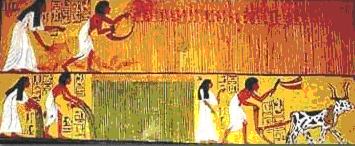
The ancient Egyptians were always ready to party and celebrate. In fact almost all the days in the year they seemed to be celebrating something or a god. Since Thanksgiving has just passed in the US, and Christmas (of course unknown to the ancient Egyptians) is on the way, what better time than to celebrate show their harvest festival.

In many respects, Thanksgiving is a major world holiday, and has been since ancient times, although the date may very according to different growing seasons. The traditional Horn of Plenty is a traditional harvest icon, and the celebration of a good harvest means plenty of good food for all.

It is also a timeless celebration, with a tradition dating back to mankind's earliest farming efforts. Today, most of us cannot comprehend the importance of a good harvest, but in ancient times the difference between a bountiful harvest and a weak yield could spell the difference between life and death, malnourishment or health. It could also have much more disastrous effects, such as setting the stage for dynastic change, and periods of upheaval.

Throughout history, people have given thanks to a god or gods for a good harvest. In many cases, it was the ruler who had the ultimate responsibility of appeasing the gods so they would provide a good harvest, and it was the ruler who might be blamed if that were not the case.


In ancient Egypt, crop failures and the resulting famine are suspected as being at least in part the cause of several intermediate periods of governmental collapse between strong dynasties. Good harvests were a source of pride and bragging rights by kings who could take considerable credit for the good fortune because the gods were pleased with his deeds.

This comes as no surprise. Egypt became famous as a "bread basket", and the fertility of the Nile Valley was a source of pride for the ancient Egyptians. While Egypt may be well known to us for its huge and glorious monuments, it was almost certainly the easy agricultural economy that allowed such sophistication.

Jean AdamsAs in many lands, harvest did not occur in Egypt during the fall months, but rather during late March or early April. Because of Egypt's mild climate, crops could be planted at almost any time, but it was the Nile inundation that triggered the initial production phases.

The height of these floods would usually occur in mid August, and at that time, each farmer would row around his land in small boats, closing the vents in the surrounding dykes. This would allow the water to leave behind a deposit of enriched mud, which would soak down deep into the soil. Around October, the land might be firm enough to plant, but in these early days, there were always rites surrounding most agricultural operations.

Even in predynastic Egypt, we find the king taking part in a symbolic inauguration of breaking the earth and sowing the grain. This ceremony came to symbolize the ritual burial of the god, Osiris, who had died at the hand of his brother Seth, but came back to life to thank his wife and sister, Isis. Indeed, grain became the symbol of Osiris' body because it appears to have no life until it sprouts anew.

Around the end of March, or the beginning of April, the first cereal grains would be harvested, and although additional crops could and would be planted, this marked the most important harvest of the year, and a time of celebration if the crops were good.

Over its 3,000-year-old pharaonic history, harvest rites changed. Harvest celebrations could also vary depending on the location. They might be considerably different for those in the Nile Valley as opposed to those at a desert oasis.

However, the best known harvest festival was dedicated to the god, Min, who was also a fertility god, who took interest in both the land, as well as the fertility of mankind. So identified was the fertility of the land and of mankind, that a virgin girl was poetically referred to as an "unplowed field".

The start of the harvest in ancient Egypt involved celebrations in honor of Min, which were often opened by the king himself, who reaped the first ears of grain with a sickle. This was the month of Shemou (harvest), and a statue of Min, represented as an ithyphallic god of fertility in iconography, was placed on an inclined pedestal, which was the symbol of Ma’at (the goddess if truth and justice). This pedestal represented the primordial mountain, a symbol of resurrection, renewal, and rebirth. During the processional honoring Min, songs were sung and ritual dances were performed. Many festivals around the land honor the harvest.

Heqet, goddess of childbirth was also associated with grain germination while Renenutet was also a goddess of grain, as well as a fertility goddess. Isis, who caused Osiris to rise after his death, was closely associated with the harvest festivals for she was seen as the reviver of the grain who caused it to sprout.

The harvest began with this festival, and there would, as in most ancient Egyptian festivals, have been some abundance of food and festivities for all. However, it is interesting that the festival occurred before the actual harvest.

Afterwards, there was likely to have been more celebration. Most of the land belonged to the king, or temples, so the harvest, for the most part, would have been a personal celebration by individual farmers.

In fact, traditional thanksgiving which is seen as the end of the growing season and a time for rest, in Egypt there would have been another crop to plant. Since Egypt's earliest times, it was recognized that two crops could be grown between Nile floods, but getting this second crop in the ground would have left little time for celebration of the first crop beyond the initial festivals. Hence, for many common farmers, the end of the harvest did not warrant much time for giving thanks.