Showing posts with label Sports and Entertainment. Show all posts

27 July 2010

Good Times: Parlor Games

By Jennifer Linforth

In preparation to interview an escape artist, gambler, and magician for an upcoming book set in Victorian London, I stumbled into the world of Victorian parlor games. I needed one for the opening of this book and found "Poor Pussy." Strangely enough my magician's wife recalls playing a game called "Pat the Kitty" as a child.

Gathering together for parlor games was popular in the evenings in Victorian families. The central theme of many of them were games involving trying not to laugh. Poor Pussy was one of them. It involved one proper guest having to mill around on all fours amongst the seated company, meowing and stopping in front of someone who then had to say "poor pussy" without ever cracking a smile. Neither the cat or guest could smile. If one of them did the latter was the next cat.

I never recalled playing that as a child but I do remember this...

The Laughing Game where players sat in a circle and one says "ha." The next, "ha-ha" and so on until someone laughed in earnest.

Many games we know today stemmed from Victorian parlor games. Red-Light, Green Light, Simon Says, Charades and Musical Chairs. Hot Potato of today sounds very similar to the game of "Change" where an object was passed in a circle and directions shifted out of the blue.

Hunt the Thimble sounds like great fun. The mistress of the house would hide a tiny object in a room and guests would have to search for it. When they found it, they simply took their seat until one poor person was left still looking for the item.

Victorians seemed to enjoy embarrassing each other...

...or catching each other for that matter. There were many versions of Duck, Duck, Goose then called Wolf and the Lambs.

Memory games such as Grandmother's Trunk were wildly popular (hence the interview with my magician who is a master of Victorian memory games. His website is here: Dr. Wilson ) In this game a player would say "My grandmother has a trunk and in it is.... apples" or some such item beginning with the letter A. Around the room they would go, each guest having to build on this list with a new item with the following letter while remembering and reciting as well all the items before!

Way more fun than Wii? Oui?

20 July 2010

Good Times: Food Fight

By Zoe Archer

No, Bluto, not that kind of food fight.

It seems that as long as there have been cultures blessed with a surplus of food, there have been food fights. Frenetic, messy, anarchic food fights. A collective release of aggression that also, mysteriously, builds community. One moment, you’re throwing tomatoes at your neighbor’s head, the next moment, you wrap them in a tomatoey, pulpy hug.

Our food fight tour begins first in Spain, where the famous Tomatina Food Fight is held in the village of Buñol, near Valencia. If you happen to be in Buñol on the fourth Wednesday of August, be sure to wear clothing you don’t mind getting stained. La Tomatina is a fairly recent event, its earliest origins dating to somewhere in the 1940s. Apparently, a civil disturbance in the town lead to a confrontation with local police, and this degenerated (or evolved) into a tomato fight.

That food fight was so popular that it became an annual occurrence, and is now a huge tourist attraction, drawing more than 20,000 eager tomato-throwers from around the world. A week-long fiesta culminates in a climactic tomato battle. Trucks laden with 90,000 pounds of tomatoes rumble into town, and people on the backs of the trucks throw tomatoes into the crowd. The crowd retaliates, and soon a full-blown batalla takes place between anyone and everyone who happens to be in throwing distance. Within thirty minutes, the battle is over, and combatants/celebrants all head down to the river for a good wash.

For those of you who need more vitamin C, we head to the small Italian town of Ivrea, 40 miles north of Turin. Here, during Carnival, the local citizens commemorate an 1194 insurrection against a local despot with a Battle of the Oranges. Popular lore has it that the tyrant attempted to exercise his droit de seigneur with an unwilling maiden on the eve before her wedding. The maiden, Violetta, turned the tables on her would-be assailant and decapitated him, after which, the populace stormed and destroyed the castle.

The event and assertion of independence is celebrated by teams of Aranceri (orange handlers) on foot throwing oranges at Aranceri riding in carts. Originally, beans were thrown by the celebrants, but some time in the 19th century oranges became the projectiles of choice--which are considerably harder than beans, especially after a winter frost. No wonder many of the Aranceri wear helmets.

Stretching the definition of "food fight," we head north, to Cooper’s Hill, near Gloucester in England. During the Spring Bank Holiday, local citizens and tourists make a mad dash down a steep hill for a wheel of Double Gloucester cheese. It’s estimated that the event is over two hundred years old, though between 1941 and 1954, a wooden cheese took the place of the actual cheese due to rationing. During the event, a round of cheese is rolled down Cooper's Hill and, one second later, competitors race after the cheese. The hill is very steep, and not only does the cheese reach high velocity, so do the racers. Sprains and broken bones are not uncommon. Separate races are run for men, women and children, with the winners receiving small monetary compensation as well as a wheel of cheese--but everyone who tumbles down Cooper's Hill in pursuit of Double Gloucester is a winner. Surely Wallace would agree.

19 July 2010

Good Times: Horse Racing

By Jacquie Rogers

When the first two people walked the face of this earth, one of them had to prove he could go faster than the other. Whatever means was available in any time and place, people have raced. Foot races, camel races, elephant races, buffalo races, ostrich races...on and on. Hey, the human race is called the "human race." Must be something to that.

And horse races.

Probably the oldest continuous horse race in the world is held in Mongolia, the Naadam Festival, featuring the Eriin Gurvan Naadam--the three manly sports of archery, wrestling, and horse racing. The horse races are from 12 to 35 kilometers in length and the riders, both boys and girls, are from four to 12 years of age (the minimum age was recently raised to six years old). The horses are trained rigorously for this event, and the winner brings great prestige to its owner.

In Britain, knights arrived home from the Crusades with Arabian horses--warm bloods that where sleek and fast. These were bred with the Hobby horses native to the British Isles. Henry VIII had a bad case of racing fever, then his daughter, Elizabeth I, continued improving the breeding program. This went on until Cromwell, who switched from breeding for speed to breeding for the cavalry. At any rate, Englishmen were dedicated to thoroughbred horse racing from then on.

Professional horse racing as we know it started in the 1700s during the rein of Queen Anne. Later in 1750, the Jockey Club was formed, which created the rules generally used today. In the 1790s, James Weatherby recorded all the horses' pedigrees in the General Stud Book. His descendants have been the keepers of the General Stud Book to this day.

Britain's five race classics are: Derby Stakes, the Oaks, the One Thousand Guineas, the Saint Leger, and the Two Thousand Guineas. The Saint Leger is the oldest, formed in 1776. The Derby Stakes, named after the 12th Earl of Derby and held at Epsom Downs, is the richest and most prestigious of Britain's races.

The Belmont Stakes is the oldest of the USA's Triple Crown. The first race was held in 1867. The Preakness started in 1873 and the Kentucky Derby (at the right) began in 1875. These races followed the English tradition, and the Belmont even specified the saddles must be made by Merry of St. James Street, London. The term "Triple Crown" was first used in the 1930s and was coined after Britain's Triple Crown.

While reading The Owyhee Avalanche (Homedale, Idaho), I saw this article in the "Looking Back" section, republished from the July 9, 1870, issue of The Owyhee Avalanche (then in Silver City, Idaho Territory).
THE FOURTH AT WAGONTOWN

A number of our citizens attended the races at Wagontown last Monday. Everything passed off in the most satisfactory manner. There were four races of a quarter of a mile each, as follows: LW Walker's chestnut horse and Jno Catalows's sorrel mare, for $50 a side, won by the latter. Second, Tim Shay's sorrel horse and Frenchman's roan filly, for $40 a side, won by Shay's horse. Third, Catalow's sorrel mare and Frenchman's sorrel horse, for $50 a side, Catalow's mare winner. Fourth, Jordans's black mare and Tom Walls' gray horse, for $45 a side, Jordan's mare winner.
That's pretty good money for 140 years ago, but a pittance compared to what went on in San Francisco, CA.
Gradually, as wealthy men made a hobby or a sideline of breeding horses, Western races became more carefully orchestrated, the crowds grew and betting flourished. Indeed, gambling and a day at the races became a virtually synonymous. And when Westerners got around to staging formal stakes races the prizes were sometimes much richer than those back East. In 1873 what was billed as "the richest race in the world" was run at Ocean View Park in San Francisco. The winner's purse was $20,000 paid in gold. In the same year New York's famous Belmont was worth only $5,200 and Maryland's Preakness a mere $1,800. ~ From: Gamblers of the Old West, p.200
Currently, Mongolia hosts the longest horse race in the world, 1,000 kilometers. It's actually patterned after Ghengis Khan's mail system, where a horse and rider had to go from water to water, usually about 30 kilometers. Think Pony Express. The US certainly wasn't the first to come up with that system.

There's every iteration of horse racing you can think of: barrel races, sulky races, chariot races, suicide races, wild horse races, endurance races, and many more. Mule racing is becoming popular now, too.

I read that horse racing is the second most popular sport in the United States. That's interesting because in today's society, a lot more people know how to drive cars than know how to ride horses, so you'd think horse racing enthusiasm would diminish. But all over the world, horse racing is as popular as ever.

Sources:
Horse Racing History
History of Horse Racing
Belmont Stakes
The Owyhee Avalanche


I wish Good Times to all of you!
Jacquie

Down Home Ever Lovin' Mule Blues (See the Book Video featuring Justin Saragueta)
Jacquie's Website * 1st Turning Point * Myspace * Twitter * Facebook
Faery Special Romances (Book Video) * Royalties go to Children's Tumor Foundation, ending Neurofibromatosis through Research


Read a book by Jacquie Rogers

13 July 2010

Good Times: The USO

By Carrie Lofty

Contrary to popular opinion, the USO (United Service Organization) wasn't entirely about WWII-era dances and popular entertainment. Formed in 1941, it was established as a private non-profit organization devoted to providing morale-building services of all kinds to members of the armed forces. This included religious needs, games and recreation, temporary lodging, postage services, the distribution of books and magazines, and food stations in cities, ports and railway stations. Particularly famous were USO doughnuts. If USO volunteers were handing out food, doughnuts were sure to be involved!

The USO was chartered by Congress to bring a variety of hitherto separate units under one united banner, but it was and remains technically independent of the US government. I say "technically" because the USO worked very closely in conjunction with the War Department, and continues to coordinate its efforts today with the Department of Defense and Homeland Security. No matter how nominally independent, the organizers of USO events and services were never going to put their people in harm's way or compromise military operations.

A USO canteen dance in 1943

USO dances became a staple of life of wartime life. Girls considered to be of the best character were chosen to host and participate in these canteen dances, both at home and in foreign nations such as Britain. Morale was buoyed by the girls' clean-washed hair, pretty smiles, and patient conversations. Because of how near this skirted toward hints of offering their bodies of comfort--eep! almost prostitution!--the USO was especially strict to enforce their chosen boundaries of propriety.

Girls were trained in how to talk with servicemen, how to make them feel included, and how to firmly tell them "no" at the end of the night. Volunteers were discouraged from dancing too frequently with the same man, and they were forbidden from leaving the premises with servicemen. Even the exchange of phone numbers so that eager young people could arrange an after-work rendezvous was prohibited. (Not to say some folks didn't get around the restrictions!)

Bob Hope performing on a USO tour

Camp Shows also became widely recognized aspects of USO morale. Entertainers from all walks--from Bob Hope and other tremendous stars, to independent troupes of acrobats, singers, poets, classical musicians, and ballerinas--all made the rounds. Homefront shows were organized to keep restless men in training camps from becoming too bored and destructive to local towns. "Foxhole Circuit" tours of the the European and Pacific Theaters soon followed, from Alaska to Egypt to New Guinea. These intrepid performers traveled at their own risk, but they also performed under the USO's very strict watch. Anyone who deviated from an approved show schedule and script could be sent home instantly, contract canceled.

Contrary to what you might expect of entertainment aimed at hundreds of hard-up, lonely soldiers, USO performers were expressly forbidden from making their shows too vulgar or sexual. In fact, the longer a man had been in the field--such as Marines who had not been home for two years or more--the more eager he was for wholesome entertainment. They had seen enough vulgarity and had experienced far too much degradation and shame to want that reflected in their entertainment. Pretty girls in good Sunday dresses who sang songs of home were the most appreciated entertainers--the sorts of girls they were fighting for, the sort of girls waiting for them to return.

The Andrews Sisters on tour for the USO

12 July 2010

Good Times: Drinking Games of the Past

By Jeannie Lin

"Drunkenness is nothing but voluntary madness." ~ Seneca, Roman philosopher and statesman (3 BC–65 AD)

What are good times without a small discussion of drinking and the games that people play while drinking? A brief survey of the drinking games of old reveals that alcohol and the revelry in its presence is a humble yet universal link across different times and cultures.

One of the earliest written records of a drinking game was in Plato's Symposium where a group of men attend a drinking party and deliver speeches about Eros, love. The game there was simple as drinking games tend to be: fill a bowl with wine, drain it, slap it down, pass it on.


The ancient Greeks also played a game called kottabos, which involved flinging dregs of wine from their bowls onto a target at the center of the room, with prizes or penalties designated for making or missing the mark. Then there was an even simpler drinking game--endurance drinking. The host would designate a number. Anyone who couldn't hang would be banned from future games.

The ancient Chinese also had a host of drinking games to liven an evening. The basic game had an appropriately descriptive name, "Bottoms Up." The elite and educated would often play drinking games that involved spouting poetry or guessing riddles. Less literate games involved drinking based on the roll of a dice or drinking contests with referees and governors. One game involved setting up a series of puppets of dolls dressed as Westerners in the center of the room. When one fell over, whoever it pointed to had to drink.

A famous Chinese drinking game involves both coordination and rhythm. Tiger, Chicken, Worm, Board is believed to have been around since medieval times and is variant on Rock, Paper, Scissors:
  • chicken eats worm
  • tiger eats chicken
  • board hits tiger
  • worm eats board
It involves a chant, pounding out a rhythm on the table, and then shouting out of one of the items. Missing a beat or losing the battle results in a penalty drink.

A variant of the "Tiger, Chicken, etc" or "Rock, Paper, Scissors" drinking game became a popular staple of the geisha drinking culture, which flourished in 17th and 18th century Japan. Geisha were trained in the exquisite arts of dance, music, and conversation. They also had a range of parlor games and drinking contests in their arsenal to keep their guests entertained.


Sometimes simple is best. A drinking game that originated in 14th century France involved a special drinking vessel--the puzzle jug. The contestant was given a jug with holes built into the design. The goal was to tilt it just right to get to the alcohol. My guess is most of the players must have already been inebriated to start with as most of the drink inevitably poured out of the holes onto the victim to the enjoyment of all onlookers.

The pinnacle of special drinking vessels has to be the yard of ale, a one yard long glass that holds 3 pints. Most likely this practice originated in 17th century England. John Evelyn, a Fellow of the Royal Society, records the practice of toasting James II with a yard of ale in Kent in 1683. Drinking a yard of ale became a traditional pub game. As with all classical games, the rules were easy. Drink the entire yard without pausing.

The still popular "yard of ale"

In more recent history, the popular game of "beer pong" is believed to have originated in the 1950s at Dartmouth College and morphed from the practice of playing ping pong and drinking beer at the same time. The origin of the popular game of "quarters" is unknown. It belongs to antiquity.

Good times to all and remember to drink responsibly!

13 January 2010

Humor: Commedia Dell Arte

By Anna C. Bowling

Barring time travel, how many of us can claim to have seen performances of sixteenth century Italian theater? Show of hands, please? Hm, I don't think that number is right. How many have seen the US or UK versions of Whose Line is It Anyway? Ah, more. UK friends, how about traditional pantomimes or a Punch and Judy show? More there, as well. How about Matt Groenig's cartoon series, Futurama? Thought so.

Wait a minute, what does Futurama have to do with sixteenth century Italian theater? I'll share the exact connection a bit later, but many traditions and stock characters found in the comedy that entertains us today was equally entertaining half a millennium ago.

Commedia Dell Arte, which can be translated as "comedy of craft" or "artist's comedy" originated as a form of professional theater in sixteenth century Italy. As we can recognize favorite characters today through images of their distinctive costumes audiences of the time could identify the players by the costumes and masks particular to the character. Though an audience member might not see the same troupe twice, as the players traveled, the characters stayed the same, and actors improvised from suggestions given by each particular audience.

The roster of characters could vary from locale to locale, but usually could be divided into: Inamorati, male and female lovers; vecchi, the older people, often parents of the lovers; and the zanni, who were servants or commoners, and from whom we get the word "zany." Other names used in commedia are still well known today: Rafael Sabatini's classic novel, Scaramouche, gets its title from the boastful swashbuckling character, and singers who perform the Queen song, "Bohemian Rhapsody" invoke Scaramouche as well. (It has yet to be determined if he will do the fandango.)

Arlecchino gives us Harlequin, which brings to mind not only a Renaissance clown and distinctive diamond pattern, but the largest publisher of romantic fiction in the world. Iconic as well are the images of Pierrot, the sad, white-faced clown whose tear-streaked face tops a huge white ruff. Then, as now, Isabella was a very popular choice for the name of the female lover. The absent-minded professor, crotchety miser and bumbling official all have their histories in commedia as well.

The usual plot of a commedia performance often revolved around the lovers wishing to marry but being kept apart by the machinations of one or more of their elders, until with the help of cunning servants, the obstacle is removed. This may sound familiar to readers of romance novels today. Of course, exactly how any of the above might come about would vary according to actors, audience, local political or religious climate. Working from a basic framework with characters needed to fill certain roles, one can imagine that provided enough variations that the same play was seldom performed twice unless the actors worked from a script. Actors frequently performed outside, with elaborate masks and costumes making up for the lack of setting or props. There was no fee to see the performances, and actors passed the hat afterward to collect what the audience could pay.

By the seventeenth century, commedia troupes began to work from scripts and the style became stricter and less improvisational, moving from outdoor performances to inside more traditional theaters. As time progressed and other forms of theater came into vogue, commedia took a back seat to more modern entertainments but true classics never die. In the nineteenth century, the likes of George Sand and Frederic Chopin constructed a theater for performances of commedia in France. Interest in the form revived through the twentieth century and into the twenty-first. True romance is, indeed timeless.

What about the Futurama connection? Visit the Commedia Dell Arte entry at TvTropes.Org and scroll down to the Western Animation section.

What commedia characters can you find in modern television, movies or books?

09 December 2009

The Seasons: Naadam Festival

By Zoe Archer

We've been talking a whole heap about winter traditions and winter events here at UH, but couldn't we all use a little jolt of summer fun as we dip closer and closer to the longest night of the year?

Villages and towns all over the world often host festivals, outdoor amusements and sporting events during the summer months, capitalizing on warm weather, high spirits and short nights. Lest you think that the modern Olympics has cornered the market on multi-sport competitions, might I turn your gaze eastward, toward Mongolia, and the traditional naadam festival. The festival dates all the way back to the 3rd century BCE.

Nowadays, the naadam festival is traditionally held every July, the largest being held in the capital of Ulan Bator from July 11-13. It celebrates Mongolia's "three manly sports:" horseracing, wrestling and archery. In modern times, women also participate in the archery and children vie in the horseracing event, but the wrestling is strictly for men. (Take a look at the wrestling costume. Now you know why women don't compete in that event. In fact, according to legend the costume was devised after a woman secretly entered the wrestling competition and won.)

After an opening ceremony of music and dancing, the competition begins. Wrestling is a hugely popular event. (Again, look at the costumes.) Men from all parts of Mongolia travel to compete. There are no weight divisions, meaning a big man can go toe-to-toe with a smaller man, and no time limits on bouts. The loser is the man who falls first. Bouts can happen very quickly, or seem to take a very long time as the wrestlers look as if they are standing in an embrace, waiting for the perfect opening to throw their opponent. Then the winner performs the "eagle dance" as his defeated opponent takes off his jacket and walks under the winner's outstretched arm.

Mongols come from a nomadic tradition which is still very much part of Mongolian life. In order to cross huge expanses of steppe, horses are essential, and it is often said that a Mongol child first learns to ride before he or she can walk. Genghis Khan and his descendants relied on their expert horsemanship to create and maintain their vast empire. So it's no surprise that horseback riding is part of the naadam. Horses are ridden cross-country, with the length of each race determined by the horses' age class. The true competitors of the horse racing event are the horses, not the jockeys. In fact, most of the jockeys are between the ages of five (yes, five) and thirteen, ensuring their smallness so as not to tire the horses. Feasting inevitably surrounds the races as spectators eat and cheer their horses to victory.

Archery is another key Mongolian sport. Bow hunting and bow-based warfare are both vital historical aspects of life on the steppe. At the naadam, men and women compete in separate divisions. All the competitors dress in traditional dress. Unlike modern archers' use of compound bows, Mongols vying in the naadam use recurved composite bows of horn, leather and bark. Arrows are made of willow branches with vulture feather fletching. They shoot at round, leather targets. Men stand 75 meters and women 60 meters from the targets. Nearby judges evaluate each shot with a shout of "uukhai" ("bull's-eye") and a raised hand. Winning archers are those who hit the targets the most times.

Accompanying all these competitions are, of course, celebrations, music, games, dancing and feasts--all the things Mongols love, and they take special delight in celebrating during the brief summer.

When I began researching Mongolia for my upcoming "Blades of the Rose" novel WARRIOR, I learned about the naadam. The whole festival captured my imagination, being so emblematic of Mongol life and culture. I knew I would have to incorporate the naadam into WARRIOR's plot--and I did, but I can't reveal just yet how the festival plays an important part in the story. For that, you'll have to read the book. Until its release next September, stay warm and dream of competing on the wide, grassy steppe beneath the eternal sky.

13 January 2009

Professions: Wandering Showmen

By Karen Mercury

Circuses and road shows once were the main entertainment in America in the 1800s. Family members traveling about in mule-drawn vans doubled as acrobats ("long-distance double somersault leapers"), jugglers, tightrope walkers ("rope dancers"), or musicians. Marionettists and puppeteers were skilled woodcarvers and costumers making their own "little people" dolls, sometimes figures enacting the story of Orlando Furioso, the travails of Dr. Faustus selling his soul to the devil, or the battles of David and Goliath, the most clever puppets being "figures that fell apart and reassembled themselves."

Sideshow acts were fire-eaters spinning plates, "punch men" who depicted the antics of Punch and Judy with metal diaphragm "swazzles" inserted into their mouths to change their voices, and experts at the "London Ghost Show," an illusion with mirrors. There were rope dancers, trained muzzled bears, human skeletons, roughnecks and razorbacks, and tattooed performers.

Showmen had to build their own sets with hand-stitched curtains of velvet, sequins and spangles of beaten gold. Three-inch curtain fringes were even hand-wrought from gold bouillon, apparently a cheap commodity back then. Entering a town, they would first go to the keeper of the main tavern and arrange for the show, making a deal with the town crier. They would parade up the main street in motley clown outfits, the one-man band loaded down with musical instruments, bells on his ankles, elbows, and head, followed by apprentices with banners that assured townspeople that the shows were "refined in nature" and "on a high moral plane." Food or furs were often accepted as admission on the frontiers of Minnesota, and showmen often hoarded the turkeys and passenger pigeons.

Showmen rarely did matinees, since the filtered sunlight spoiled the effects of the stage. Inside the tent the stage was lit by "lighters," iron baskets filled with pitch pine that burned with a yellow glow and helped hide the marionette strings to prevent the audience from figuring out how they worked--men jealously guarded the backstage area. Audiences weren't too picky about lighting, but sometimes they became irate about other items.

"One Saturday, for example," wrote David Lano, "we were performing Doctor Faustus in Berryville, Virginia. I spotted a big mountaineer who followed the rope-dancing with attention so rapt that I was sure he had never seen a show. With mounting excitement visible on his rough features, he next watched the puppet show. He was mesmerized. In a sense he began living out the play, as part of it. I began to feel uneasy, and sure enough, when Mephistopheles came in at the end to carry Faustus away to Hell, the big mountaineer leaped to his feet, yelled 'Git back, you devil!' whipped out a pistol and whang, sent a bullet at the innocent puppet.

"The audience went straight into a panic, scrambling for the exit. The bullet passed through the backdrop, missed the puppet, but lodged in the shoulder of one of our Negroes helping to hang up the puppets as they came off the stage. The town marshal appeared and took off after the mountaineer, but he galloped away on his long shanks and disappeared before the Law could touch him."

The doctors wouldn't treat a black man, and the marshal, "outwitted by the gun-toting hillbilly, came back, resolved to put on his own show of maintaining law and order, arrested Grandfather on a charge of inciting to riot and made him pay a fine!"

In larger cities, museums often imitated Barnum's famous American Museum in New York, and exhibited permanent collections of "curiosities" such as stuffed mermaids, sea serpents, fetuses in alcohol bottles, and firearms of "The War Between the States." The second floor held living attractions like giants, dwarfs, and fat ladies. The third floor was where the vaudeville theaters would set up.

The advent of the automobile freed people from their farms, and soon even the smallest rural towns had a movie house. The circuses of the gypsy trail were soon gone, and the mechanized semi-trailers of Barnum and Bailey didn't do justice to the wandering showmen of the Far West.

31 December 2008

Sports & Entertainment: Colonial Fun and Games

Carol A. Spradling

Force me onto a stair stepper and I'll spill family secrets faster than a mob snitch. I'm void of the endorphin gene and there is no worse punishment for me than exercise. Colonial Americans, on the other hand, considered a foot race highly anticipated entertainment. God love them. Luckily for anyone of the time who shared my genetic defect, walking, horseback riding, carriage and sleigh rides were also appropriate leisure activities. Ah, that's more my speed.


Other activities that drew a crowd were militia musters, court days, and public executions. Talk about being desperate for entertainment. To fill the lulls during these occasions, the townspeople would conduct side entertainment in the way of wrestling contests, horse races, and a rather interesting activity where participants would bludgeon each other with a stout stick. Thank goodness for the war. Apparently the Continental Congress felt it best to reserve energy for a more unified cause.

Away from the war effort, dancing became very popular. A dance master would travel the country, teaching the latest maneuvers. His repertories included minuets, reels, and jigs. However, not everyone preferred such physical amusement.

For the more even-toned, there were card games, board games, and billiards. Women enjoyed these games of skill and chance as well as the men. To encourage the sexes to mingle, and since females were not permitted in taverns, these games were played in private homes. Some card games of the period have evolved into modern games. Whist is commonly known as bridge and if you have ever sat with three other people and held thirty-two cards between you, you have probably played euchre. So did the Colonists.

We have all heard about the evils or cards and dice. My grandmother would not permit a card or dice game of any type into her home, no matter how innocent, because of the immorality associated with it. The Colonists were no different, and with good reason. Many card and dice games attracted unseemly characters and brought ridicule from Colonial society. Polite society did not play hazzard or put, a precursor to poker, this was left to the lower classes. Instead, refined citizens entertained themselves with cribbage, loo, and the royall. I suppose this is better than cockfights, boxing, and knife throws, which most men enjoyed. However, both sexes of all classes enjoyed gambling and drinking.

Printing literature was as time-consuming as every other chore. Broadsheets were a great source for current events, but chapbooks provided stories of shipwrecks, folk heroes, villains, and even boasted lurid plotlines. These cheap books with paper covers were very similar to genres found in local bookstores.

The mentioned activities were ideal for grownups, but children were technologically disadvantaged compared to their modern counterparts. While adults may have been forced to substitute chocolate or coffee for their tea, it brewed on in little girls' imaginations. Pretend tea parties ensured hours of fun along with tops, marbles, dolls, puzzles, balls, and Bilbo catchers.

Remove batteries and solar power from the quotient and we are no different than our ancestors. We tend to work hard and play harder. Only the toys are different.

30 December 2008

Sports & Entertainment: Fox-Hunts

By Jennifer Linforth

Oh bloody hell. Was I completely foxed last night?

Digging, snorting...even pulling on the plug with his teeth did no good. The hole to his den was completely plugged. Lifting his whiskers to the pre-dawn light, he cussed again--a sneezy, yelping sort of combination. For a moment he thought his late night romp in the farmer’s chicken coop had resulted in him digesting some foul meat--until he recalled what he ate was fowl—thus removing the notion that he could be hallucinating.

He certainly would not plug up the entrance to his hole. Nocturnal animals would not do this. Yet here it was plugged solid. He scratched his ear with a back paw as he thought. Could only mean one thing—the field was gathering. Horror struck, he stopped scratching. Beady black eyes shot toward the sun then down to his bushy tail. He regarded his shadow. 11AM.

Spinning in a circle until he was crazy like the fox he was, he pondered his way out of this one. "The field," those mounted sportsmen would be gathering with their dogs...usually forty to fifty to a pack if he recalled correctly. They would be at the "meet" by now--the designated spot for start of the hunt.

He paced frantically. He was a fox. His instinct told him to head to the covert. Hide there. But wait, what the hell was that saying? He paused to bang his head repeatedly against the trunk of a tree. Think, think, think you red furred fool...this is important! 'A fox can change his fur but not his habits'...damn it.

Seems he would have to change his habits...

The covert would be out. That is the first place the master of the hunt would lead his sporting troupe. All foxes would run to a covert if they found their den plugged. Coverts meant shelter--unless a fox-hunt was under way. Then it meant dogs. The hounds would be sent in one end of the thicket or gorse patch with the intent of sniffing their way through until they flushed him out.

Then all hell would break loose and he as so not in the mood for that.

For as soon as he ran from the covert, the "tally-ho" would be sounded and men, horses and hound would all be charging after him. It was not a good time. Seriously. Man found it a good time… but from his point of view it was anything but a delightful afternoon. Trotting in a circle pondering what to do, he failed to see the sport in all of it. Men riding at ridiculous speed through forests, streams, dashing across fields all while trying not to break their necks in pursuit of him. Eventually they would corner the fox and the hounds would eat him.

Relatives often made the worst friends...

They would typically not eat all of him... the "brush" (tail), "mask" (head), and "pads" (paws) would be cut off and handed out as macabre trophies to the sportsmen.

So. Not. Fun.

Though instinct told him to heat for shelter and hide he decided to turn tail and run fast and far--immediately. He heard there was a new gathering of geese at the farm on the opposite end of the estate. Perhaps they might care to listen to him preach a sermon or two...

This day he would keep his reputation intact and avoid the hunt.

He was, after all one sly fox.

29 December 2008

Sports & Entertainment: Baseball Cards

By Eliza Tucker

As far back as the 1840s, baseball was a popular sport in the U.S. As with any tournament game, its players and fans wanted a way to show their support for specific teams and the sport in general, and so many people made their own cabinet cards with photographs of players or teams pasted onto wood or thick paper for the purpose of displaying their interests.

In years following the American Civil War, Peck and Snyder, a sporting goods company based in New York City, came up with a way to further market the game--and their business. By printing "trade cards" with famous players or teams on the face with advertisements on the back. These cards were not sold, but handed out on the streets, much like today's fliers.

During the 1870's to the 1890's, trade cards were popular form of advertising. In fact baseball theme trade cards made up only a fraction of the total trade cards. Trade cards depicted many subjects, including presidents, animals and comics. A popular type of baseball trade card were comic trade cards, which shown baseball scenes in a comical situation. Collecting trade cards and pasting them into scrapbooks became one of the country's most popular hobbies. Many of these baseball trade cards found today have some damage on the back where they were removed from scrap books. Collecting old trade cards is popular with some collectors today...

Goodwin & Co., another tobacco company in New York, issued the Old Judge cards, a small picture card that was inserted into packs of Old Judge brand tobacco. Goodwin & Co. produced these cards both as a 'stiffener' for their cigarette packs and to boost sales.
Cycleback.com
By the start of the first World War, the tobacco companies had released their hold on the baseball cards, but the prize prints had long since found their way into Cracker Jack boxes, gum packages, and even boxes from clothing shops.

17 December 2008

Sports & Entertainment: Bundling

By Anna C. Bowling

Imagine tucking your teen or twentysomething daughter snugly into bed with her gentleman friend and wishing the couple a good night while the rest of the family goes on with the rest of the evening's entertainments as usual. Perhaps you sit down to a spirited game of cards with your spouse, help your younger children with schoolwork, or regale the family with the newest song you've taught your caged canary or discuss the merits or flaws in last week's sermon--interrupted, of course, by shooing away any curious family members who might try to listen at the bedroom door.

Daughter and her friend need their privacy, and even the most inquisitive family members need to respect that. The younger children may want such privacy of their own someday, and the older family members were young once, too. Everybody back to business. How about that sermon, hmm? If the couple want to share any highlights before the gentleman returns home tomorrow, they'll do so.

Where and when would such a scenario take place? In a modern, metropolitan American household? Possibly. But this practice, called bundling, was also a common scenario for colonials of Dutch, German or British extraction during the eighteenth century, and could provide a good deal of entertainment for all involved--not just the bundled pair.


During warmer months, courting couples would spend most of their time alone walking out, which is exactly what it sounds like; taking a stroll outdoors, likely in sight of some older family member of one of the pair. What's the same couple to do, though, when the temperature drops, flakes fly, and a fellow can't be sure it's quite safe to traverse the icy roads after paying court to his lady fair? Pack themselves off to bed, of course, and no, not necessarily for what first comes to mind.

Though of course the actual practice varied, depending on the individuals and societies involved, the couple would climb into bed together, fully dressed, often separated by a bundling board, a long piece of wood down the middle of the bed. (In my colonial historical romance, My Outcast Heart, my hero and heroine substitute a rolled quilt for the board.) A chaperon may or may not be present, and sexual activity was not expected or encouraged for the bundlers. They would be expected to converse and get a taste of what it might be like to spend time in solely each other's company in close quarters.

While this could make for a perfect setup for romantic scenes for any genre from inspirational to erotic, the couple did have other distractions than merely being a hair's breadth from their beloved. Remember all those relatives mentioned above? Remember all their activities? Add in the chatter of several generations of relatives, children with clackety wooden toys, a musical instrument or two, and that noisy canary, not to mention assorted individuals trying to listen or peek, or concerned older relatives "just checking" on them, the mood was not always the most romantic. Nevertheless, bundling did often lead to a wedding--and sometimes a rather hasty one.

Modern bundling board photo courtesy of: The Benchmark Inn, Provincetown, MA

16 December 2008

Sports & Entertainment: Viking Board Games

By Michelle Styles

It is very tempting to think of the Vikings as always out raiding or fighting. However, the Vikings had many leisure activities including playing musical instruments, reciting of sagas, composing poetry and playing board games. Many grave sites include some evidence of game playing. With boards or counters being found in a number of graves across the entire Viking world.

The board games were important as they helped to teach strategy, a skill that many Viking warriors would have needed when deploying their men. They are not the sort of game where you simply followed a path, but pitted one opponent against another. From the sagas we know that women also played the games and so they were not simply a male preserve. Board games were often a place where men and women could pit their wits against each other.

Chess is a late 11-12 century addition to Viking board games. The famous Lewis chessmen which were discovered on the Island of Lewis in 1831 date from the early 12 century and are thought to be a lost Viking hoard. Uig, the place where they were discovered is windswept white sand and things rapidly become buried or hidden as I know from nearly losing a shoe on the beach. They are not sure if the chessmen were owned by a Viking, or if they were part of a Viking trader's stock.

The 93 pieces are divided between the Scottish National museum and the British museum and are considered to be part of Britain's great treasures. They are made from whale's teeth and show little sign of use. It is possible to buy replica sets. The rooks have berserker type fury on their faces and the queen simply looks glum.

In Old Norse chess was called skak-tafl and took the Viking world by storm, rapidly displacing other perhaps more pagan board games.

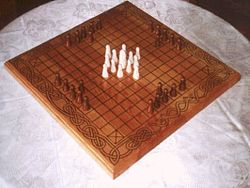
Prior to the introduction of chess, tafl referred to hnefatafl or king's board/table. No one is quite sure how it was played but there have been many guesses based on a variety of clues and riddles left in the sagas and the incomplete boards that have been found. The hnefa is thought to refer to the king piece who is surrounded by eight maidens. Scholars are not sure if dice were used in the game or not. Thud, a game from Terry Pratchett's disc world owes something to tafl, and perhaps gives the most flavour of what it could be like to play.

Other games in the Viking period included a variation on fox and geese (a complex game where one player has one piece and the other tries to surround him) and nine men morris.

However the games were played, they were a popular pastime and required a great deal of intellectual thought and a knowledge of the rules.

15 December 2008

Sports & Entertainment: Ancient Egypt

By Jean Adams

It is obvious from the scenes depicted on pyramid and temple walls that the ancient Egyptians knew how to keep fit. In ancient Egypt sport was a part of the daily life and culture. Archaeologists and scholars have uncovered interesting information about ancient Egyptian sports practiced thousands of years ago.

Not surprisingly, ancient Egyptian games and sport are not that different from the games we practice and enjoy today. Murals and paintings dating back to the days of the ancient Egyptians indicate that the pharaoh and his people enjoyed activities such as wrestling and the javelin.

With the fact that Egypt lies on the banks of the Nile River it is quite likely to assume that many of the ancient Egyptian sports were water related. Evidence indicates that Egyptians enjoyed such sporting events as swimming and rowing.

Judging by drawings and paintings, ancient Egyptian sport also included an assortment of ball games. One of the games involving ball play appears to be a version of handball, while other games were played using balls and bats fashioned from palm trees.

Many of the ancient Egyptian sports were enjoyed for the pure fun of it but others might have developed into professional spectator sporting events. Certainly the latter would have been attended by the royal family as a means of entertainment and diversion.

In addition, ancient Egyptian sport included marathons that were recorded in a number of Egyptian texts. Marathons seem to have even played a part in the coronation festivities of pharaohs throughout most ancient Egyptian history.

The Egyptians favoured organised sporting events, such as boxing and fencing with sticks. Marathon races were important events, particularly during celebrations commemorating a new pharaoh. One of the rituals of these celebrations was to hold a marathon run by the pharaoh around the temples before spectators to reveal his physical strength and his ability to rule using his bodily and mental capabilities.

The artist has brought out, with a thorough knowledge of anatomy, the harmonious play of muscles. The positions of Zoser's arms, trunk and legs denote an expertise of technique and movement which only advanced development can achieve.

The ancient Egyptians engaged in sports with the intention of training and strengthening their bodies, as well as for pleasure and recreation.

The high standard of physical fitness reached by the ancient Egyptians is revealed in their standard portrayals of the male and female forms in sculpture and painting.

The men are strong, and radiate a muscular vigour, while the women are slender, and redolent with femininity.

There are countless representations on tomb and temple walls, but none is more striking than the oldest document relating to sport. It is a unique mural, not only because of its date, but also through its social implications, depicting the Pharaoh Zoser the Great, the founder of the third dynasty nearly 3000 years before Christ, or about 5000 years ago.

Fully aware of the invaluable role of sport in raising the standard of health, and hence of national productivity, the ancient Egyptians as a whole, men, women, youths and children, were all engaged in sporting activities with a zeal which amounted to a cult.

There is a theory that the ancient Egyptians began the custom of holding international games regularly at Akhmem in Upper Egypt. It should also be said that in Egypt, sport was born and flourished, and from there spread to Greece, Rome and to the rest of the world.

The ancient Egyptians filled their leisure time with many pleasant activities. They enjoyed good food, drink, music, singing, and dancing. The upper class watched professional dancers at formal banquets. A number of musical instruments accompanied the dancers. The flute, oboe, trumpet, and an instrument resembling a clarinet were the most common wind instruments; stringed instruments included various types of harps, lutes, and lyres; and tambourines and drums were the normal percussion instruments. In rituals, sistra and clappers were used.

Other leisure activities included hunting, fowling, and fishing for sport. Hunters used a bow and arrow for most game--ibex, gazelle, wild cattle, ostriches, and hares. Fowling and fishing took place in marshes. For fowling, Egyptians used a throwstick that acted like a boomerang, stunning the bird and knocking it out of the sky. For fishing a long, double-barbed spear was used.

Members of literate households (5 percent at most) enjoyed reading. In the quiet of their homes, the ancient Egyptians played a number of board games, the most, popular being senet. Ancient Egyptian children had games and amusements similar to those of Egyptian children today. A number of simple toys like balls and dolls have been found in tombs. They lived life to the full. At festivals and parties they feasted and drank, and were entertained by singers, dancers and musicians.

Egyptians held feasts to celebrate births, marriages and religious festivals, or simply to entertain friends. The wealthy enjoyed holding dinner parties, where cooks would prepare huge meals, flavoured with imported herbs and spices. Dressed in their best clothes, guests sat on chairs or on cushions on the floor, eating and drinking large quantities of wine.

Party scenes show how much the Egyptians liked music and dance. This well known banquet scene is from a tomb of a wealthy nobleman named Nebamun. The tomb was built around 1400 BC in Thebes. One woman plays a double flute while others clap along and dance.

An integral part of both religious and secular festivals, dancers and musicians would enliven the festivities with harps, lyres and lutes, the oboe (most often played by women) the double flute, and drums to keep up beat of the music. Dancers and musicians were usually employed by a temple, or could work as freelancers.

These carved wooden toys would have been pulled along by a string. Pulling the string on the wooden cat would have made its mouth open and close. Other ancient animal toys have glass eyes, movable legs and arms and tails that wag. Simple rag dolls were also a popular choice.