Showing posts with label Christmas. Show all posts

21 December 2011

Rites of Winter: Stille Nacht - The Humble History of a Carol

 By Jennifer Linforth

As a child my older brother would glare at me each time I sang “Silent Night” at church in German. I spoke the language and being the teen I was, I thought it hip to sing it in its original language and to annoy my brother.

Christmas creates many creative stories about how this timeless carol came into being, from mice eating the bellows of an organ forcing the need for the hymn to be accompanied by a guitar to Joseph Mohr having to write the words in haste due to a broken organ. The story has been sensationalized through the years in film and books, but the reality of this hymn is humble in its origins.

"Silent Night" was written by Joseph Mohr in 1816, a young priest assigned to a pilgrimage church in Mariapfarr, Austria. Christmas eve of 1818, Mohr visited the home of Franz Gruber. He showed his friend the poem he wrote and asked him to write a melody for it for the Midnight Mass. Later that night the first stanzas of “Stille Nacht! Heilige Nacht!” were heard.

An organ does tie into the tale as master organ builder, Karl Mauracher, did work at Mohr’s church several times over the years. While doing his work Mohr’s church, he obtained a copy of the composition and took it home with him. Thus, the simple carol began its journey around the world in the hands of an organ builder.

Naturally the melody of so long ago changed over the years, but how? In December of 1832 two traveling families of folk singers, similar to the Trapp Family Singers, did a concert in Leipzig. Several musical notes were changed at this concert and the carol evolved into the melody we now know. According to historical documentation the song was performed before an audience Emperor Franz I and Tsar Alexander I. By 1839 “Stille Nacht" was performed for the first time in America at the Alexander Hamilton Monument outside Trinity Church in New York City.

Without doubt it will be performed this holiday season in churches across the globe.

Ein frohes Weihnachtsfest und alles Gute zum neuen Jahr!
Jennifer Linforth expands the classics by continuing The Phantom of the Opera. and her books are available now. Look for future books based on the classics, in addition to her unique historical romances. "Ms. Linforth's prose is phenomenally beautiful and hauntingly breathtaking." ~ Coffee Time Romance 

14 December 2011

Rites of Winter: Medieval Christmas Revels

By Lindsay Townsend
Make we mery, both more and lasse,
For now ys the tyme of Chrystymas
(From a 15th century carol)

When Christianity developed in the ancient Roman world, the winter solstice was already marked at 25th December. Followers of Mithras believed in the ‘unconquered sun’ and also held a feast-day for the sun on December 25th.

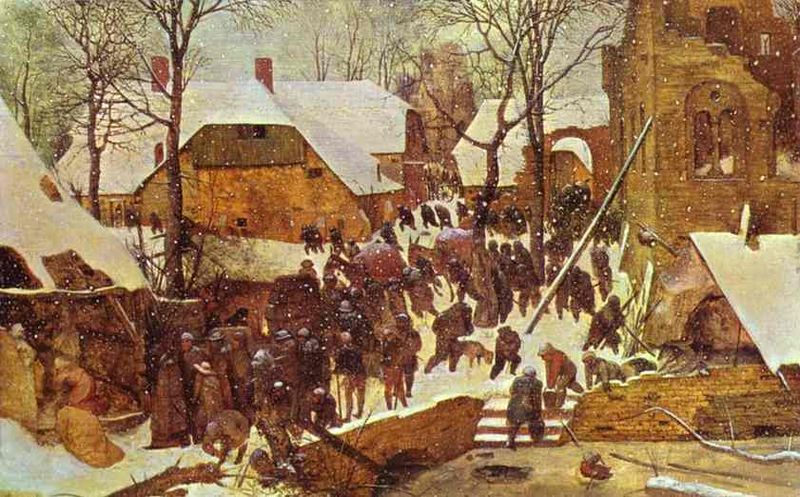
Pieter Breugel the Elder - 'The Visit of the Magi at Christmas'
The gospels did not give a date for the birth of Jesus, but ancient beliefs in the Roman Saturnalia, the solstice and sun-worship led to the church choosing December 25th as the time of his nativity.

‘Christmas’ means ‘Christ’s Mass.’ In England in the Middle Ages three masses were celebrated on December 25th - the Angel’s Mass at Midnight, the Shepherds’ Mass at dawn and the Mass of the Divine Word during the day.

Before the three masses of Christmas there was the forty days of Advent. Advent was similar to lent, a time of spiritual reflection and preparation for the coming of Christ. Feasting and certain foods such as meat and wine were meant for be abstained from during advent (something the evil Denzils ignore in my forthcoming Yuletide novel, The Snow Bride).

The feasting and revelling time of medieval Christmas began on Christmas Eve and lasted 12 days, ending on Twelfth Night. There was no work done during this time and everyone celebrated. Holly, ivy, mistletoe and other midwinter greens were cut and brought into cottages and castles, to decorate and to add cheer.

The most important element of the revels was the feast. Christmas feasts could be massive – Edward IV hosted one at Christmas in 1482 when he fed and entertained over two thousand people. For rich medieval people there was venison or the Yule boar, a real one, and for poorer folk a pie shaped like a boar, or a pie made from the kidney, liver, and other portions of the deer (the umbles) that the nobles did not want – to make a portion of ‘umble pie'. Carefully hoarded items were also brought out and eaten and other special Christmas foods made and devoured. Mince pies were made with shredded meat and many spices. ‘Frumenty,’ a kind of porridge with added eggs, spices and dried fruit, was served. A special strong Christmas beer was usually brewed to wash all this down, traditionally accompanied with a greeting of 'wes heil' ('be healthy'), to which the proper reply was 'drinc heil'.

There were also other entertainments apart from eating and drinking – singing, playing the lute or harp, playing chess, cards or backgammon and carol dancing.

Presents and gift giving was originally not part of Christmas but of New Year. Romans gave gifts to each other at Kalends (New Year) as well as a week earlier at Saturnalia, and by the twelfth century it seems that children were already receiving gifts to celebrate the day of their protecting saint, St. Nicholas, and the practice soon began to extend to adults as well, initially as charity for the poor. As the Middle Ages wore on, the custom grew of workers on medieval estates giving gifts of produce to the estate owner during the twelve days of Christmas - and in return their lord would put on all those festivities.

Wes heil!
Lindsay Townsend
http://www.lindsaytownsend.net/

27 December 2009

Guest Authors: Jan Scarbrough and Magdalena Scott

This week on Unusual Historicals, we're welcoming authors Jan Scarbrough and Magdalena Scott as they celebrate the release of Three Decades of Love, A Legend Christmas Anthology. Here are the blurbs:

"The Christmas Heart" by Janet Eaves
Christmas, 1944: Mary Ellen Chambers has learned to appreciate simple comforts in the midst of war coffee rations, her job at the factory and the upcoming Christmas season in Legend, Tennessee. She's already lost one sweetheart to the war, and the last thing she wants is to get involved with another soldier. Could Captain Austin Watkins be the best Christmas gift she's ever received?

"A Groovy Christmas" by Jan Scarbrough
Christmas, 1968: A year where women are burning bras and men are burning draft cards. Can Kathleen Fields and Grant Winchester, from feuding families like the Hatfield's and the McCoy's, reconcile their differences and find love in Legend, Tennessee?

"Under the Mistletoe" by Magdalena Scott
Christmas, 1975: Dorothy Robbins is working hard to build up her Leaving Legend Fund. Charles McClain escaped the small town life years ago, but is home for the holidays. No way will either of them stay in Legend, Tennessee, and no way will a brief fling turn into something complicated...like love.
***

Note: Available as individual novellas: "The Christmas Heart," "A Groovy Christmas," and "Under the Mistletoe."

***

Can you tell us more about your 'Ladies of Legend' series?

We came up with the idea of Legend, Tennessee during back-and-forth chatter over e-mail. As critique partners, we already worked together on story ideas. Making up a fantasy community was a natural outcome. These stories come from that original idea. You can learn more about it at our Legend website.

Why did you decide to move away from your original 'Ladies of Legend' books?

We haven't completely. We still write romances with contemporary settings. However, we wrote our first Christmas anthology last year, A LEGENDARY CHRISTMAS. This year we wanted to do something different when our publisher asked for another Christmas book.

Magdalena, why did you pick 1975?

Seems to me, when we were choosing decades, I had the option of the 1950s or 1970s. At least I remember the 1970s! I thought it would be fun pulling recollections from my high school years to create some of the ambiance.

Why choose 1968, Jan?

Like Magdalena, I remembered the year well. It was pivotal for me because I graduated high school and went to college. I was in Washington DC with my band when Martin Luther King was killed. I traveled overseas for the first time and had my first kiss.

How hard was it to write a historical? Jan?

I've written a medieval and this was totally different, because I remembered the year. However, I did research 1968 to refresh my memory. I learned that 1968 was a tough year all around for many people--two national deaths, riots, a presidential election. The year ended with a bit of hope, astronauts flying around the moon and speaking to the American people on Christmas Eve. I tried to put the flavor of the times into my novella.

Magdalena?

Well, since it is 1975, the worst part was afterward, when I realized OMIGOSH, this is set when I was a teenager, and it's an historical! Ouch! But the actual writing wasn't difficult, since I wasn't required to do what I would consider research. Between my memory, friends' memories, and Wikipedia, it came together rather easily.

Historicals are usually considered pre-20th Century, but the Depression and World War III are coming into their own as historical romance topics. Did you worry that 1968 and 1975 are too contemporary, Magdalena?

As I indicated earlier, for my own ego, I'd like to think of 1975 as contemporary, but there are masses of romance readers out there for whom 1975 probably seems like ancient history. They don't remember that we were in a recession then, that gas prices were high, that war veterans were coming home and trying to deal with their own set of problems in the midst of all that. There are a lot of similarities between what people were going through then and now. I think that's one of the things I like best about historicals. No matter the year, people and problems don't change that much.

Do you plan another Christmas anthology next year?

Yes! Right now it looks as if we'll all do follow-up stories to this year's. Our publisher and editors are wonderful, and so very supportive of the Legend series.

***

Thanks for stopping by, ladies!

If you'd like to win a copy of THREE DECADES OF LOVE, leave a comment or question for Jan and Magdalena. In particular, we'd like to know what you think of historicals set in the 50s, 60s, and 70s. Are these setting historical enough or too contemporary for your tastes? I'll draw a winner at random next Sunday. Void where prohibited. Best of luck, and happy holidays!

24 December 2009

Excerpt Thursday: A Christmas Anthology

This week on Excerpt Thursday, we're featuring a slice of Jan Scarbrough's novella, "A Groovy Christmas," which is included in Three Decades of Love, A Legend Christmas Anthology, with authors Magdalena Scott and Janet Eaves. Join us Sunday when these fine ladies will be here to talk about their unusual historical and give away a copy!

"The Christmas Heart" by Janet Eaves
Christmas, 1944: Mary Ellen Chambers has learned to appreciate simple comforts in the midst of war coffee rations, her job at the factory and the upcoming Christmas season in Legend, Tennessee. She's already lost one sweetheart to the war, and the last thing she wants is to get involved with another soldier. Could Captain Austin Watkins be the best Christmas gift she's ever received?

"A Groovy Christmas" by Jan Scarbrough
Christmas, 1968: A year where women are burning bras and men are burning draft cards. Can Kathleen Fields and Grant Winchester, from feuding families like the Hatfield's and the McCoy's, reconcile their differences and find love in Legend, Tennessee?

"Under the Mistletoe" by Magdalena Scott
Christmas, 1975: Dorothy Robbins is working hard to build up her Leaving Legend Fund. Charles McClain escaped the small town life years ago, but is home for the holidays. No way will either of them stay in Legend, Tennessee, and no way will a brief fling turn into something complicated...like love.
***

The following is an excerpt from Jan Scarbrough's novella, "A Groovy Christmas."

At 9:30 Walter Cronkite came on TV anchoring live video images from outer space. Apollo 8, the first manned mission to the Moon, had entered lunar orbit with its crew of Frank Borman, James Lovell and William Anders.

"This is amazing," Kate said breathlessly. She sat forward and the strange little cat hopped off her lap.

Pictures of the lunar surface appeared on the screen. Captivated immediately, Grant stared at the grainy, poor quality video while each astronaut talked about his impression of the Moon and what it was like to be in orbit above lifeless gray craters and mountains. One astronaut described it as "a vast, lonely, forbidding expanse of nothing."

Kate's eyes were full of wonderment. "Imagine going to the Moon!"

Grant couldn't find his voice. His throat clogged with a sublime sense of awe. Why was this mission moving him so much? He regarded those fearless men, who had little chance of returning home, with respect. They were doing something important and making a difference.

"We're now approaching the lunar sunrise," said the scratchy voice of William Anders.

A full view of Earth appeared on the TV rising over the gray horizon of the Moon. The orb seemed suspended in an empty blackness, but swirled with the color of life.

"For all the people on Earth, the crew of Apollo 8 has a message we would like to send you," Anders continued.

"In the beginning God created the heaven and the earth.

"And the earth was without form, and void; and darkness was upon the face of the deep.

"And the Spirit of God moved upon the face of the waters. And God said, Let there be light: and there was light.

"And God saw the light, that it was good: and God divided the light from the darkness."

In a deeper voice, Jim Lovell picked up the Biblical reading:

"And God called the light Day, and the darkness he called Night. And the evening and the morning were the first day.

"And God said, Let there be a firmament in the midst of the waters, and let it divide the waters from the waters.

"And God made the firmament, and divided the waters which were under the firmament from the waters which were above the firmament: and it was so.

"And God called the firmament Heaven. And the evening and the morning were the second day."

Frank Borman finished reading:

"And God said, Let the waters under the heavens be gathered together unto one place, and let the dry land appear: and it was so.

"And God called the dry land Earth; and the gathering together of the waters called he Seas: and God saw that it was good."

Then Borman added, "And from the crew of Apollo 8, we close with good night, good luck, a Merry Christmas, and God bless all of you--all of you on the good Earth."

"That was from Genesis," Kate murmured, her voice hushed and awed. "We are so blessed."

Grant nodded, still absorbing all that he had seen and heard. The universe was so vast. In the context of space, the Viet Nam war and his family feud with the Fields' seemed petty and senseless. His heart warned with a profound sense of wonder. It was almost as if he needed this broadcast to cheer him up after a year fraught with death and disillusionment.

He glanced at Kate. She wiped a tear from her eye. He reached out and fingered a strand of hair that touched her shoulder. She turned and smiled.

At that moment, his world altered and arranged itself differently like a scattering of puzzle pieces dropping into place. He sensed he belonged here with Kate, and his life suddenly didn't feel so unsettled.

Going to Canada was still his plan. Yet for the first time he wasn't a hundred per cent certain. No matter his objection to the war, he understood Canada was a coward's way out.

"Let me sleep with you tonight," he whispered. It was important for him to be with her--to make love to her again.

She searched his eyes as if deciding. After all, she had admitted her impending engagement. Having sex with him might be off limits now.

"I don't have a Christmas present for you," she said.

Grant took her into his arms and kissed her. "This is gift enough."

23 December 2009

The Seasons: Christmas Trees

By Elizabeth Lane

Why do we have decorated Christmas trees? Where did they come from? In the 7th century a monk from Devonshire went to Germany to spread the Word of God. Legend has it he used the triangular shape of the fir tree to describe the Holy Trinity. Converts began to revere the Fir tree as God's Tree. By the 12th century it was being hung upside down from ceilings at Christmastime, as a symbol of Christianity.

The first known decorated tree was in Latvia in 1510. Martin Luther, in the early 16th Century, is said to have decorated a small tree with candles to show his children how stars twinkled on Christmas eve. By the mid 16th Century, special Christmas markets in Germany were selling shaped gingerbread and wax ornaments for people to hang on their trees. Some early trees were made to symbolize the Paradise Tree in the Garden of Eden. Trees were often decorated with candy and paper flowers, symbols of plenty.

The Christmas tree was brought to England by the Georgian kings, who came from Germany. The British people, not being fond of their German rulers, rarely followed the custom at the time. However, when the popular Queen Victoria married Prince Albert, a German, and they put up a tree for their family, Christmas trees became the instant fashion, not only in Britain but on the East Coast of America. The Christmas Tree had arrived!

Although the Christmas tree had been introduced in America by Hessian soldiers during the American Revolution, the custom didn't catch on widely until the mid 1800s. Advances in communication--magazines, newspapers, etc., spread the custom.

Most decorations at the time were homemade. Young women crocheted snowflakes and stars and sewed little pouches for gifts. Small bead decorations and silver tinsel came from Germany, along with angels for the top of the tree. Candles were often placed in wooden hoops for safety. About 1880 the first glass ornaments came to America, quickly followed by American patents for electric lights (1882) and metal hooks for hanging decorations (1892).

Small artificial trees were fashioned from goose feathers for years. But the artificial tree as we know it came along in the early 1900s. In America, the Addis Brush Company created the first brush trees, using the same machinery that made their toilet brushes. They were more durable than feather trees and would hold heavier decorations.

Whatever kind of Christmas tree you have at your house, if any, I wish you a warm and happy holiday season.

22 December 2009

The Seasons: Christmas Carols

By Lisa Marie Wilkinson

"Deck the halls with boughs of holly, fa la la la la, la la la la..."

Caroling is a rich oral tradition going back countless generations and suspected to have its roots in feudal societies where the poorest citizens would travel from door to door, often pausing to sing for their supper.

The term "caroling" is thought to be a derivative of the old French carole, a kind of dance, or from the Latin, carula, meaning a circular dance. Carols were originally secular pieces of music associated with traditional folk dances. A celebration of song and dance designed to honor the Winter Solstice; the "Festival of Yule" is believed to have played a part in the evolution of caroling as a Christian tradition.

Early Christians substituted hymns for the pagan songs sung around stone circles. Songs to commemorate the birth of Christ date back to the 4th century, but it took several centuries for traditional somber Christmas music to gradually give way to a new version of carols that incorporated upbeat Latin rhythms and joyous lyrics. St. Francis of Assisi is credited with beginning the popular tradition of the Christmas song with the advent of his nativity plays in the 13th Century.

There are several theories speculating how the practice of caroling--alternately known by the old Norse term, "wassailing"--originated. One theory holds that carolers went door to door because carols were viewed as a pagan custom and they were refused permission to perform the songs in churches. Another hypothesis claims that the practice is actually a pagan custom adopted by Anglo-Saxon peasants, who stopped at the doors of their superiors and proceeded to sing in exchange for a meal or a hot beverage. A hot, spiced beverage known as "wassail" was often served to these impromptu guests.

In 17th century England, the joyous spirit in which carolers serenaded their hosts offended Puritan Oliver Cromwell, resulting in a ban on caroling that lasted for an entire decade. The carols survived because people still sang them in secret; however their popularity had dimmed by the 16th century. The practice of caroling was revived again during the 18th century and experienced a dramatic resurgence in popularity during the 19th century Victorian Era.

Interesting Carol Facts:

"I Saw Three Ships"
First written in the middle ages, this carol married a traditional English folk melody to lyrics written by wandering minstrels. Several versions of the lyrics have existed, with the original believed to describe the skulls of the three wise men being carried by vessel to Cologne cathedral in Germany. The version sung today features a tale of Mary and Joseph as they travel to Bethlehem.

"Silent Night"
An Austrian priest wrote the lyric in 1816, and the words were fitted to a melody by his friend Franz Gruber in 1818. The carol made its debut when performed by its writers in a midnight mass Christmas service that same year. The original German lyric was translated into English in 1863 and in 1914 "Silent Night" became the first carol sung to mark the Christmas Truce during World War I because it was the only carol known by soldiers on both sides.

"Jingle Bells"
This perennial Christmas favorite was actually composed by James Pierpont in 1857 as a song to commemorate Thanksgiving, and was originally titled, "The One Horse Open Sleigh."

"The First Noel"
Although words and melody were not published together until they appeared in a collection of hymns in the early nineteenth century, this carol dates back to the dramatizations of Biblical stories known as Mystery Plays in the thirteenth and fourteenth centuries.

"Ave Maria"
With a melody rooted in liturgical chants dating back to the tenth century and words derived from an old Roman Catholic prayer based upon biblical scripture Luke 1:28, "Ave Maria" is felt by many to be the most sacred of hymns. The version of the hymn we celebrate today was orchestrated by composer Franz Schubert in 1825.

"Joy to the World"
Although the lyric was eventually traced and validated as having originated from the Old Testament, the American composer, Lowell Mason, credited the lyric to George Handel when setting the words to music in 1839, in an effort to ensure the popularity of the song. For over a century Handel was erroneously credited with having written the lyric until music historians were able to prove the true author of the lyric: King David.

With the invention of radio and recorded media, we can now enjoy our favorite carols sung by our favorite artists at any time of the year. These days, carols invoke the season as much as the scents of holiday baking, decorated Christmas trees, special church celebrations, and the sighting of Santas in every mall.

15 December 2009

The Seasons: Medieval Christmas Court

By Margaret Mallory

In Medieval times, everyone who was anyone attended the king's Christmas Court. The Christmas festivities started later then--no Black Friday shopping--but they went full-bore through Twelfth Night, January 6th. The nobility and others lucky enough to be invited to Christmas Court feasted for days. And, since the water was bad, they drank wine by the gallon.

Christmas Court was a time to see and be seen, ask favors, and ingratiate yourself with the royals with a special gift. Perhaps a lion for the royal menagerie? Of course, it was important to dress to impress.

Woe to the nobleman who didn't get an invitation! And being a no-show was dangerous, particularly if your monarch was the sort to see plots everywhere. (Seriously, my hero in KNIGHT OF DESIRE had no choice but to leave his pregnant wife to make an appearance, even though he had just rescued her from the rebels.)

The royals provided lavish entertainment to make their guests merry, from acrobats, jugglers and mummers to dog fights and the occasional joust. Everyone enjoyed music. The sound of lutes, psalteries, and horns would float down from the gallery. Even the king or queen might take up the harp or sing a song. (You'd best clap loudly if they do.)

The king himself might appear in costume, so be careful what you say. It wasn't at Christmas, but at another celebration, Charles VI of France and a few friends masqueraded as hairy wild men in outfits made with frayed hemp and pitch. Such fun! The king's ambitious younger brother, however, "happened" to get too close with a torch and set the men afire. One lady sacrificed a spectacular gown to save the king by throwing her train over him, but several others died of their burns.

(Note the musicians in the gallery above the burning men.)

The royal kitchens worked overtime to prepare countless courses and elaborate presentations for the feasting. Peacock anyone?

In France, at least, the royals were expected to cook enough food to have mounds of leftovers to give away. After England's Henry V marched into Paris and celebrated the holidays at the Louvre, he was bad-mouthed for years for not giving the common people the leftovers.

Who can blame my young couple in KNIGHT OF PASSION for sneaking off to one of the guest's bedchambers at the Louvre Palace while everyone else is feasting, drinking, and politicking? I suspect they weren't the only lovers to take advantage of the opportunities for clandestine meetings during Christmas Court.

I hope you and your family have a wonderful holiday season! My advice is to sit at the high table where they serve the good wine and ale and avoid over-indulging in the peacock.

*All images from Wikipedia.

12 November 2009

Excerpt Thursday: Elizabeth Lane

This week on Excerpt Thursday, we're featuring a taste of Elizabeth Lane's latest novella, "The Homecoming." It's part of Harlequin Historical's holiday-themed western anthology, COWBOY CHRISTMAS, featuring Carol Finch and Pam Crooks. We won't be giving away a copy of this one, so make sure you put it on your Christmas list ASAP!

Twelve days of Christmas—three heartwarming romances!

"A Husband for Christmas" by Carol Finch
To reassure her overprotective parents, Victoria Thurston must convince the town marshal to be her "holiday husband." But the magical, festive air--and Tori's luminous green eyes--make it very difficult for Logan Daniels to keep to their marriage in name only!

"The Homecoming" by Elizabeth Lane
Brooding rancher Clay McAllister paid his reckless brother's dues in a tough Kansas jail. Now Clay must win back his beautiful wife, Elise. And, after three years apart, some yuletide passion is just what Clay and Elise need to reignite the fire that still smolders between them....

"The Cattleman's Christmas Bride" by Pam Crooks
With her reputation cruelly slandered, Allethaire Gibson is forced to flee to the snowy Montana mountains. There the dazzling socialite unexpectedly finds a Christmas romance with a man who has fought for respect just as she has--rugged cattleman Mikolas Vasco!
***

Kansas State Penitentiary
Leavenworth County, Kansas
December 4, 1878

"You've served your time, McAllister. You're free to go."

Clay McAllister shivered as the iron gates clanged shut behind him. The December cold cut to his bones. His cheap prison-issue coat was too thin for the weather, but it would have to do until he got back to Texas.

Back home--if he still had a home.

A lot of could change in three years, Clay knew. His wife hadn't written to him once. The only thing he'd received from her were his own unopened letters, with a terse "Return to Sender" penned on each envelope. The returned letters had told him, at least, that she was still living on the ranch. But they answered none of his other questions.

Why was Elise so angry? Didn't she know what had happened to him?

What in hell's name had gone wrong?

The memory of that awful night still darkened Clay's dreams. He and his eighteen-year-old brother Buck had driven a thousand head of longhorn cattle up the trail to Abilene. After selling them for top dollar, they'd paid off the hired vaqueros and set out for an evening of celebration. A bath, a good meal and a couple of drinks had been enough for Clay. With the cash in the hotel safe, he'd retired early to rest up for the trip home.

He'd drifted off to sleep with a smile on his face. The money from the cattle sale--almost $20,000--would pay off the debts on the ranch and give them a good start for next year. It would also buy the new furniture Elise had been wanting, as well as clothes and toys for their two-year-old boy, Toby. They'd been living on the ragged edge of poverty for so long. What a pleasure it would be to buy nice things for his wife and child.

Sometime after midnight he'd awakened to discover that Buck's bed was empty. His brother hadn't returned to the hotel.

Worried, Clay had dressed and gone out looking for him. Buck was a strapping lad, able to do a man's work on the trail. But at eighteen he had a lot to learn. Abilene was as rough as any cow town on the map, a place where a young man could get into no end of trouble. As he searched the saloons and gambling dens and checked the drunks passed out on the boardwalk, Clay had lashed himself for leaving Buck on his own. If anything had happened to the boy, he would never forgive himself.

He'd lost track of the time it took to work his way toward the far end of the street. Here, even at this late hour, the discreetly shuttered houses swarmed with activity. Half-opened doorways offered glimpses of seductively clad women. Raucous female laughter and the notes of a tinny piano drifted through the darkness.

Damn him! Clay didn't relish the thought of dragging Buck out of a whorehouse. But he was getting worried--and angry. He'd raised his kid brother after their parents died, and he'd tried to teach him decent values. But it appeared that the lessons hadn't taken. When he found the young whelp, by heaven, Buck was going to get the tongue lashing of his life!

He was mounting the steps of the first house when he heard the commotion. Upstairs, in the place across the street, a fight had broken out. Glass shattered as a chair smashed through a window. Shouts and screams erupted in the night, accompanied by the sound of crashing furniture and bodies.

Thinking only of his brother, Clay plunged across the street, shoved his way inside and charged up the stairs. By then the whole place had become a melee of shrieking women and their scrambling customers. In a lamplit room at the end of the hall he found Buck, half dressed and fighting off three men. A tired-looking redhead, her makeup smeared, cringed in a corner, clutching a sheet against her body.

One of the men, a stocky, fellow in a checkered suit, had drawn a hidden knife. The blade flashed as he made a lunge for Buck. Reacting instinctively, Clay seized a cast iron boot jack and swung it against the man's head. The man sagged to the floor, collapsing without a sound.

Seconds passed before someone realized he wasn't breathing.

A sudden hush fell over the room. Rough hands seized Clay from behind, holding him fast. Before they dragged him away, Clay managed to mouth a few words to his brother.

"Get out of here, Buck. Take the cash from the hotel and ride for all you're worth. Give the money to Elise and tell her what happened. I'll come as soon as I can."

His trial was speedy. Under different circumstances Clay might have gone free on the grounds of defending his brother. But the man he'd struck down was a city councilman, and the town was screaming for justice. With a verdict of manslaughter, he was sentenced to serve five years in the state penitentiary. Good behavior had gotten him out in a little more than three.

Clay had never learned what the fight was about. And he'd never heard from Buck again.

Now, mounted on an aging buckskin horse that was all he could afford, Clay headed through swirling snow--south by southwest, along the empty cattle trails to the high Texas plains he called home.

With luck, he would be there by Christmas.

24 December 2007

Holidays & Celebrations:
Bethlehem

By Penny Ash

She knew it would be soon, the whisper soft sound of voices offered encouragement. In her heart she knew that everything would be alright, still she couldn't help feeling just a little fearful. After all this was something she had never done before. She watched the throngs of people crowding the streets and filling up the small square around her while she waited for her husband.

When he came out she knew right away he'd had no success. He lifted his eyes to hers and there was an apology in his smile. A cold breeze ruffled the hem of her dress and she pulled the blanket closer. The stars blazed brighter for a brief moment and she grimaced at the discomfort. She would be glad to get off the donkey and feel solid ground beneath her feet.

Her husband tugged on the rope and the donkey obediently plodded forward. They entered the small stable. "I'm sorry, it was all they had," he said.

"It is shelter. It will be alright," she said as he lifted her down.

The donkey promptly shuffled over to the hay filled manger and snatched a mouthful.

"Wake up," Simon gave his brother a sharp nudge. "Something strange is happening."

"Wolves? What?" Benjamin struggled up and looked around himself for any danger to their sheep.

"No, look at the sky," Simon shivered and clutched his staff tighter.

The two shepherds watched the stars slowly growing brighter and then dimming. A sound began to grow with the pulsing of the heavens. It was a multitude of voices, a joyful sound like the rushing of the wind.

Suddenly an angel stood before them and a brilliant light surrounded them. They held onto each other in their fear.

And the angel said, "Fear not: for behold I bring you good tidings of great joy, which shall be to all people. For unto you is born today in the city of David a Saviour, which is Christ the Lord." He was joined by a great number of angels singing, "Glory to God in the highest, and on earth peace, good will towards men," and as quickly as they had appeared they were gone.

The shepherds looked at each other for a moment. "Let's go into Bethlehem and see this miracle that the Lord has made known to us," they said and hurried into the town.

When they had found the child and seen him they told all they encountered of the words the angel had told them concerning the child. They returned to their flock at last, glorifying God for all they had seen.

"For God so loved the world that he gave his only begotten son, that whosoever believeth on him should not perish, but have everlasting life." John 3:16 (King James Version)

Lest we forget that the real meaning of the Christmas season is not the tinsel and tree.

19 December 2007

Holidays & Celebrations:
O Tannenbaum

By Jennifer Linforth

Charlie Brown? Real? Fake? As a child of the eighties, dare I ask aluminum...?

Once indulged as a custom in royal courts of the 19th century, the Christmas tree is now a widespread icon of holiday festivities. But as varied as Christmas trees are so is its history.

The modern tradition is traced to 16th century Germany. Small fir trees were decorated with edible ornaments like apples, pretzels, dates and nuts and set outside guild houses and churches. Originally, for early Germanic tribes, the tree was symbolic of the trinity due to its triangular shape. By the 17th century the custom moved into homes. It usage spread by the Protestant majority in the 18th century, but did not increase across the Germanic regions until the wake of the Congress of Vienna, when Prussian officials began to spread its usage.

Trees ranged as far as England, coming from the Georgian Kings who hailed from Germany. But the German monarchy was not a favorable one in England at the time. The tradition remained a part of the royal courts. Usually isolated to those who had some form of German influence or had an image to upkeep in the eyes of the German monarchy.

All changed in 1846 with the 'Albert Tree.' Queen Victorian and her husband, German cousin Prince Albert, were depicted in the London news standing around a Christmas tree. Though Victoria's family used the tree to a degree in her childhood, Albert is credited with bringing the tree to life in the royal family. Like many today, he wanted to celebrate a tradition of his youth. Queen Victoria was a popular monarch. What she did... England did! And thus the Christmas tree spread like wildfire and not just in England, but worldwide.

Decorations were still homemade at this time until 1850, when fancy glass beads and tinsel made of pure silver (a German creation again, first produced in 1610) started to creep onto the branches. The Rauschgoldengel, angels dressed in gilded tin, became a common sight. Small gifts started to be hung on the branches as well as scattered beneath the tree.

By 1880 the tree became a hodgepodge of designs, from fanciful decorations to the aesthetic trees that were delicately balanced in design. Come 1900, theme trees emerged. Single colored ribbons or balls, musical trees, or trees depicting other countries were fashionable. With the death of Victoria in 1901, so died the Christmas tree. Few still had the huge parlor trees strewn with shining tinsel, but most families opted for the smaller table top tree. (The first sort of tree she was familiar with in her youth.) It was not until Charles Dickens returned the nostalgia of the tree to his books did the tradition pick up again in the 1930s.

Wartime Europe saw dip in the use of the Christmas tree. Many families were hesitant to display the beloved ornaments and heirlooms with air raids being a constant threat. Public trees were still a sight--and a much needed morale booster. Fast forward thirty years to 1960 America and the iconic silver aluminum trees. Patented in 1950, the 'Silver Pine Tree' was designed to have a revolving light source at its base. Colored gelatin windows over the lights would give the tree a different shade with each rotating pass. No need for decorations.

By 1970, the good old Victorian nostalgia was back and it has held fast. However enter the '90s and fiber optic trees...

This writer grew up in an Italian family. My mother was German, my father Italian. For some reason I always identified more with my German heritage. But to this day I always think of my Italian Aunt's tree when Christmas rolls around. The perfectly triangular, totally blue Christmas tree. Blue branches, blue garland, blue ornaments. It gave a whole new meaning to 'I'll Have A Blue Christmas.' I swears she pressed a button and the tree rose from a hole in the floor decorated in the exact manner. Every. Single. Year. Those who grew up in Italian families will understand...

But I hold fast my German roots. With snowshoes on and ax in hand an entire afternoon is spent hiking my tweleve acres looking for a balsam fir to fulfill its Christmas destiny. And I do look at it that way. No need to tell the tree its fate... Once inside we wrap it with handmade ornaments, wooden beads and flags proclaiming my German heritage and my husband's Danish roots. Go ahead, share with us. What is your favorite type of tree? What is your favorite decoration? And fess up... who remembers an aluminum tree?

18 December 2007

Holidays & Celebrations:
Holly, Ivy & Mistletoe Rraditions

By Erastes

The holly and the ivy,
When they are both full grown,
Of all the trees that are in the wood,
The holly bears the crown.

Oh, the rising of the sun
And the running of the deer
The shining of the winter stars
As the longer days draw near.

The holly bears a blossom
As white as any flower
As our Mother bears the infant Sun
In the winter's darkest hour.

The holly bears a berry
As red as any blood
As our Father bears the hunter's spear
for His hungry children's good.

The holly bears a prickle
As sharp as any thorn
As we shall bear our song of hope
On triumphant Yuletide morn.


The Christian festival of Christmas has overtaken the Pagan feasts that commemorated the Winter Solstice, where the darkening nights finally turned lighter and people celebrated the Sun God's return, who made the skies lighter in morning and evening. Ancient beliefs held that bringing the eternal life of evergreens kept away the seemingly death bringing evil spirits and since time immemorial people have been bringing holly, ivy and mistletoe into their houses, and now it has blended into the Christian tradition. Today we still hang a wreath on our front doors.

Pre-Christian

The Romans used holly during their Solstice celebration, known as Saturnalia and it had a close association with the God Dionysus.

Holly boughs were given as gifts during Saturnalia as it was believed to protect against lightning strikes and ward off evil spirits.

The Romans used Ivy as part of celebrations related to the god Bacchus, whose worshippers were thought to have worn Ivy crowns.

The Holly and Ivy represented the unity between the dual halves of divinity the Holly was the Goddess and was feminine while the Ivy was the eternal consort to the goddess and there fore was masculine in nature.

Folk Lore

In Germany, it is traditional that Ivy is only used outside and a piece tied to the outside of a Church was supposed to protect it from lightning!

Holly was thought to be a male plant and Ivy a female plant. An old tradition from the Midlands in England says that whatever one brought into the house first over winter, tells you whether the man or woman of the house would rule that year!! It is considered unlucky to bring either into a house before Christmas Eve, as it contained sprites which were unkind at any other time of year.

For hundreds of years before the birth of Christ the ancient Druids used mistletoe to celebrate the winter solstice.

Mistletoe: The druids regarded the mistletoe as the most sacred of plants. They made certain that it never touched the ground and it was dedicated to the Goddess of Love which is the Druid explanation of kissing under it.

Originally, when a boy kissed a girl, he plucked a berry from the cluster and presented it to her. When there were no more berries, there were no more kisses. The custom of kissing under the mistletoe originally was a belief that the evergreen plant increases your sexual power or promotes fertility.

Another source of the love/mistletoe tradition comes from the Norse myths. Balder was son of Frigga, goddess of love and beauty. She loved her son to such a degree that she had the four elements: Fire, Water, Air, and Earth- promise that they would not harm her son. However, Loki, an evil spirit, found the one thing that could defy this promise - mistletoe. He made an arrow from its wood, which was shot at Balder's heart, and he fell dead, and Frigga's tears became the mistletoe's white berries. Balder is however, restored to life, and Frigga is so grateful that she reverses the reputation of the offending plant--making it a symbol of love and promising to bestow a kiss upon anyone who passes under it.

Christian

Holly: The prickly leaves are said to represent the crown of thorns that Jesus wore when he was crucified. The berries are the drops of blood that were shed by Jesus because of the thorns. In Scandinavia it is known as the Christ Thorn.

Ivy: Ivy has to cling to something to support itself as it grows. This reminds Christians that they need to cling to God for support in their lives.

Mistletoe: Not so much Christian, but following on from the folkloric tradition, it still gains kisses at Christmas parties!

Merry Christmas to everyone!

13 December 2007

Thursday 13: The Holiday Season

By Morag McKendrick Pippin

Thirteen Things I love about the Holiday Season:

1) Christmas is my birthday so I get a cake all to myself with lots of butter cream frosting!
2) The wonderful holiday spirit
3) Christmas carols
4) Christmas movies
5) Attending holiday parties
6) Shopping the merchandise that comes in only for the holidays
7) Staying in touch with family and friends
8) Sending and receiving cards
9) Indulging in candies rarely eaten outside of the holiday season
10) Choosing special gifts for special people
11) Decorating the house
12) Remembering Christmas past
13) Spending time with loved ones

What are your favorite things about this time of year?

12 December 2007

Holidays & Celebrations:
"Stille Nacht" - A Christmas Carol Travels the World

By Sandra Schwab

One of the most popular and most widely known Christmas carols is "Silent Night, Holy Night", or rather "Stille Nacht, heilige Nacht," for the text and the melody originated from Austria. Since its first performance in 1818 the carol has been translated into over 300 different languages and dialects.


The German version sung by the famous St. Thomas Boys' Choir (Leipzig)

The text of the song was written by Joseph Mohr in 1816 as a Christmas poem. Two years later, when he was temporary priest of St. Nicola's Church in Oberndorf near Salzburg (Salzburg--remember The Sound of Music? *g*). He asked Franz Xaver Gruber, the organist and headmaster of Oberndorf, to set his poem to music. Gruber finished the melody just in time for Christmas, and because Mohr liked the new song so much the two of them performed it during the Christmas Mass on 24 December, with Mohr accompanying them on the guitar. (According to another version of the story, the organ of St. Nicola's was broken therefore they needed a song for guitar accompaniment.)

In the following years, the carol became apparently well known throughout the Salzburg area, even though the names of the men who had written the text and music were forgotten. Gruber eventually felt compelled to write down the history of the carol in his Authentische Veranlassung zur Composition (Authentic Motive for the Composition, 1854).

But it was an organ builder who inadvertently caused the international popularity of "Stille Nacht": in the Authentische Veranlassung Gruber describes how Carl Mauracher brought the carol to Tyrol. And there it was picked up by two family choirs: by the Rainers and the Strassers. Both families toured Europe in the 1820s and 30s and "Stille Nacht" eventually became part of their repertoire: a Leipziger newspaper of 1832 reports that the Strassers performed "Stille Nacht" at their concert on 15 December. The Rainer Singers in turn brought the carol to the New World: from 1839 to 1843 they toured the USA, and on Christmas Day 1839 they gave "Stille Nacht" in New York.

English translations of the carol appeared in print as soon as the mid-19th century, and around 1900 Protestant and Catholic missionaries made "Stille Nacht" popular on all continents of the earth.


Enya sings "Silent Night" in Irish

"Stille Nacht" / "Silent Night" was one of the carols sung by German and British soldiers in the trenches of Belgium during the Christmas Truce of World War 1.

~~*~~~*~~~*~~

Unfortunately, the original church St. Nicola no longer exists: it was torn down about 100 ago. In its place a smaller "Stille Nacht Memorial Chapel" was erected. Each year on Christmas Eve a mass is held there in memory of Mohr and Gruber. In 2002 a webcam has been installed to allow people worldwide to catch a glimpse of the chapel and to follow the mass on 24 December.

10 December 2007

Holidays & Celebrations:
Winter Festivities in the Old West

By Jacquie Rogers

Yule Brings Celebration For All

The snow blows nearly sideways as it blankets the range. Ranch hands hunker down in their saddles, scarves over their ears and their Stetsons protecting them from the fierce wind. They dream of a warm fire and hot buttered rum. But they have livestock to save from freezing and starvation, so they ride on.

It's Christmas on the open range. Miserable for man and beast. But it isn't just another day at the office, so to speak. They whittle gifts for one another, sing a few carols as they sit around the campfire warming their hands and feet. Cook gives them a hot meal--the finest beans with maybe some meat thrown in. And with a little luck, Cook would bake an apple pie. Life couldn't be better and they thank their lucky stars for a sound horse and solid tack.

(Yes, I know these cattle are a modern breed and very fat, but it's the only picture I could find.)

Chanukkah in the mines

It's the 1860's in Silver City, Idaho. The Festival of Lights has been celebrated in the West since the beginning of frontier settlement, but not like their counterparts back East who have a warm and dry place to worship with their families. A menorah can be lit anywhere, and the Jewish silver miners do just that. They pray, play a little dreidel, and think a lot of home.

The picture to the left is the oldest continuously used synagogue west of the Mississippi. It's located in Boise, Idaho, and was built in 1896 by the Beth Israel congregation, now called the Ahavath Beth Israel congregation. Very beautiful.

Christmas on the farm

Everyone has chores to do every day. Cows needs milked, livestock needs watered and fed, eggs need gathered, and the barnyard needs to be tidied (to use a gentile term). So after the chores are done, the family can gather together and celebrate Christmas with what meager resources they have. If they don't have evergreen trees to spare, they might decorate a sagebrush with popcorn and berries. They make ornaments with precious bits of paper and scraps of cloth. Peach tins make nice ornaments, too, and they shine in the firelight.

1876 Christmas, Harper's Weekly

Their celebration might be more humble than those in the eastern cities, but they have a grand time, nevertheless. The women cook for days. They're resourceful and whatever they have available will do for a fine pie or stew. The Christmas feast could consist of chicken, venison, or maybe a ham, along with homemade rolls, freshly churned butter, potatoes and gravy, and pies--maybe one made with dried apples and a vinegar pie. Each family member has made modest gifts for the others and even the smallest child has labored over precious gifts--maybe a drawing or a doll made of sticks. They sing carols, maybe read the Bible, and if they're close enough to town, maybe even go to church.

For most Christian families, Christmas is a day for family togetherness and to show their love and appreciation for one another, as well as celebrating the religious aspect of the holy day.

Christmas for Outlaws, Gunslingers, and Cyprians

The saloon owner brings small gifts for the working ladies, the bartender, the resident gambler, and a few of the regulars. A few cowpunchers bring gifts for their favorite girl. They might have a nice meal together before they open for business, and even then, the customers are few. It's one night they can relax.

Happy Holidays to Everyone!

***
Enter the Name that Christmas Carol contest. It's fun!

Princess Keely, Star of Faery Special Romances

Jacquie Rogers *** Myspace *** Bebo *** Faery World
Faery Special Romances (Available now)
Take a look at the book video
Royalties go to Children's Tumor Foundation,
ending Neurofibromatosis through Research

05 December 2007

Holisdays & Celebrations:
Victorian Christmas Recipes

By Anne Whitfield

Christmas was important to the Victorians, as it was a time for family gatherings, good food, exchanging of gifts, playing games, and for one day to forget the world outside their front door.

Some meals, depending on the family's income, could be an elaborate affair of many courses, which would take hours for the meal to finish. I've kept it simple and gone for two of the old favourite recipes.

Roast Goose with Sage & Onion Dressing
Serves 8

9 pound goose (or turkey)
2 teaspoons coarse salt

For The Stuffing:
3 medium onions, peeled
4 large apples, peeled, cored & chopped (use tart apples, Granny Smith are best)
2 tablespoons loosely packed dried sage leaves, crumbled
½ teaspoon freshly ground black pepper
1 tablespoon butter, cut into tiny bits

Garnishes:
sliced apples, parsley or watercress

For The Brown Gravy:
Gizzard, neck, heart, liver and wing tips of the goose, chopped
1 onion
1 carrot, sliced
1-2 tablespoons rendered goose fat or cooking oil
3 cups stock or beef bouillon
½ bay leaf 3 sprigs parsley
Salt & pepper to taste

For The Port Wine Sauce:
½ cup port
1 teaspoon mustard
Pinch cayenne pepper


Oven: 450

Rub inside of goose with salt and set aside. Parboil onion in boiling water for five minutes. Remove with a slotted spoon and, when cool enough to handle, chop them finely. In large bowl, combine onions, chopped apples, sage, pepper and butter. Stuff cavity of goose, sew or skewer the openings, and truss in the usual way.

Roast goose at 450 for 15 minutes, then reduce heat to 350 degrees and turn the goose onto its side. After 1 hour, turn goose onto its other side. For the final 15 minutes, roast goose on its back. Baste every 20 minutes during entire roasting time. (Allow approximately 15 minutes per pound for the total weight of the stuffed goose, or 2½ hours for a 9 pound stuffed goose. The internal temperature should register 180 degrees when done, the legs should move up and down freely, and the juices should run a pale yellow.)

Prepare the gravy while goose is roasting. In a large saucepan, brown the goose parts, onion and carrot in the fat. When they are nicely browned, add the stock and seasonings. Simmer, partially covered, for about 1 hour, skimming occasionally. Strain, degrease and pour into a warmed sauce-boat for serving. For the optional port wine sauce, combine the ingredients in a small saucepan. Just before serving the goose, slit open the breast and pour the sauce on top.
It is said that the Christmas pudding originated in Shakespearean times as a plum porridge consisting of meat broth, fruit juice, wine, prunes, mace and breadcrumbs served in a semi-liquid state. Charles II saw plum porridge solidify into the true Christmas pudding in the late 1600's. The fruity alcoholic aroma of the pudding delighted George I in 1714 when it was served to him at the first Christmas he celebrated in England after his arrival from Hanover to take the throne.

In those days the pudding was ball shaped and wrapped in a cloth and it wasn't until Victorian times that the pudding was first placed in a basin to boil it. Since that time pudding has been served as a dessert during the festive season.

Christmas Pudding

1 lb sultanas
1 lb raisins
1 lb currants
½ lb glace cherries
¼ lb mixed peel
¼ lb flaked almonds
¼ lb chopped walnuts
1 tsp cinnamon
1 tsp ground ginger
½ tsp ground cloves
½ tsp ground nutmeg
1 lb Demerara sugar
1 lb breadcrumbs
1 lb suet
5 Eggs
4 oz brandy
½ pint Guinness


Mix all dry ingredients in a large mixing bowl. Add liquid and stir thoroughly. Leave to stand over night. Transfer into well grease pudding basins and cover with greaseproof paper and tie around bowl. Then cover with tin foil. Steam puddings for two hours. Cool and allow to mature for at least one month before Christmas.

I want to wish everyone at Unusual Historicals and our readers a magical Christmas holiday season. May you all be healthy and happy.

Take care,
Anne Whitfield

04 December 2007

Holidays & Celebrations:
Gift-Giving in America

By Christine Koehler

Look, Charlie, let's face it. We all know that Christmas is a big commercial racket. It's run by a big eastern syndicate, you know. ~ Lucy Van Pelt, A Charlie Brown Christmas

Eastern Syndicate aside, Christmas gift giving in America (as we know it) has been around since the 1820s. So when your parents or grandparents or Great-Aunt Honoria says she remembers when it wasn't so, check that birth certificate. Chances are she's wrong, but one never knows, does one.

In doing research for this blog, I came across site after site after site of Christmas Traditions. No matter how I changed my search, the amount of info I could find on Christmas presents was limited. Now I know people exchanged gifts; from the earliest times they did. Why was it so difficult to find something on gift giving in America?

You'd think I asked to have the moon hand delivered and covered in melted chocolate. At least that would've had chocolate.

Harriet Beecher Stowe, in a story she wrote in the 1850s, has a character complain about this: "the very idea of a present was new! [T]here are worlds of money wasted at this time of year." Hey, at least she (and her character) really did remember 'the good ole days.' Commercialization did occur in her life time.

The first advertising for Christmas Gifts is found in the early 1800s. In 1804, the New York Historical Society was founded, and St. Nicholas became the society's patron saint. It was here that the Dutch tradition of St. Nick as a gift bringer was revived.

"Old Santeclaus with much delight
His reindeer drives this frosty night
O'er chimney tops, and tracks of snow
To bring his yearly gifts to you."
William B. Gilley, "A Children's Friend," 1821
By the 1820s, ads began to spring up more and more, and by the 1840s, they were an integral part American Society. This sudden interest in gift giving may be tied to the rise of Clement Moore's "A Visit from St. Nicholas."

Thomas Nast popularized the current image of Santa Claus, whom he drew differently every year beginning in the 1860s. Yet it wasn't until the 1920s when the image was standardized by, yup you guessed it, advertisers.

During the 1930s, FDR proposed moving the Thanksgiving holiday date to extend the Christmas shopping season and boost the economy during the Great Depression. That lasted three years before people complained. I;m not sure those complainers were retailers, however.

Even with this limited information, it's clear: Americans have always loved shopping for Christmas presents.

Sources:
St. Charles Christmas
World of Christmas
US Government Archives

19 November 2007

Release Party: A Christmas Wedding Wager

Christmas by Candlelight Michelle Styles
Monday 19 November sees the official publication in the UK of Michelle Styles's new book A CHRISTMAS WEDDING WAGER, as part of the single title duo CHRISTMAS BY CANDLELIGHT. And although the official publication date for the US edition isn't until 1 December, it is already in stock at Amazon and Barnes and Noble.

Michelle stopped by to answer some of Unusual Historicals questions and to officially launch the book.

Christmas Wedding Wager Michelle StylesFirst Romans, then Vikings and now Victorians. Why Victorians?

When my editor first asked me to do a Christmas book, I said that it would have to be Victorian rather than Regency, as the Victorians re-invented Christmas. Christmas up to the Puritans was mainly an adoption of the Roman festival of Saturnalia and other pagan mid winter festivals such as the Scandinavian Jul. It then fell into disuse and during the Regency time, there were many who did not mark the day. It was not until Dickens published his Christmas stories, in particular A Christmas Carol that people really began to celebrate Christmas again.

Are there any real differences from the Victorian English celebration and our celebration today?

One of the biggest differences is the figure of Santa Claus. In the early Victorian period, he was called Old Christmas and more a Father Time figure--thin and rather stern. The more jovial Father Christmas did not develop until the 1870s. Old Christmas carried a punch bowl, had a yule log strapped to his back and wore green robes. I think it is one of the reason why the ghost of Christmas Present wears green robes in A Christmas Carol.

And what about Christmas carols?

Most of the songs we know as traditional Christmas carols were written in the period from 1200-1640, dying out again with the Puritans. The first modern collection of carols ancient and modern was compiled by Davies Gilbert (whose method for calculating the torque of a suspension bridge remained in use for over a 100 years) and appeared in 1822. He was attempting to preserve the remains of this dying tradition. Christmas broadsheets also started appearing, and the patterers (the men who sold the broadsheets) would sing the tunes, passing them on in this fashion.

Tell us a bit more about the book. Is it a Christmas story? Or has it been adapted for the Christmas season?

It takes place during the Christmas season of 1846 in Newcastle Upon Tyne. And the build up to the Christmas festivities in the industrial North does play a significant role in the book. The blurb reads:

Lovely Miss Emma Harrison has long turned her back on the frivolities of the Marriage Mart and dedicated herself to helping her father. But this Christmas everything changes--the unforgettable Jack Stanton is back! No longer the charity boy determined to make good, he has become one of the richest men in England. Driven to succeed and used to getting anything he wants, Jack makes it clear that he wants Emma.

And as the Yuletide festivities throw Emma into his company, she can’t help but wonder if she made the right choice seven years ago...
You can read an excerpt here.

Is there anything unusual about the story?

It is set in the northeast of England and it has a self-made man as a hero. I loved being able to have a civil engineer as a hero as at the time they were treated as the peace time equivalent of heroic soldier. So much went into building the early bridges and tunnels and the civil engineers put their lives on the line.

The reviewer on Publishers' Weekly Beyond Her Blog expressed a wish that you might write a sequel. Is this going to happen?

It has already happened. My daughter was so taken with a secondary character, Lottie Charlton, that she demanded her story. I wrote Viking Warrior, Unwilling Wife and then gave into her demands. My editors adore Lottie's story and were supposed to title it this week and firm up scheduling, but illness struck and this has been put off. At the moment, all I know is words like Scandal, Secret and Debutante are being bandied about. It is tentatively scheduled for release in the UK in August 08 and it should be my next North American release as well.

What are you working on at the moment?

I am currently doing the revisions for the first part of my Regency duo. It is again set in the Northeast and deals in part with the beginnings of the Industrial Revolution. The revisions are some of the hardest that I have ever tackled, but ultimately I hope the reader will get a really good read. I then have to write the second part and am facing a deadline in early January. After that, I think I am writing my third Viking.

Many thanks for dropping by! You can purchase A CHRISTMAS WEDDING WAGER via Amazon, Amazon.ca, Barnes & Noble, eHarlequin, or from your favorite independent book retailer. CHRISTMAS BY CANDLELIGHT can be purchased via Amazon UK and Amazon.ca.

Michelle is giving away a copy of A CHRISTMAS WEDDING WAGER. All you need to do is post a comment--maybe about your favourite Christmas tradition or Christmas carol. The winner will be chosen at random. Be sure to check back next week to find out who has won.