A handful of historical authors brave the wilds of unusual settings, times, and characters to create distinctive, exciting novels just outside of the mainstream. Join us as we chronicle the trials and rewards of our quest - from research and writing to publication and establishing lasting careers.
This week on Unusual Historicals, we're featuring debut medieval author Margaret Mallory as she celebrates the release of KNIGHT OF DESIRE, the first of her "All the King's Men" trilogy. It's available now from Grand Central. Join us Sunday when Margaret will be here to talk about her debut and give away a copy!
FEARLESS IN BATTLE
His surcoat still bloody from battle, William FitzAlan comes to claim the strategic borderlands granted to him by the king. One last prize awaits him at the castle gates: the lovely Lady Catherine Rayburn.
TENDER IN BED
Catherine risked everything to spy for the crown. Her reward? Her lands are declared forfeit and she is given this choice: marry FitzAlan or be taken to the Tower. Catherine agrees to give her handsome new husband her body, but she's keeping secrets and dares not give him her heart. As passion ignites and danger closes in, Catherine and William must learn to trust in each other to save their marriage, their land, and their very lives.
***
Set-up: Five years before the story begins, William is delivering a message at a castle near the Welsh border when he surprises a young lady as she is sneaking out for a midnight ride on the eve of her wedding. When she refuses to abandon her plan, he accompanies her to ensure her safety.
***
"Tomorrow I am to be married."
The surge of disappointment in Williams' chest caught him by surprise. Although he was told the castle was crowded because of a wedding, it had not occurred to him that this achingly lovely girl could be the bride.
"I do not expect this will be a happy marriage for me," she said, lifting her chin. "But tomorrow I will do what my father and my king require of me and wed this man. From that time forward, I will have to do as my husband bids and submit to him in all things."
William, of course, thought of the man taking her to bed and wondered if she truly understood all that her words implied...
"Lady, I would save you from this marriage if I knew how."
He spoke in a rush, not expecting to say the foolish words that were in his heart. He was as good as any man with a sword, but he had no weapon to wield in this fight. Someday, he would be a man to be reckoned with, but as a landless knight, he could only put her at risk by interfering with the king's plans...
Impulsively, he reached out to trace the outline of her cheek. Before he knew what he was doing, he had her face cupped in his hands.
Very softly, he brushed his lips against hers. At the first touch, a shot of lust ran through him, hitting him so hard he felt light-headed and weak in the knees. He pressed his mouth hard against hers. Dimly, through his raging desire, he was aware of the innocence of her kiss. He willed himself to keep his hands where they were and not give in to the overpowering urge to reach for her body.
He broke the kiss and pulled her into his arms. Closing his eyes, he held her to him and waited for the thundering of his heart to subside. God have mercy! What happened to him? This girl, who trusted him blindly, had no notion of the danger.
Swallowing hard, he released her from his embrace. He could think of no words, could not speak at all. With deliberate care, he pulled her hood up and tucked her long hair inside it. Then he let his arms fall to his sides like heavy weights.
"I did not want his to be my first kiss," she said, as though she needed to explain why she had permitted it.
She took a quick step forward and, rising on her tiptoes, lightly touched her lips to his. In another moment, she was running across the yard, clutching her cloak about her.
For many years, William dreamed of that night. In his dreams, though, he held her in his arms by the river in the moonlight. In his dreams, he kissed the worry and fear from her face. In his dreams, he rescued her from her unhappy fate.
San Francisco, the Paris of the West, was just awakening to a new day when disaster struck. The animals sensed it first--dogs barking, horses shifting and whinnying. Then, as a distant rumbling rose to a deafening roar, the quake thundered through the city.
Witnesses described how they could actually see the quake coming. "The whole street was undulating," police officer Jesse Cook recalled. "It was as if the waves of the ocean were coming toward me, billowing as they came."
The first shock lasted forty seconds, followed by a brief silence and another twenty-five second shock--little more than a minute in all. But to the million Californians who felt it, the quake seemed to last forever. The heaving, cracking earth toppled chimneys and towers, splintered rows of frame houses, twisted steel rails, bridges and pipelines. People and animals were crushed by collapsing buildings and falling brick walls.
In the silence that followed, survivors poured into the streets, gaping in horror at the damage. The scene that met their dazed eyes looked like the end of the world. But the worst was yet to come.
Fueled by broken gas mains, fires began to flare in the city. San Francisco's superbly trained firefighting crews, the best in the nation, rushed to do what they could. But the odds were stacked against them. Water was in short supply, the water mains broken, the cisterns in such poor condition that many of them were empty. And their beloved chief, Dennis Sullivan, who had trained and led his crews for years and who knew more about fighting fires than anyone in the city, lay dying in an emergency hospital, mortally injured in the quake.
Most of the structures in San Francisco, especially in the vast working class neighborhoods, were made of wood. They burned like tinder. One of the worst blazes, known as the Ham and Eggs Fire, was started when a woman lit her stove to cook breakfast. Soon much of the city was ablaze. The heroic firemen were driven back as fire swept toward the towering office buildings and hotels in the downtown area.
The wealthier neighborhoods had suffered little damage from the quake because they were built on solid rock. Now, with water gone, the military commander, General Funston, ordered that many of these homes be dynamited by the army to create firebreaks. Unfortunately the one man who knew how to use dynamite in fighting fires--Chief Sullivan--was gone. As a result, many buildings were blown up unnecessarily, and some fires were even started by the dynamite.
By that afternoon the downtown area was on fire, its tall buildings going up like torches. People were leaving the city by the thousands, burdened with their most precious possessions. Some were herded to refugee centers set up in the parks and in the Presidio, where the military base was located. Some took the long road south, out of the city. Others trooped toward the waterfront--saved by the navy fireboat crews--and lined up for the ferry to Oakland. From the safety of the water they looked back on a city ablaze from horizon to horizon.
The fire raged for three days. By the time the Saturday evening rain dampened the ashes, 490 blocks, totaling 2831 acres, had been burned and more than 450 lives had been lost.
But the spirit of San Francisco was undaunted. Within days, aid was pouring in, and the cleanup and rebuilding had started. The city was on its way to becoming even greater than before.
My April Harlequin Historical HIS SUBSTITUTE BRIDE, is set against the backdrop of 1906 San Francisco in the last days before the quake and fire. It's a story of devotion, danger and sacrifice. I hope you'll enjoy it.
Long ago, in a not so faraway (for me) land called New York state, I gloried in the splendor of an autumn afternoon, my long skirt swishing about my ankles as I traversed the dirt road adjacent to the home of John Jay, the United States' first Chief Justice. To my left, behind a stone wall, an endless sea of identical white tents covered the green lawn. I felt a rumble behind me, and a deep male voice called out, "Make way for the king's men." I stepped quickly to the side, and a long column of scarlet-coated soldiers streamed by, posture ramrod-perfect, marching in step behind a Union Jack toted high.
The actual calendar year was of somewhat more recent vintage, 2003, but for that one particular day, I found myself swept back in time to when a native New Yorker could well have been a loyal British subject...and also to my own childhood, when the Bicentennial meant fife and drum corps everywhere, beginning a fascination with those gents in the red coats that continues to this day. Cue music. Leonard Bernstein British Grenadiers
The procession was only the start of the day's events, followed by a muster, where the historical interpreters demonstrated how their unit might attract new recruits. Hint; free liquor was involved for any able bodied male of adult years willing to sign or make his mark. This, apparently, was a valid recruiting technique. Speeches of the glory of king and country, of the sterling reputation of soldiers (which one may snort at without qualms once one mucks about the tents for a while, as I did) and thus swelled the ranks.
Being the nosy historical author I am, I took the first opportunity to venture into the tents and hunt down the interpreter playing the commanding officer. What was life really like after the free liquor wore off or commissions were purchased? What sort of men would have inhabited these tents two hundred plus years ago, and furthermore, what sorts of men recreate British Army life in the country where the redcoats were the antagonists during our revolution?
The answers to the above may surprise some readers. Reenactment units such as His Majesty's Tenth Regiment of Foot can give a different perspective on what we think we know about life in the eighteenth century British Army. Though the unit I saw that day was re-creating 1740s life, the gentlemen (and that they were, to a man) were more than happy to discuss Redcoat life up to and beyond the Revolution. Whatever the period, a soldier's life was seldom one of comfort. Even the officers' tents I inspected were of necessity small, to be easily packed up and moved to the next site at a moment's notice. A cot, a trunk for personal items, perhaps a few comforts of home such as a deck of cards or musical instrument, perhaps a book for those so inclined, but with space at a premium, functionality ruled over pleasure.
The soldier's life might not always be a lonely one; those who could afford it could sometimes bring along wives, and where wives (and other women) go, babies could follow. Even bringing one's dog was not entirely unheard of, and visitors to reenactments can often see all of the above as important parts of the units as a whole. Add in camp followers, noting that "laundress" did not always mean laundress, wink wink, and my mind started to fill in those rows of tents with people who might have inhabited each one. Some aspects of the military life are universal, no matter what era or affiliation.
The soldiers themselves, on these colonial shores, could come from any walk of life. A younger son from a noble English family might have bought his commission, to find himself shoulder to shoulder with a young recruit born to laborers in the colonies, or during the Revolution, even a German Hussar or a former slave. Male slaves who enlisted in the British army would be considered immediately freed from slavery, certainly an extremely appealing incentive. After the Revolution, when British and Hussar forces returned home, several former slaves stayed with their units, making new lives for themselves in England or Germany. Great story potential right there, methinks.
Story potential as well in the Grenadiers, those gentlemen memorialized in the music above. Dealing with explosives at such close range takes a special sort of man; calm under pressure, willing to do what it takes to get the job done, knowing, as all soldiers do, that any engagement may be their last, but hoping to come through to the end of the day.
Why would a modern American choose to devote his (or her) free time to interpreting the other side of our country's first war? Perhaps the most succinct answer is that somebody has to. The British Army is part of our history, and those who comprised it were individuals who also deserve to be remembered. While some British (civilians and military alike) did oppose colonial independence, others were actually for it, but believed that a different time or method for that independence would be better for all involved. Some interpreters do also interpret patriot units, and I spoke to one, an actor by trade, who has appeared on the History Channel, in different productions, as both Benedict Arnold and George Washington. Talk about seeing things from both sides.
Which is, really, one of the best parts about historical reenactments. We can muck about in as close as we can get to the real thing, interact with those who study hard to get the feel of the era and convey it to those who may not be as familiar with the big picture. If the reenactment includes a battle, consider traipsing over to those re-creating the other side, whatever that might be, for a different perspective. Who knows, you might meet a new character along the way.
He had the personality of a curmudgeon, was known for being eccentric (showing curious tourists at the Great Pyramid his pink underwear to scare them off), read Euclid and conducted chemistry experiments when he was just a lad of 15, and authored over 1,000 books and articles on the digs he conducted.
Sir William Matthew Flinders Petrie, born in 1853 and died in 1942, is considered the "Father of Modern Archaeology." The British Egyptologist and archaeologist was the first to insist on careful, meticulous excavations and examining each handful of earth. He censured the crude methods of using dynamite to blast into ancient tombs. His scientific and mathematical method of measuring the Great Pyramid of Giza set the standard for pyramid measurement.
Before writing my first book, THE FALCON AND THE DOVE, I was researching ancient Egypt and the 18th dynasty pharaoh Akhenaten. In 1892, Petrie excavated Akhetaten, the city the pharaoh built to worship the god Aten. Petrie's work inspired me to include the dig in my book when the heroine, Elizabeth, becomes part of the historical excavation. In THE FALCON AND THE DOVE, Elizabeth, a rebel at heart, breaks Petrie's rules by riding a donkey to the dig site. History tells us Petrie ordered all his workers to walk there. He led a very spartan life while on site.
I'm so fascinated with Petrie that I decided to interview him.
Bonnie: Sir William, is it true your expeditions meant sacrificing luxury and comfortable accommodations while at the dig site?
Petrie: Pah! Who complained to you about that? Bunch of lily-livered saps. Need to buck up. Nothing wrong with sleeping in an old tomb, and eating canned meat. The work's all that matters.
Bonnie: I read that you stripped off your clothing when outside Khufu's pyramid and showed off your Calvin Kleins for the tourists to scare them off. Your PINK Calvin Kleins.
Petrie: Who is this Calvin Klein?
Bonnie: He makes men's underwear.
Petrie: Useless profession. Yes, I did and I detest tourists. Get in the way, the whole lot of them. Worse than the flea-bitten donkeys.
Bonnie: So you did measure the inside of the Great Pyramid nude?
Petrie: Damn hot inside, what else was I supposed to do? Wear a fur coat? Have you ever been inside one? Stuffy as a tomb. Considering it was a tomb.
Bonnie: You worked with Howard Carter on the dig at Akhetaten. He was working as an artist, but made some important discoveries. You're partly to thank for Carter's training that led him to discover the tomb of King Tutankhamen.
Petrie: Carter? Insignificant sap, told him he'd never be more than an artist. Never would make a good excavator. I trained many gifted archaeologists much better than Carter.
Bonnie: Amelia Edwards, who authored A Thousand Miles up the Nile, was a great admirer of yours. She funded the Edwards Professor of Egyptian Archaeology and Philology at University College, London. You had the distinct honor of being the first to take the chair.
Petrie: Yes, yes, Amelia, lovely woman, bequeathed her collection to the college. Intelligent and a very good author.
Bonnie: So where did you take it? The chair, I mean.
Petrie: (silence)
Bonnie: That was a joke.
Petrie: Pah! Are you quite done? I have work to do.
Bonnie: Almost. It's said you never did quite get the hang of Arabic. But you changed the way excavations were conducted, and as a result, archaeologists after you understood the importance of examining every bit of debris at a site, every single potsherd. You set the standard, and because of your sequence dating at Naqada, we now have the Predynastic Period of Egypt's history. You, sir, are to be commended for all your wonderful contributions to history.
Thanks for inviting me to the blog! Among the first books I placed on my keeper shelf were Laura Kinsale's The Dream Hunter and Mary Jo Putney's Veils of Silk, so I've been a card-carrying fan of unusual historicals for fifteen years, now. It's good to be among kindred spirits.
Tell us a little about your new release, WRITTEN ON YOUR SKIN.
In a nutshell... World-weary former spy, now determined to walk the straight and narrow, runs smack into a beautiful blond obstacle: the woman who saved his life four years ago. When she calls in the debt, he has no choice but to guide her back into the world of his nightmares. The object is to find her mother. Neither of them count on falling in love. They're both cynics, after all--and damaged. Love just isn't what people like them do.
Somebody at the RWA conference asked me if this book is dark. It's certainly emotionally intense; Phin and Mina have their respective Big Issues. But the pleasure they take in their battle of wits--these are two people who have never before found someone able to match them--made it an incredibly fun book to write. They're both very clever at disguising themselves from the world, and very, very good at dismantling other people's facades. When they turn these skills on each other, things get interesting...and steamy. Quite steamy, actually. A reviewer told me she blushed!
Any favorite scenes?
Every time I answer this question, my opinion changes! On the lighter side: Mina has perfected the art of playing a wide-eyed featherhead; it's one of her most valuable survival skills. There's a scene, just after the events in Hong Kong, in which Phin hunts her down. As he bundles her into custody, he gradually catches onto the fact that she's playing a role--that she is, in fact, the farthest thing from stupid. Meanwhile, Mina, not yet realizing that he's onto her, industriously continues to demonstrate her vacuity. I particularly like her speculations about the identity of this ubiquitous chap named "Anonymous."
On the darker side: Phin is damaged. He has seen and done terrible things. There are a few moments in the book in which he balances on the edge of the precipice--when he truly is convinced he might be losing his mind. My favorite of these comes when he visits the home of a former tutor, Mr. Sheldrake, now deceased. Sheldrake taught him cartography, and in Sheldrake's study, he comes face to face with the ghost of the naïve, idealistic boy he once was. It was only after writing this scene that I finally felt as though I fully understood his character.
A brief snippet from it:
The surface of the globe felt thick with wax beneath his palm. His finger fell on the Indian Ocean. This antiquated shading spoke of an older time, when Britons had known nothing of the Transvaal or Baluchistan, the Suez or Upper Burma. When he'd last looked at this globe, he'd known nothing of them either. Hot, humid, the river yellow with mud, moving so slowly it seemed to creak; it still amazed him that he had not died on that last expedition. The bounty on British heads would have bought the locals a decade worth of meals.
He tapped the ocean once, and looked up. On the uncrowded desk, a pen lay discarded across a sheet of foolscap. He picked it up. Brandauer's Oriental. Naturally. 'Steel-crow quills, Phineas; that's the real secret to a drawing. Got nothing to do with your hand.'
As he set it down again, an uncanny feeling prickled over him. It looked as though Sheldrake had just left off drawing. As if he would return in a few minutes.
He exhaled and stepped backward, his throat tightening. In his father's generation, they had counted nostalgia a disease. The mind was believed to rot on impossible longings; it fixated on a time that would never come again, and cannibalized itself by embroidering memory until it collapsed into fantasy. He could see the logic in it. This library felt like a sickness. The scents of paint and paper and polish and ink filled his chest and turned to stone. More wholesome than the odor of baking bread in the hall outside, they conjured safety, peace, knowledge, everything he had once taken for granted. Such sweet and easy lies.
***
Is this book related to any of your other releases?
WRITTEN ON YOUR SKIN is billed as the sequel to BOUND BY YOUR TOUCH, but for the most part, the stories occur simultaneously, and neither story requires knowledge of the other. In the end, I only wrote one overlapping scene, which turned out quite differently in the two books, largely because the heroes are night and day in terms of how they view the world.
It was an interesting experiment, and I wonder how readers will receive it. The heroes were once very close. While they're still ostensibly friends, they no longer view each other very charitably. For instance, if you read WRITTEN ON YOUR SKIN before BOUND BY YOUR TOUCH, you'll get a very different picture of James Durham, Viscount Sanburne, than you would if you began with Bound—although WoYS was, of course, written afterward, when I already knew James (and his story) backwards and forwards.
Any plans to write more unusual historicals?
Well, there's my next book, WICKED BECOMES YOU, out in May 2010. The shorthand synopsis: Provoked one too many times, London's nicest girl snaps. If nice isn't working anymore, perhaps it's time she learned to be wicked. And what better place to learn to be wicked than the Riviera?
Unfortunately, the rake she chooses as her unofficial tour guide happens to be in love with her just as she is with him. Not that it signifies, of course. He knows that the tangled history they share--a history even darker than she realizes--makes any future between them impossible.
...Or does it?
I haven't read many historicals that move from London to Paris to Monte Carlo, so perhaps this one counts as unusual. If not, then I've got some other cards up my sleeve. Lord Lockwood, for one. A secondary character in THE DUKE OF SHADOWS, he endured a very interesting stay in Australia...and I plan to explore that soon. So don't count me out! There's more unusualness on the way. ;)
***
Thanks for joining us today, Meredith! You are breaking lovely ground for all of us with your talent and imagination. Readers, if you'd like the chance to win a copy of Meredith's new releases, leave a comment or question. She's giving away both BOUND BY YOUR TOUCH and WRITTEN ON YOUR SKIN, so you have two chances to win. I'll draw our lucky winners next Sunday!
This week on Unusual Historicals, we're featuring the fabulous Meredith Duran. Today it's an excerpt from her July release, WRITTEN ON YOUR SKIN, which is partly set in Hong Kong. Be back here on Sunday when Meredith will be giving away one copy of both new releases, BOUND BY YOUR TOUCH and WRITTEN ON YOUR SKIN. Don't miss it!
***
The Society Beauty Who Saved His Life...
Beauty, charm, wealthy admirers: Mina Masters enjoys every luxury but freedom. To save herself from an unwanted marriage, she turns her wiles on a darkly handsome stranger. But Mina's would-be hero is playing his own deceptive game. A British spy, Phin Granville has no interest in emotional entanglements...until the night Mina saves his life by gambling her own.
The Jaded Spy Who Vowed to Forget Her...
Four years later, Phin inherits a title that frees him from the bloody game of espionage. But memories of the woman who saved him won't let Phin go. When he learns that Mina needs his aid, honor forces him back into the world of his nightmares.
In Lives Built on Lies, Love is the Darkest Secret of All...
Deception has ruled Mina's life just as it has Phin's. But as the beauty and the spy match wits in a dangerous dance, their practiced masks begin to slip, revealing a perilous attraction. And the greatest threat they face may not be traitors or murderous conspiracies, but their own dark desires....
***
About the excerpt: Hong Kong, 1880. Phin Granville, an undercover British agent, has been poisoned. He's about to discover a very unlikely savior: his enemy's stepdaughter, a woman whom he has already kissed and dismissed as an empty-headed flirt.
***
Someone was muttering secrets. Here they were, the facts that Phin guarded more closely than his life, being recited like a children's rhyme. He knew what it meant. Someone was going to die tonight.
"Wake up!"
Eyes. Blue like cold things, deep seas and winter skies. He fastened on to them. They made his mind go still. "Hush," came a voice, and he saw the lips beneath those eyes, parted around tiny white teeth like threats unveiled. "Quiet. Swallow this. Now!"
The bitter taste of the liquid recalled him to the existence of his mouth. His tongue was so dry. God above. It was he who'd been speaking. He who'd been telling secrets.
He would die tonight.
"No," the voice whispered. Something wet and blissfully cold moved down his cheek. He thought of snow tigers with tongues of ice, blue and crackling, lapping his skin. Their tongues dripped in the heat, beginning to crack and splinter. Chunks of melting tongue rained across his face.
"Shh."
Hands pressed his shoulders to hold him down. He had held Tanner down. He had used ropes to do it, taking the easy way Tanner had sneered, but he was wrong, there was no scope for cleverness in killing a man, no talent required for it: you simply pulled the trigger. You gave them forewarning, but only to scare them; once they pissed their trousers then they would talk, they babbled like children and then you killed them, you killed them once you could see the infant they'd once been, the little boy afraid to tell a lie.
"You must keep quiet."
The voice floated to him through layers of darkness, pulling him from--memories, these were memories, they were not happening to him now, he was--in a bed. The darkness began to fracture and split away, revealing a ceiling, blond hair, a woman's eyes. Her lips, parted like petals, flowers, the smell of roses. No. Focus. She was speaking to him.
"We are alone in this room," she said. "I have covered the spyholes. But I cannot say who listens at the door."
His instincts recognized a cause for alarm, but his wits could not work out the reason for it. His bones felt as if they were trying to break out of his skin, his entire body singing with a sensation so extreme he could not say if it was bliss or agony.
She slapped him.
His head fell to one side. He stared now at a wall, wallpaper, patterned with flowers. This pain in his jaw was clearer, simpler; he focused on it and her voice emerged over the babble in his brain. "Breathe," she said, and something pressed against his nose, cold and metallic. A spoon.
He tried to avert his face. She covered his mouth with her palm, and when he moved to knock it away, he realized his hands were tied down.
Fire raged up his nostril. Bitterness flowed down the back of his throat.
"It may kill you," she said. "I don't know how it interacts with morphine, much less the nightshade." Her laughter sounded ragged. "At least you'll feel very cheerful as you die. Collins's way would not be so pleasant."
Collins.
He felt his thoughts reordering, forming straight lines. Collins. Right. He was in Collins' house. Christ, this girl was Collins's stepdaughter--the intemperate little flirt who conspired with his body to turn his brain to mud.
That knot around his wrist looked goddamned professional.
He tried to speak, but his lips and tongue felt like cotton, too thick to shape the words. He throbbed. Everywhere. Looking at her, it was not an entirely unpleasant sensation. He watched through a haze as she leaned across him. The rope of ebony pearls at her neck fell over his chin, cool and smooth. Her shoulders were white and slim as a child's, her breasts like the snow-covered slopes of mountains, a dark, scented valley between them. Think. He remembered that dress she was wearing. It matched her eyes, but did her no favors.
She straightened, a cup in her hand. He could not feel it against his mouth, but liquid splashed onto his chin. The sharpness of alcohol stabbed his nostrils.
"Swallow," she said. "It's only Vin Mariani."
He knew the wine. He'd told Collins he wanted to create a brand of it for American distribution. Its main ingredient was not alcohol, but syrup of--"coca." The word was his, the voice unrecognizable. Hoarse, as though he'd been screaming.
"Yes." Laughter escaped her, obscenely musical. She had tied him to the bloody bed, and she was laughing. "And the powder you inhaled--also from coca." Her lips quirked. "Mr. Monroe, you will be so full of coca by the time you leave, you won't even feel a bullet."
He recognized now the feeling coursing through his body--the cause for his mounting strength and the numbness in his mouth. It was the drug she was feeding him. He knew something of it. The effects wouldn't last for long.
He cleared his throat, focused on schooling his vowels. "You have me trussed up like a roast pig." Passably American, there.
"You were thrashing," she said. "But now you must go."
She was making no sense. "Where is your stepfather?"
Her brows arched. "I recommend you avoid him. Unless, of course, you wish to explain why you are so interested in the Pilgrim's Paradise, and speak in your sleep like the Queen." She spoke so lightly that he wondered if he were still dreaming. "Oh, also--why nobody in Chicago has ever heard your name."
The domestic arts were essential for keeping a decent house in Colonial America. Even so, men gave little regard to women's chores, offering a third or fourth less wages for domestic help compared to a man's wages for agricultural labor.
The majority of Americans clothed themselves in homemade woolens, linen, and "towcloth" made from flax. Daughters often took the task of spinning, and unmarried women of the household, hence the term 'spinster'. Once the thread was ready, it was usually taken to a weaver in the village in exchange for goods or labor. Weaving wasn't as widespread as spinning, and not ever household had a hand loom. The cloth had to be cut and sewn into garments. Skill with a needle and thread, and sewing, were synonymous with womanhood.
"I somehow or somewhere got the idea," wrote Lucy Larcom, "when I was a small child, that the chief end of woman was to make clothing for mankind." [The Reshaping of Everyday Life by Jack Larkin]
The process of making butter and cheese still had a mysterious air about it. This attitude lingered from the witch hunt days, when trouble with cattle and milk was enough to accuse a woman of witchcraft. While women were safe from the pyre for curling milk, the process remained a magical transformation. In a corner of the kitchen, shed, or springhouse, women churned milk into butter and cheese without worries.
Butter took over an hour to churn, and then it was kneaded and pressed into solid consistency. A talented dairywoman could make good money by packing her flavorful butter into tubs or crocks, marking it with a distinctive butter stamp, and selling it or trading it for goods. Cheese-making was more widespread north of Pennsylvania and also provided a decent trade for women.
Cooking was the center of a woman's daily life. "Women needed to know the craft of salting, pickling and smoking meat to preserve it, of making wheat or "rye and Indian" bread, johnnycake or hominy, of stewing, roasting and frying. Salt, sugar, sugar, spices and coffee had to be taken in bulk form, ground and pounded." [The Reshaping of Everyday Life by Jack Larkin]
Can you image lifting heavy iron pots to set on the hearth, or hooking it to a crane which swung over the fire? This visual is enough to make my back hurt! The quantity of kitchen equipment depended on the family's wealth. If you were lucky to be affluent, you'd have various pots and kettles, gridirons and toasting forks, and a large fireplace oven. If not, often bread was baked in ashes and there'd only be one pot to cook in.
I'm doing a load of laundry as I type this post, and usually, I complain about having to wash clothes. Spoiled me! Back then, women rose before sunrise to begin their washing day. In the morning, they scrubbed and pounded their clothes in tubs of near-boiling water and homemade soft soap - washing, rinsing and repeating the cycle. In the afternoon, the washed clothes were spread out to dry.
The Industrial Revolution was about to change the lives of women by providing convenient appliances to shorten her work load.
I'd started plotting a new American Colonial-era romance. I'd visited Williamsburg, VA and spent two unbelievable days there, with people who were so knowledgeable that no matter where they worked and what questions I asked, they knew the answer. I can't tell you how much fun I had. It was just great.
So when this topic came up, I though "Oh, I'll do something on the Revolutionary War battles." People in the know about American history can probably name several Civil War Battles--Gettysburg, Shiloh, Bull Run, and Sherman's march through Georgia, which wasn't technically a battle. But the Revolution?
Interest in it kind of dies off after Washington's crossing of the Delaware and the winter of 1777-1778 spent in Valley Forge, PA. The beginning of that war is ever so exciting: you've got Lexington & Concord and the shot heard round the world. You've got the siege of New York, the barricade of Boston, the threat to the then-capital, Philadelphia. Treason, sedition, Tories and Patriots, and all sorts of political maneuverings.
After all that? It's just a war. Eh, we won. I challenge you to name five commanders who were not Washington or Benedict Arnold. Go ahead...I'll wait. And no cheating with the internet!
There were tons of battles. I mean tons! And they were everywhere. From Quebec to Ogeechee River, Georgia. My Revolutionary War has everything you'd ever want to know about these battles and more. Much more...my eyes crossed.
But let's talk Valley Forge, Pennsylvania. Granted, you probably have heard of it, especially if you live within driving distance of the National Park. It's not the most esoteric of places, and is one of the more widely known locales of the Revolution.
But does anyone really care about The Battle of Ogeechee River, Georgia on July 12, 1781? Let's see.
On July 12, during the night, Capt. Anthony and 20 men from his privateer proceeded up the Ogeechee River. They wanted to capture a schooner loaded with rice. Anthony captured the ship, but before he get it out to sea, a British galley, commanded by Capt. ?? Scallan, intercepted him. Anthony's force escaped to the shore.
Hmmm. Not very exciting.
But Valley Forge National Park is gorgeous. And the winter spent there truly was the turning point of the Revolution. The official blurb on their site says:
Valley Forge National Historical Park commemorates more than the sacrifices and perseverance of the Revolutionary War generation; it honors the ability of citizens and their leaders to pull together and overcome adversity during extraordinary times.
So after all this research, my blog entry morphed into: What you might not know about Valley Forge.
Back then, war was not fought in the winter, hence the term Winter Quarters. So Washington, searching for winter quarters for his men, and having just fought the Battle of White Marsh (now Fort Washington State Park), decided on Valley Forge, Pennsylvania. Named for an iron forge on Valley Creek, the area was ideal: Close enough to the General Sir William Howe and his redcoats to keep them out of the Pennsylvanian interior and, more importantly, only 18 miles from the Philadelphia capitol, and far enough away so the British could not spring any surprise attacks. The high ground of Mount Joy and the adjoining elevated ground of Mount Misery combined with the Schuylkill River (pronounced SKOO-kull), to the north, made the encampment defensible.
On December 19, 1777 the army limped into Valley Forge. They were cold, tired, hungry, poorly equipped, and poorly trained. It was frigid out, and the 12,000 soldiers of the Continental Army pretty much collapsed. But they'd collapsed on cold ground, so they built cabins and huts, and began foraging. But this was winter during the Little Ice Age when the Delaware River actually froze--that painting of Washington Crossing the Delaware wasn't imagined. This was one of those winters on the east coast where it's freakin' cold!
It snowed--then melted...and snowed again. They weren't dry. They were sick and disease festered. So what made it the turning point of the Revolution?
Time. They had nothing else to do but complain and train. While not the deserter army many picture, they weren't the British either...no one was. But Americans had something the British Army did not: determination. And they had Baron Freiherr Friedrich Wilhelm von Steuben>. Formerly on Frederick the Great of Prussia's elite General Staff, and now unemployed, Friedrich was hired by the American Army to train the troops.
He worked directly with the men, drilling them every day all day. Before that winter was over, American soldiers moved smartly from line to column, column to line. They loaded muskets with precision and drove imaginary redcoats from the field by skillful charges with the bayonet. When the Army paraded on May 6, 1778, to celebrate the French alliance with America, Friedrich received the honor of organizing the day's activities.
Still at the site today is Washington's military headquarters, recently restored. Also on the south side of the Schuylkill River are the Grand Parade, the Welcome Center, and the paved Joseph Plumb Martin Trail. They have original cannon lining the park, and you can take pictures on it. Or you could last time I was there which was...ah, a very long time ago.
Other than the history, there's the nature aspect of it. The 3,500 acre park boasts a river, numerous streams and forested wetlands, eastern deciduous forest, and tall-grass meadows. In addition to wetlands and archaeological sites, you can bike, hike, or picnic along permitted paths. It's a wonderful way to spend the day, or better, a long weekend so you can really see everything. There's also a restoration project going on, whose goal is to improve trout habitat and angler access.
So maybe you've heard of Valley Forge after all, but now you know more about it!
He stared at his unraveled cravat and the ruby stains marring his vest. Flexing his hand made the wounds on his swollen knuckles split and pour fresh blood.
Yes...he definitely regretted that last drink.
The doors of 'her majesty's carriage' slammed shut in his face. Within minutes it rumbled down the cobbled road, jostling its newest prisoner. There was nothing he could do now but reflect on his foolish temper. His life was pulled down the road toward inevitable change. And changed roared around him like a hungry lion the instant he set foot on the grounds of his new home.
Bathed in water not unlike mutton broth, the newest prisoner of Kirkwood Goal began his new life with humiliation. Where was his valet now, he wondered, as his privacy was raped by men scrutinizing his naked body for distinguishing marks. His anger flared when his hair, once tangled by a woman's fair fingers, was cut to the scalp. His bloody vest and cravat were removed and bundled up, his breeches and waistcoat replaced by ill-fitting uniforms. The boots he once took such pride in were sold to a dealer and replaced by ones heavier than lead. (He tried to guess the weight. 14 pounds seemed accurate.)
He caught his reflection in a dusty window. Who he had been before was of little importance. The markings on his uniform designated his standing in the hierarchy now. He was a convict. Gone were the days of climbing social ladders in salons and country balls. Here social isolation was his dance partner. All too often he would see the dark interior of separate confinement or be forced to adhere to the strict silence rule. All because he tried to garner a bit of humanity and speak to a fellow convict.
He would find ways to break the unearthly silence imposed upon him. He tapped messages on the walls or water pipes. The chapel he found was ripe with opportunity. He was a quick student, learning to use hymns (meaningless to him before) to his advantage. Emphasizing the first word of each line then quickly dropping to a lower tone, he could carry on a conversation with his neighbor. The longer the hymn, the longer the conversation he could murmur between lines. Sign language useful as well. The isolation was a forlorn hope. Man was not designed to live alone...
Morning noon and night his belly rumbled for the succulent soups, roasts and puddings his crime denied him. Three-quarters of a pint of cocoa was his breakfast, a sludge of flaked cocoa mixed with molasses. Dinner was four ounces of meat, a half-pint of soup and one pound of potatoes. Supper: a pint of gruel sweetened with molasses with one and a quarter pounds of bread and salt.
Tired and hungry, he retreats to sleep. But the silks of his pillow are gone and the down that warmed him is a distant memory. Nothing is so aptly designed to depress than his prison cell. Thirteen by seven feet (4 by 2 meters) and nine feet high, only a tiny window offers a glimpse of freedom. But standing on a stool to look out was a punishable offence.
He was cold in the winter, hot in the summer and his eyes constantly fighting the poorly lit conditions. Why not just go blind? Maybe he would not be reminded of this hell. His isolated room seemed private, but the spy hole in the door made him uncertain as to if whether he was being watched or not.
Perhaps he could sleep? Wake up and this nightmare would be over? The year was 1865, a few months previous a new Prison Act was initiated bringing with it the hard plank bed. Part of a severe regime introduced where punishment and deterrence took precedence over reform. Not that he thought he needed reform.
When morning dawned and he choked down the cocoa, a question was poised. Was this labor he faced meant to encourage fulfillment in honest work, or break him body and spirit?
The tread wheel was an ominous beast. He would climb the wheel as if trying to summit an endless mountain. As the wheel fell way beneath his feet, he was forced to lift his body into the next step.
All this for grinding corn? He thought not.
If not at the wheel he would be at the crank, turning a handle until his shoulders ached. There was no harder or more degrading work. He would do his work, eat his meals, live in silence and fight for a small scrap of interaction with the other convicts. Prison officers were products of their own draconian regulations. They lived in a powder keg, where one spark could set off a symbiotic relationship between guards and convict. Each could make the other's life difficult.
And life would be difficult.
Staring down at calloused hands in a sweat soaked uniform, isolated, angry and questioning his "reform"...he definitely regretted that last pint.
This week on Excerpt Thursday we're featuring one of our contributors, Anna C. Bowling, and a glimpse at her short story NEVER TOO LATE.
Ameila Sinclair has lived all her life with the decorum expected of a 19th century banker's wife. She remained faithful to a husband who never loved her, raised three children, and turned away the love of a lifetime. Now widowed at the dawn of a new century and facing her second fifty years, she decides she can no longer deny the love that has burned within her for decades. Can she throw away the only life she has ever known in order to find the only life she has ever wanted?
***
December 01, 1899
What shall I write to begin the second half of my life? I begin this diary as I have begun every one I have ever kept. My name is Amelia Bennington Sinclair. I am fifty-one years old today, and my son has given me this diary. "To write your life's story, Mama," he says.
Were there only one story of a life, that would be an easy task. Today, however, when I think of what I would like to record for the ages, I can think only of the way I felt when I was with Tommy.
I didn't love Tommy because it was the right thing to do. I just loved him.
Was it right? I'm not sure.
It all happened in one of those pockets of time and space that are cut off from everything else. When looked at on their own, for what they are, in and of themselves, then they do make a kind of sense. It's when someone--somebody else--tries to fit times like that into the rest of life that it becomes complicated. One moment he was only a man, a colleague of my husband's, come to dinner to talk of business, but a lame horse and bad weather kept him long after, and within a week, he had become my life.
Now, from the safe haven of years, I can say aloud, as I write the words for the very first time, what I never could during those most champion of days I loved him.
I loved Thomas Van Wyck.
I loved his eyes of Caribbean blue, his weathered hands and the weight of his step. I loved the tilt of his head as he listened to me ramble about the most inane of subjects, merely because they interested me. I loved to breathe the air he exhaled and touch the doorknob that still held the heat of his fingers. I loved him and I was not ashamed of it. I loved him. I loved Tommy.
His name emerges from my lips in a hushed whisper, soft and smudged like an Impressionist painting. Like Monet's people at market, washed by the rain, he is captured on the canvas of my heart, one good, bright and shining spot in the dull morass of duty.
To this day, I can never stand in the last light of sunset without feeling his presence. It is an ache I seek out when I can, the way a child's tongue probes at a loose or aching tooth. If only Tommy were as easy to dislodge.
Nobody knows, because we made a pact never to speak of it, he and I, that we sat once under the rose arbor and planned--not vaguely, but intricately--how to make our escape. Tommy never cared much for banking, you see, and I had by then already had my fill of being the society matron. We shared a yearning to escape and fly away like a great, tall ship of old over the Atlantic, to some exotic port of call. Bermuda, maybe, or all the way to Africa, where we would live on a lush plantation with native servants and dress in loose cotton robes. No bustles or celluloid collars awaited us in our new lives. Those cumbersome symbols of everything that was wrong with the world, those we could leave behind when we reached Italy. Italy was as good a place as any to begin again.
An uncle had fled there in his misspent youth, Tommy told me, after a great scandal with his employer's fiancée. We would find a haven in Italy, he was certain, until we decided where we wanted to settle. Bermuda, or Africa if we wanted, or we could stay forever in the villa that overlooked the sea.
I curse myself every day for not going. Understand that I would never, not for another twenty or thirty years of life, exchange my children, Jonathan and Margaret and Sylvia, for sand in my toes and bananas at lunch. They've grown into fine, respectable people, but still...
At times like this, when every hothouse flower with half a heartbeat to its name bursts forth into a riotous symphony of color, I remember the inkstained fingers that held a buttercup to my chin. It's when I remember bright blue eyes I always imagined a child of ours would share. This is when thoughts of Tommy insinuate themselves into the daily scheme of things and take my mind dancing through the clouds like the tail of a kite.
I remember the kite. I do, I do. It was a horrible thing, really. Ugly thing, put together from ledger sheets and tailed with strips of cloth from an old petticoat of mine. The string burned my hands as the kite flew up, so Tommy took it from me. We ran like children, breathless and laughing. It was a right moment there if ever there was one.
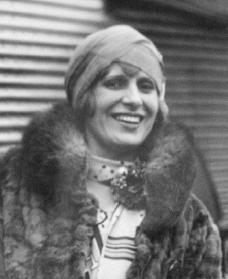
Back before Jimmy Swaggart and Jim and Tammy Faye Bakker brought their scandals to the religious world, there was Aimee Semple McPherson.
After spending years as an itinerant Pentecostal minister in the early 1920s, Aimee pulled into Los Angeles with her mother and two small children in tow. Her husband, Harold McPherson, had filed for a separation in 1918 and was granted a divorce in 1921 on the grounds of abandonment. She was a woman called on a mission and she couldn't let something like a reluctant husband slow her down.
Within five years, her ministry had grown from going from town to town in her "Gospel Car"--a 1912 Packard decorated with religious sayings painted on the sides--to a multi-million dollar business. Starting off by giving sermons wherever she could find crowds, including boxing rings before and after matches, she raised enough money to fund the Angelus Temple for her church, The International Institute of Four Square Evangelism. The temple cost $1.5 million and included a $75,000 radio studio, seats for over 5,000 people, a nursery, a lonely hearts club, and a miracle room for the discarded wheelchairs and crutches of those followers who were healed of their earthly afflictions. Aimee had a good thing going.
In 1926, the world was shocked by the disappearance of Mrs. McPherson. Aimee had gone for a dip in the ocean. The last her secretary had seen of her before heading out on an errand, Aimee had been joyfully frolicking in the waves. When the secretary returned, Aimee Semple McPherson had disappeared. The faithful gathered to pray for her deliverance while others, spurred on either by evangelical zeal or the $25,000 reward for her recovery, diligently searched the area for their missing leader. In the resulting clamor, one man drowned, one died of exposure, and a young girl killed herself, distraught at the loss of her idol.
Finally admitting to the loss, a memorial service was held. Shortly after the service, Aimee's mother received a ransom note, asking for half a million dollars for the release of the evangelist. Believing her daughter to be dead and the note a fraud, she threw it away.
On June 23, 1926, thirty-five days after her disappearance, Aimee Semple McPherson stumbled out of the desert and into a small Mexican town just south of the Arizona border. She'd been held hostage, she claimed, trapped, drugged and tortured in a small desert shack. She'd only escaped after making her way thirteen hours through the desert to civilization. The world rejoiced.
But...(you just knew there was going to be a 'but,' didn't you?) Aimee's story had more loopholes than an afghan made by your far-sighted great-aunt Millie. Though she supposedly made her way thirteen hours across the desert, her shoes weren't worn and had grass stains on the sides. Grass stains in the desert? The shack she described could never be found, and even though she had disappeared while swimming, she returned fully dressed and wearing a watch given to her by her mother, which she'd not had with her when she'd gone to the beach. Aimee's house of cards was beginning to topple, but it wasn't over yet.
Coinciding with Aimee's disappearance was another missing person. Kenneth Ormiston, a married radio operator for the Four Square Church with whom Aimee had developed a close friendship, had also gone missing. After tracing his whereabouts, the District Attorney found that Ormiston, along with a female companion matching Sister Aimee's description, had been visiting various hotels and beach resorts all along the West Coast. Handwriting analysis matched some of the entries in the hotel registers with Mrs. McPherson's own penmanship.
Oops.
An investigation ensued and though the prosecution could find no clear-cut proof that Sister Aimee had committed fraud or obstruction of justice, there was also no proof she'd been kidnapped, either. The DA produced an array of witnesses, hotel chambermaids, bellhops, etc., who could identify the amorous couple, but then he mysteriously moved for an acquittal without any explanation. So, Sister Aimee got off scott free...or did she?
After the scandal, she went back to proselytizing, but things just weren't the same. She was no longer a media darling and people no longer blindly followed her lead. Her subsequent marriage in 1931 to a musician and actor further riled up her congregation, as it was, against one of the tenants of The Four Square church which stated that a person could not remarry while a previous spouse was still alive--Harold McPherson was still around and kicking, though he'd had no part in Aimee's life for years. She and her latest husband were eventually divorced in 1934. Aimee and Harold's son, Rolf, took over the running of the church, though Aimee was still around to give her standby sermon, "Story of my Life".
In September of 1944, Rolf went to Aimee's hotel room to pick her up for a scheduled preaching session and he found her dead in her room, an open bottle of pills next to her. Aimee's death was not believed to be a suicide, despite how it looked. The barbiturate that was found in her room was commonly found to cause a hypnotic effect that could easily lead up to accidental overdose.
So now you know the story of Sister Aimee. Isn't it interesting to know that in a decade known for its wild abandonment, even the religious leaders of the 1920's weren't immune to its lure?
"No pen could describe it, nor tongue express it, nor thought conceive it unless by one in the extremity of it." -- Daniel Defoe
The southern part of Britain was devastated by the most catastrophic storm it had experienced in five hundred years on November 26–27, 1703. Believed to be a revitalized Atlantic hurricane, the storm began as a series of gales earlier in November, and brought with it a prolonged period of unseasonably warm weather and high seas.
A warm front from the hurricane moved from the West Indies, traveled along the coast of Florida, and swept into the Atlantic prior to reaching England. The warm front collided with cold air, creating wind speeds estimated at over 120 miles per hour, and establishing conditions for a tempest that would peak during a six- to eight-hour period beginning at midnight on November 26. Although very little rain was reported, strong winds and a North Sea surge elevated tides by nearly eight feet, causing severe flooding.
There was significant loss of life. On land in England and Wales alone, collapsing roofs and chimneys killed more than one hundred and twenty people, and injured more than two hundred. Eighty more were drowned in marshland cottages surrounding the Severn Estuary.
Those at sea during the storm fared even worse. It is estimated that between eight and fifteen thousand people lost their lives along the coast and in over one hundred reported shipwrecks at sea.
Britain was at war and three fleets were assembled to aid the King of Spain against the French. By dawn, the majority of the vessels were destroyed, and fifteen hundred seamen had lost their lives. Twelve warships with thirteen hundred men were lost while still within sight of land. On the Thames, hundreds of ships were driven into each other in the Pool, the section downstream from London Bridge.
The Eddystone Lighthouse, in the direct path of the storm when the hurricane was at its most powerful, was destroyed. Its designer and builder, Henry Winstanley, was working on the structure at the time, and he was swept away with his creation.
No segment of the population was untouched. It was reported that Queen Anne stood at a window and watched as the trees in St. James's Park were violently uprooted by the force of the wind. She was forced to take refuge in a cellar when falling chimney stacks and a partial roof collapse damaged St. James Palace. The bodies of the bishop of Bath and Wells and his sister were discovered amid the ruins of their palace.
Property losses estimated at £6 million exceeded the £4 million loss suffered as a result of the Great Fire of London in 1666. In and around London alone, two thousand chimney stacks were blown down, and over a hundred church steeples in the capital were damaged. The heavy lead lining on the roof of Westminster Abbey was lifted and tossed some distance from the building.
All over southern England, streets were covered with tiles and slates. Rural village causeways and paved London roads alike were buried in slates and tiles from demolished buildings; even on hard ground they amassed to a depth of as much as eight inches. More than eight hundred houses were blown away or destroyed by the collapse of a central chimney stack. The majority of the houses left standing were partly or completely stripped of roof tiles.
Windmills, common structures at the time, were particularly vulnerable. More than four hundred windmills were destroyed. Many burned to the ground after their cloth sails rotated at such speed that friction led to fire. Millions of trees were uprooted or damaged. In the county of Kent, over a thousand barns and outhouses were destroyed. There were reports of men and animals being lifted into the air by the force of the wind. Tens of thousands of sheep and cattle were lost.
Restoration would prove to be slow and costly. The day following the storm, in one of the first recorded instances of price gouging, the price of tiles jumped from twenty-one shillings per thousand to one hundred and twenty shillings per thousand. English merchants were hard-pressed to keep a ready supply on hand; many had suffered the loss of company ships whose cargo holds had been burgeoning with goods.
The storm would remain in the collective consciousness of the British people as "The Great Storm" for many years to come.
In Georgian England, for a man about town to enlist the services of a prostitute was an accepted part of life. London in1797 contained a total of 50,000 'Ladies of the Night,' which was around one in ten of the total female population. Covent Garden theatres were built with 'retiring rooms' connected to the boxes in order for the entertainment of clients while they enjoyed an evening out at the theatre. Even the vocabulary used to describe them was colourful.
-- Prostitutes who waited outside theatres for the plays to finish were called 'spells.' -- Lower class streetwalkers were 'flash mollishers.' -- Covent Garden Ague was a term for venereal disease. -- Covent Garden Nun was another name for a prostitute. -- Covent Garden Abbess was a bawd (madam) most of whom started out as whores themselves.
Between the years of 1757 and 1795, a publication was produced each Christmas entitled Harris's List of Covent Garden Ladies. This book was handwritten to begin with, but soon went into print and sold a quarter of a million copies during the thirty eight years it was produced. The List, priced at two shillings and sixpence, was a catalogue of around eighty up-market prostitutes. It included biographical details of each lady, together with a description of her appearance, personality and her sexual specialties, together with their charges.
The name "Harris' referred to a Jack Harris, the head waiter at the Shakespeare's Head, a Covent Garden tavern frequented by sea captains and the directors of the East India Company. Harris christened himself the "Pimp General of All England," but in 1757, he was in Newgate prison for debt. He gave an impoverished, heavy drinking Irish poet by the name of Samuel Derrick, permission to use his name for the book.
A 'common whore' could be purchased in London for a shilling, perhaps two or three shillings to enjoy her company in a bedroom in a local tavern or lodging house. The average wage at the time was around a pound a week, and two pounds was a fairly large sum of money. With some of the ladies on Harris's Lists charging a guinea a time, the lists represented the top end of the market.
An account of one young woman from the 1773 edition reads:
Miss M__tague is a well-shaped girl, about twenty-three, good-natured and said to be thoroughly experienced in the whole art and mysterie of Venus's tactics and as soon reduce a perpendicular to less than the curve of a parabola. She is rather generous and you may sometimes find your way in there free of expence.
From the 1780 edition, the entry for a Miss B____rn. of No. l8 Old Compton Street, Soho:
This accomplished nymph has just attained her eighteenth year, and fraught with every perfection, enters a volunteer in the field of Venus. She plays on the pianofort, sings, dances, and is mistress of every Maneuver in the amorous contest that can enhance the coming pleasure; is of the middle stature, fine auburn hair, dark eyes and very inviting countenance, which ever seems to beam delight and love. In bed she is all the heart can wish, or eyes admires every limb is symmetry, every action under cover truly amorous; her price two pounds.
The list also alerted its readers to those women who were best avoided, a Pol Forestor was reported as having "breath worse than a Welch bagpipe" and warned against the "contaminated carcase" of a certain Miss Young from the Turk's Head Bagnio. And warning them off Miss Robinson, at the Jelly Shops, "a slim and genteel made girl--but rather too flat."
A review of one resident of Drury Lane reads, "Very impudent and very ugly; chiefly a dealer with old fellows. It is reported that she uses more birch rods in a week than Westminster school in a twelvemonth."
And another:
Known in this quarter for her immense sized breasts, which she alternately makes use of with the rest of her parts, to indulge those who are particularly fond of a certain amusement. She is what you may call, at all; backwards and forwards, all are equal to her, posteriors not excepted, nay indeed, by her own account she has most pleasure in the latter. Very fit for a foreign Macaroni - entrance at the front door tolerably reasonable, but nothing less than two pound for the back way.
A Mrs. Crosby of 24 George Street, for example, "being particularly attached to the sons of Neptune," (sailors) had married an elderly sea captain. When he died he left her a small annuity. This was enough to keep her off the streets, but not enough to live on--so she worked as a part-time prostitute. Harris's List says, "Mrs. Crosby could be contacted at home during the day or in the theatre at night. She has dark hair flowing in ringlets down her back, languishing grey eyes and a tolerable complexion." She charged one guinea (£1.05).
Of a Mrs. Grafton of Wapping, her "...best customers are sea officers, who she particularly liked, as they do not stay long at home, and always return fraught with love and presents." At 40 years old, the lady "...could give more pleasure than a dozen girls half her age. Her price was 5 shillings (25p). Most naval officers could afford that, as a day's pay for most captains in this period was about 20 shillings (£1.00).
Harris often used nautical terminology when describing the charms of the women. Miss Devonshire of Queen Ann Street had "...fair complexion, cerulean eyes and fine teeth," and "...many a man of war hath been her willing prisoner, and paid a proper ransom…she is so brave, that she is ever ready for an engagement, cares not how soon she comes to close quarters, and loves to fight yard arm and yard arm, and be briskly boarded."
The mood turned against such 'immorality' when a Mr. Aitken was convicted at the Kings Bench for the offence of publishing Harris's List in November 1795, which hereafter went out of print.
A copy of the 1790 edition was sold for £5,170 at auction in March 2008.
Contact Beth to give her your address. The book must be claimed by next Sunday or another winner will be drawn. Please stop back later to let us know what you thought! Congratulations!
This week on unusual historicals, we're featuring Resplendence author Minnette Meador and her roman-set romance, THE CENTURION AND THE QUEEN. Here's the blurb:
Marius has been stationed on the island of 60AD Britannia for sixteen years, since his demotion from the famous Praetorian Guard after his suspected involvement in the assassination of Caligula. When Delia enters his life, she challenges everything he believes, effortlessly strips away years of Roman conditioning, and angers him to the point of betraying his training, and his oaths. He simply cannot resist her.
Delia is sister to an indolent Celtic king, but that role has turned to nothing more than another surrender. All she can do now is help her people survive the gradual conquest by Rome and their suicidal pride as so many throw themselves against the unstoppable Roman machine. The last thing she expected was to find herself craving the touch of an enemy.
***
The trunk lid cracked opened a half hour later, two eyes peered from the minuscule opening. Delia was grateful the hinges did not squeak when she lifted it the rest of the way.
She carefully extracted herself from the cramped space, careful not to make a sound. It took her several minutes to get the feeling back into her legs and arms. She studied the slit she had cut into the leather tent wall with the sharp Roman knife. It was barely discernible.
While Delia huddled, she watched the shadow rise and fall from the high bed. She could barely make out his rugged face, the ruffled mane of salt and pepper hair in what little light spilled from the entrance.
The wait and the cool air had taken the edge off her resolve, but her head was still spiraling with feelings her rationale was having a hard time grappling with. She did not even consider being caught; the madness making her fearless.
The unreasoning fury that dominated every sense was mysterious and frightening. It had become almost an entity in itself, fueled by crushed desires, fear, and exhaustion. The delirium seemed to consume every thought, every feeling, every emotion until it left her empty inside. It had not grown from the confusion that left her sick and disoriented; it was not from the thrill, the longing, the fear—the contempt that this man had touched her. It was not even from the disgust that a Roman had tried to violate her, not once, but twice in as many days. None of those things mattered. Delia rose and crossed in a daze to the bed, lifting the knife to grimace at it, as if the dagger were a friend and yet a stranger. The dichotomy sent her head spinning.
The fury inside her came from knowing that she loved him, had completely surrendered her life to his touch, and would do so again—in a pounding heartbeat. That was what she could not forgive. That was what her enraged mind clung to when she raised the knife, and saw not only Marius' face, but that of her brother, both of them intertwined in the Gods' sick, twisted joke. They were the same...were they not?
Marius had to die. It was the only way to justify what she had done...what she had allowed.
As the rage took over her mind, Delia's felt her face tilt a little to the right and she lifted the long dagger above her head. Whether she meant it to or not, a small moan escaped her lips and she brought the knife down.
***
PUBLISHERS WEEKLY: "I was engrossed by The Centurion and the Queen, and didn't put it down."
SIMPLY ROMANCE REVIEW: "Historical novels especially historical Romance tend to fall within fairly set parameters and usually tend to be a bit cliché this story breaks out of those parameters and destroys the clichés with a truly refreshing story of love in ancient Britannia."
NIGHTOWL ROMANCE: "I encourage you to try out Minnette's work and see how enmeshed you will become in her wonderful settings. ...this book pulled me in and I read it in two sittings..."
LONG & SHORT REVIEW's Book of the Week: "It's a fast-mover, one gripping scene after the next, with a powerful love story plaited throughout. In the last part of the book, Delia's people face off with Marius's Romans in a battle that will resonate throughout history. Some books keep you turning pages until the end then leaves you cold on the last page. Not this one. The end was so satisfying that it justified the entire exciting story. Now I want to go out and buy the paperback version. I highly recommend this memorable tale."
***
If you'd like to have a shot at winning a free copy of THE CENTURION AND THE QUEEN, leave a question or comment for Minnette! We'll draw a winner next Sunday. Good luck!
We'll also draw the winner of Beth Williamson's THE REDEMPTION OF MICAH. There's still time to leave a comment for your shot at winning!
***
Have a great week, and I hope everyone has safe travels to Nationals! There will be no announcements and no guest author next weekend, but we'll be back on schedule with Meredith Duran on July 26!
In the meantime, if you have an announcement to make for next week, email Carrie. See you next week...