31 August 2010

Tragic Tales: The Elephant Man

By Jennifer Linforth

As soon as I type his name readers will know the tragedy of this man. An image will pop into their heads and they will nod, but it was not his outward appearance that made him a tragic tale of the 19th Century, but the brilliant mind the world would never embrace.

Joseph Carey Merrick, the "Elephant Man."

As a child, Mr. Merrick's story was the first that fascinated me. Like all children I was drawn to the difference setting him apart. As I grew older I understood more about him and he was far more than a deformity and medical marvel.

He was a quiet, brilliant man--though many assumed otherwise.

His doctor, Frederick Treves, first met Merrick at a freak show. His descriptions of what he saw of Merrick are horrifying and fascinating. (This I had a particular interest in, for it is said Gaston Leroux may have been influenced by Merrick's sideshow years when he crafted The Phantom of the Opera.) But the tragedy lies here in what Treves writes of the man behind the monster:
I supposed that Merrick was an imbecile and he had been an imbecile from birth. The fact that his face was incapable of expression, that his speech was a mere spluttering, and his attitude that of one whose mind was void of all emotions and concerns gave ground for this belief.

From: The Joseph Carey Merrick Tribute Website
This is an easy thing to assume for times have not changed. The world is still judged by outward appearance (Does anyone recall Susan Boyle and the audience reaction when she first walked on stage and spoke?) Furthermore Treves shows us this:
It was not until I came to know that Merrick was highly intelligent, that he possessed an acute sensibility and--worse than all--a romantic imagination that I realized the overwhelming tragedy of his life.

From: The Joseph Carey Merrick Tribute Website
That part of Merrick's life echoed with me again while writing The Madrigals, for Gaston Leroux wrote of Erik, the horribly deformed but genius Phantom, "...all he wanted was to be loved for himself."

For a topic on tragic tales I could have gone into Merrick's life, what he looked like and how he lived. Most of the world knows this. Instead I went with how he made me feel. His story is just a brilliant tale--the tragedy lies in the assumptions left in its wake.

30 August 2010

Tragic Tales: Lady Jane Grey

By Lisa Marie Wilkinson

English history is filled with tragic tales of political pawns and religious martyrs. The markers along the path of the bloody Tudor dynasty include individuals like Anne Boleyn, whose ambition to become Queen of England proved to be the instrument of her own destruction, and Lady Jane Grey, who succumbed to the executioner’s axe after being pressured to accept a crown she did not covet.

The daughter of Henry Grey, the Duke of Suffolk, and Lady Frances Brandon, Jane was the grand niece of Henry VIII of England and cousin to the ill-fated young King Edward VI, son of Henry and Jane Seymour.

Jane was an unassuming young woman who excelled at her studies and aspired to please her demanding parents. Subject to treatment by Lady Frances that would be condemned as abuse by modern standards, Jane once told a visitor:

"For when I am in the presence of either Father or Mother, whether I speak, keep silence, sit, stand or go, eat, drink, be merry or sad, be sewing, playing, dancing, or doing anything else, I must do it as it were in such weight, measure and number, even so perfectly as God made the world; or else I am so sharply taunted, so cruelly threatened, yes presently sometimes with pinches, nips and bobs and other ways...that I think myself in hell."

Jane's father sought the most politically advantageous marriage possible for his daughter and eventually settled upon Lord Guildford Dudley, whose father--the Duke of Northumberland--was considered the most powerful man in England, as Jane's prospective husband. Jane balked at the arrangement, but married Dudley at the insistence of her parents on May 21, 1553.

When King Edward VI lay dying, Northumberland persuaded the doomed young monarch to set aside his half sisters Mary and Elizabeth in favor of Jane Grey because Jane was a devout Protestant. Without Northumberland's interference, the crown would have passed to Mary, the Catholic elder daughter of Henry VIII upon Edward's death. Instead, in a will drawn upon his deathbed and in his "Device of the Succession," Edward effectively left the throne to his cousin, Lady Jane Grey, who, like Edward, was a staunch Protestant.

After months of illness, changes in Edward's condition had been closely monitored and reported. In anticipation of Edward’s death, Mary decided to relocate to Kenninghall in Norfolk, where she would be surrounded by supporters.

Edward died at age 15 on July 6, 1553. Northumberland had to act quickly before all England learned of Edward's death if he was to become the father-in-law of the Queen of England. Not the least of his tasks was convincing a reluctant Jane to accept the crown. Jane had fainted upon hearing the news that Edward had died and named her as his successor.

Northumberland sent soldiers to capture Mary as she fled north, but his attempt to prevent Mary from reaching her Catholic supporters was unsuccessful. Mary reached Kenninghall on July 9th, where she confirmed her brother’s death, gathered her followers around her and promptly declared herself Queen of England.

Northumberland had Lady Jane Grey proclaimed Queen of England and Ireland after she was sequestered in the Tower of London as was customary for monarchs awaiting coronation. Jane marched in a coronation procession through the streets of London on July 10, 1553.

Unfortunately for Jane, when Mary raised her standard as queen, she had the support of 15,000 men. As the eldest daughter of Henry VIII, her countrymen felt Mary had a valid claim to the throne, and the people soon began to rally around her, buoyed by her promise to make no changes to the religious structure of England, a falsehood which earned her Protestant as well as Catholic supporters.

When Mary demanded that Jane renounce her title, Jane willingly did as requested, explaining that she had only accepted the title out of respect for her parents and her father-in-law, who had pressured her to accept the role. Mary was proclaimed the Queen of England on July 19th amid great celebration, while Jane and her husband were imprisoned in the Tower of London. Jane's rule of England--nine days--was the shortest in England's history.

The Duke of Northumberland was executed on August 22, 1553 for treason, and the following month, Parliament named Mary the rightful queen and declared Jane a usurper.

Jane and Guildford Dudley were tried on charges of high treason on November 13, 1553 and sentenced to death. It is widely believed that Mary intended to spare Jane's life, but when Jane's father participated in Wyatt's Rebellion in February of 1554--a revolt against the rule of Queen Mary--he sealed his daughter’s fate. Wyatt's Rebellion was a popular rebellion protesting Mary's planned marriage to Prince Philip of Spain.

Facing pressure from the Spanish court to put an end to the unrest by removing the Protestant threat, Mary signed the orders for execution and both Jane and Dudley were beheaded on February 12, 1554. Dudley was executed first in a public event at Tower Hill, and then Jane was taken out to Tower Green inside the Tower of London and beheaded in private. Private executions were usually reserved for members of royalty, therefore Mary's order for a private execution was viewed as a sign of respect for her cousin. Jane was just 16.

Lady Jane Grey and Guildford Dudley are buried in the Chapel of St Peter ad Vincula, the parish church of the Tower of London.

CAPTIVE SPIRIT Winner!

We have a winner for Liz Fichera's CAPTIVE SPIRIT guest blog. A free copy of goes to:

MARIA ZANNINI!

Contact Carrie to provide your mailing address. The book must be claimed by next Sunday or another winner will be drawn. Please stop back later to let us know what you thought! Congratulations!

29 August 2010

Guest Author: Susanna Fraser

This week on Unusual Historicals we're welcoming Carina Press author Susanna Fraser as she celebrates the release of her debut, THE SERGEANT'S LADY, set in Spain and France during the Napoleonic Wars.

Highborn Anna Arrington has been following the drum, obeying the wishes of her cold, controlling cavalry officer husband. When he dies, all she wants is to leave life with Wellington's army in Spain behind her and go home to her family's castle in Scotland.

Sergeant Will Atkins ran away from home to join the army in a fit of boyish enthusiasm. He is a natural born soldier, popular with officers and men alike, uncommonly brave and chivalrous, and educated and well-read despite his common birth.

As Anna journeys home with a convoy of wounded soldiers, she forms an unlikely friendship with Will. When the convoy is ambushed and their fellow soldiers captured, they become fugitives together. The attraction between them is strong, but even if they can escape the threat of death at the hands of the French, is love strong enough to bridge the gap between a viscount's daughter and an innkeeper's son?
***

Why does THE SERGEANT'S LADY qualify as an unusual historical?

THE SERGEANT'S LADY is Regency in that it's set in 1811-12 with a British hero and heroine--but with a big twist. Most of the story takes place not in London or the English countryside, but in Spain with Wellington's army, and the hero is not an aristocrat but a common sergeant.

Tell us more about your hero and heroine.

Anna, my heroine, is a survivor. Being an aristocratic heiress couldn't protect her from an abusive husband, so when we meet her she's just endured two years of hell. After her husband dies, she has to choose between a safe, conventional life and embracing risk and adventure.

My hero, Will, on the other hand, has led a happy life despite the challenges of being in a profession where enemy soldiers regularly try to kill him! He's good at what he does and has never regretted running away from home at sixteen to join the army. But meeting Anna calls him to challenge the limitations placed on him by his common birth.

What kind of research did you do for this book?

I read everything I could get my hands on about the Peninsular War in general and specifically about the 1811 and 1812 campaigns that form the backdrop of my book. I also did a very little bit of hands-on research--I wish I could've done far more--by spending an afternoon at a Revolutionary War reenactment. Military technology barely changed between the Revolutionary and Napoleonic Wars, so talking to reenactors and handling some of their equipment was a wonderful way to learn not just the specs and tactical usefulness of a muzzle-loading single shot flintlock rifle, but what it feels like in your hands and the sulfur-scented smoke that hangs in the air after it's fired.

Incidentally, it's fun being a woman who knows a lot about military history and technology. Men just don't expect you to be able to explain the changes in ballistics technology between the Napoleonic and Civil Wars and what they meant for battlefield tactics, nor to be able to put together a diagram of the Battle of Waterloo at the dinner table ("Your beer will be Hougoumont; my wine glass is La Haye Sainte, and the pepper shaker will represent the Prussian advance..."). Their jaws drop, they stare at your chest, they stare at you...it's the closest I've ever experienced to that awesome scene in Firefly where Kaylee is talking engines to a rapt audience of posh young men at a ball.

Really, if you're at all interested in any traditionally masculine subject, I recommend learning as much as possible about it. It's so fun to shock the guys with your expertise.

What's next for you, and do you see yourself writing outside the Regency/Napoleonic era in the future?

Carina will also be publishing my prequel to THE SERGEANT'S LADY. I don't have a definite release date yet, but it will most likely be Spring 2011, and my current title is A MARRIAGE OF INCONVENIENCE. It's more of a traditional Regency story, with Anna's viscount brother as the hero and a house party as the setting.

I'm working on a shipwreck novella with an English heroine and a French hero, and after that I'm tentatively planning to stay in the Napoleonic Era, but try my hand at historical fantasy. I definitely want to write 5th century BCE Greece one of these days, focusing on the Athenians and Salamis instead of the Spartans at Thermopylae. And I'm also interested in the American colonial era and Revolution, so who knows where my muse will take me?

How can readers get in touch with you?

I have a blog I'd love for you to visit. Also, I'm occasionally on Twitter and more frequently on Facebook.

About Susanna:

Susanna Fraser wrote her first novel in fourth grade. It starred a family of talking horses who ruled a magical land. In high school she started, but never finished, a succession of tales of girls who were just like her, only with long, naturally curly and often unusually colored hair, who, perhaps because of the hair, had much greater success with boys than she ever did.

Along the way she read her hometown library's entire collection of Regency romance, fell in love with the works of Jane Austen, and discovered in Patrick O'Brian's and Bernard Cornwell's novels another side of the opening decades of the 19th century. When she started to write again as an adult, she knew exactly where she wanted to set her books. Her writing has come a long way from her youthful efforts, but she still gives her heroines great hair.

Susanna lives in the Pacific Northwest with her husband and daughter. When not writing or reading, she goes to baseball games, sings alto in a local choir and watches cooking competition shows.

***

Readers, Susanna will be giving one lucky commenter a $10 gift card to the recipient's choice of Amazon.com, Barnes & Noble, or Books on Board. Just leave a comment or question for your chance to win. I'll draw a winner at random next Sunday. Void where prohibited. Best of luck! And thanks again to Susanna for stopping by!

27 August 2010

Weekly Announcements - 27 Aug 2010

Over the next few weeks we'll be undergoing some changes to our line-up here at Unusual Historicals. This week I'd like everyone to welcome Stephanie Dray, who writes historical fiction with romantic and mystical elements set in the ancient world. Her debut, LILY OF THE NILE, is set in 30BC in Egypt and Rome, and will be available from Berkley in January 2011.
With her parents dead, the daughter of Cleopatra and Mark Antony is left at the mercy of her Roman captors. Heir to one empire and prisoner of another, it falls to Princess Selene to save her brothers and reclaim what is rightfully hers...

In the aftermath of Alexandria's tragic fall, Princess Selene is taken from Egypt, the only home she's ever known. Along with her two surviving brothers, she's put on display as a war trophy in Rome. Selene's captors mock her royalty and drag her through the streets in chains, but on the brink of death, the children are spared as a favor to the emperor's sister, who takes them to live as hostages in the so-called lamentable embassy of royal orphans...

Now trapped in a Roman court of intrigue that reviles her heritage and suspects her faith, Selene can't hide the hieroglyphics that carve themselves into her flesh. Nor can she stop the emperor from using her for his own political ends. But faced with a new and ruthless Caesar who is obsessed with having a Cleopatra of his very own, Selene is determined honor her mother's lost legacy. The magic of Egypt and Isis remain within her. But can she succeed where her mother failed? And what will it cost her in a political game where the only rule is win or die?
And here's a little more about Stephanie, who also writes as Stephanie Draven for Silhouette Nocturne:
Stephanie graduated from Smith, a small women's college in Massachusetts where--to the consternation of her devoted professors--she was unable to master Latin. However, her concentration in Middle Eastern Studies gave her a deeper understanding of the consequences of Egypt's ancient clash with Rome, both in terms of the still-extant tensions between East and West as well as the worldwide decline of female-oriented religion.

Using the transformative power of magic realism, Stephanie illuminates the stories of women in history so as to inspire the young women of today. She remains fascinated by all things Egyptian and has--to the consternation of her devoted husband--collected a house full of cats and ancient artifacts.
***

Join us Sunday when Carina Press author Susanna Fraser will be here to chat about her debut, THE SERGEANT'S LADY, set in France and Spain during the Napoleonic Wars. She'll also be giving away a digital copy to one lucky commenter! Be sure to join us then.

***

We'll also draw the winner of Liz Fichera's CAPTIVE SPIRIT guest appearance on Sunday. You still have time to leave a comment or question for your chance to win.

***

Stay with us through the coming weeks when we'll be featuring the best unusual historical authors! Jeannie Lin, Lila DiPasqua, Christina Phillips, and Sarah Parr will be our guests. Join us!

***

Have a good weekend! Remember, you don't have to be an Unusual Historicals contributor to submit good news to the weekend announcements. If it has to do with unusual historicals, we'd love to shout it out to the world! Send announcements to Carrie. See you next week...

26 August 2010

Excerpt Thursday: Susanna Fraser

This week on Excerpt Thursday we're welcoming Carina Press author Susanna Fraser as she celebrates the release of her debut, THE SERGEANT'S LADY, set in Spain and France during the Napoleonic Wars. Join us Sunday when Susanna will be here to answer questions and award one lucky commenter a free copy.

Highborn Anna Arrington has been following the drum, obeying the wishes of her cold, controlling cavalry officer husband. When he dies, all she wants is to leave life with Wellington's army in Spain behind her and go home to her family's castle in Scotland.

Sergeant Will Atkins ran away from home to join the army in a fit of boyish enthusiasm. He is a natural born soldier, popular with officers and men alike, uncommonly brave and chivalrous, and educated and well-read despite his common birth.

As Anna journeys home with a convoy of wounded soldiers, she forms an unlikely friendship with Will. When the convoy is ambushed and their fellow soldiers captured, they become fugitives together. The attraction between them is strong, but even if they can escape the threat of death at the hands of the French, is love strong enough to bridge the gap between a viscount's daughter and an innkeeper's son?
***

With Wellington's Army in Spain, June 1811

"Aiee! Madre de Dios, it hurts!"

Will knelt on a coarse wool blanket beside his best friend's woman, gripping her hands. "Not much longer, Juana," he murmured. "Everything is going well."

He hoped he spoke the truth, but he didn't rightly know. His boyhood experience with lambing on his brother-in-law's farm hardly made him a midwife. He was a Rifle sergeant, an eleven-year veteran who had known no life but a soldier's since he was sixteen. He'd been trained to usher men out of the world, not babies into it.

Juana's birth pang ended, and she released his hands. Will flexed his fingers to get the blood flowing again. Her grip had turned so fierce he wondered if he'd be able to manage his rifle the next day.

Somewhere nearby there had to be better help for a laboring woman. He could still hear tramping feet and creaking oxcart wheels on the road, just a few yards away from the grove of cork trees where they had sought shelter when Juana's pains grew too strong for her to continue on the march. Their own regiment marched far ahead with the vanguard, but the main body of the army hadn't yet passed them by.

He allowed himself a brief daydream of seeking out Lord Wellington to tell the general exactly what he thought of him for ordering a march today of all brutally hot days. It wasn't as if they were going to or from battle. They hadn't seen action in weeks, and if camp gossip was to be believed, that was unlikely to change soon. Today they marched to improve their position relative to the French, many miles distant, or maybe simply to avoid exhausting the countryside's food and water and the goodwill of their Spanish hosts. They could just as well have waited a few days in hopes of the heat breaking, and Juana could've given birth in a settled camp.

Will shook off his insubordinate fancies and turned his mind to reality. He fixed the third occupant of the grove with a glare that would've made any private leap to obey. "Damn it, Dan, you must go for help."

Dan, however, was no private. He was the other sergeant of Will's company--not to mention Juana's lover and the father of her child.

"No," he said. "I'm not leaving her. Not this time." His jaw was set, his eyes haunted.

Will shook his head. Two years before, Dan had lost his wife in childbirth after being forced to leave her behind on the retreat to Corunna, so he had made up his mind that he could keep Juana safe by keeping her in sight. But he was useless, pacing the edge of the grove in a nervous panic. He could not take Will's place, freeing him to seek help, so somehow they had to manage. But Juana needed more. She needed a woman.

All of them tensed as a rustling in the grove heralded the approach of an animal, then relaxed as the intruder came into sight. As if in answer to Will's prayers, a beautiful woman rode toward them on a donkey, trailed by a local girl on foot. He could have kissed her. Granted, she wasn't quite what he'd had in mind. He would've preferred a stout matron who'd borne half a dozen children and attended the births of ten times that number. In short, his mother.

This one was too young--younger than he was, probably not yet five-and-twenty. She was also too much of a lady. With her servant, donkey, and fine dress and bonnet, she was unmistakably an officer's wife. Her Spanish maid was still in her teens, and she was trying to hide behind the donkey. But at least they were female.

The beauty took in their situation at a glance--a dismayed glance, Will thought--and slid down from her mount's back.

She met Will's eyes. "I heard a scream, just now. May I offer any assistance..." Her voice trailed off as her gaze darted to the neat stack of gear at one corner of the blanket. "...Sergeant?"

His uniform jacket, with its sergeant's stripes, lay atop his gear. He felt a moment's embarrassment at being caught in a state of undress by such an elegant lady. But if she'd been following the drum for any time at all, this couldn't be the first time she'd seen a strange man in his shirtsleeves.

"Thank you, ma'am," he said fervently. "Anything you can do, we'd be grateful for."

25 August 2010

Tragic Tales: Chinese Slave Girls of the Barbary Coast

By Jacquie Rogers

The California gold rush of 1849 brought men from all over the world, including China, to find their fortune. The next gold rush was of a different nature--those who provided services to the miners...for a pinch or two of gold dust.

Barbary Coast was the section of San Francisco that harbored the red light district. It was rife with gambling, prostitution, pickpockets, and violent crime. The streets were crowded with brothels, gambling houses, saloons--this was where the rowdiest of the rowdy men went to kick up their heels. The Barbary Coast was also home to the cribs--low-class prostitution housing--and small Chinese girls pleading for the men walking by to use her services.

In China girls weren't valued, and many girls, even babies, were sold to "entrepreneurs" who took them to America to be used as sex slaves. In San Francisco, girls were bought and sold--a baby sold for a little over $100. These girls were raised to prostitute themselves.

This is from The Virtual Museum of the City of San Francisco, quoted from A la California: Sketch of Life in the Golden State by Albert S. Evans:
These poor creatures are all slaves, bought with a price in China, and imported by degraded men of their own race, who, despite our laws, contrive to hold them to a life-long servitude, which is a thousand times more hopeless and terrible than the negro slavery of Louisiana or Cuba could ever be. They have been reared to a life of shame from infancy, and have not a single trace of the native modesty of women left. They are, as we have said, mere children in point of intellect, having no education whatever, and no experience of the world outside of the narrow alleys in which they have always lived, and the emigrant ship in which they were brought over to this country...

The girls cost $40 each in Canton, but are valued here at about $400, if passably good-looking, young and healthy, and readily sell at that figure in cash, or approved paper. Each colony of half a dozen girls is under the immediate control of an "old mother," herself a retired prostitute, who jealously watches over each, and receives from them the wages of their shame as fast as earned.
Officials looked the other way for two reasons. First, they were paid off by the Chinese merchants, and second, they didn't consider the Chinese all the way human. Chinese girls were no more significant, and less valuable, than a horse. Once a girl was sold into slavery, there was no help for her.

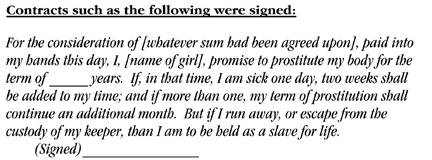
These girls were also called sing-song girls and worked in small rooms lining the cribs alleyways. The girls would bare their breasts to passers-by. If they didn't attract enough customers, they were often physically punished. During their periods, if they had any, they were considered sick and that missed time was added to her contract.

This is from http://www.foundsf.org/:

Opium was administered to them for every ailment, and many girls were addicted. Once a girl's looks had faded and/or her health deteriorated, usually before age 20, she was placed in a room with a vial of narcotics. She could either take the overdose, starve, or if she wasn't dead when they came for her corpse, she was murdered. These murders weren't reported or even noted by the authorities.

One white woman who didn't look the other way was Donaldine Cameron, the Angry Angel of Chinatown. She was born in New Zealand and came to California with her parents when she was a child. At 18 she was engaged, but no one seems to know why she never married. In 1895 she took a position as a sewing teacher at the Occidental Mission Home for Girls and became a crusader for these abused girls no one else cared about. Over a period of 40 years, she was instrumental in the rescue and education of over 3,000 Chinese girls. Miss Cameron used sledgehammers and axes to get to the girls, and learned early on to find more girls in hidden in walls and under the floor boards. Of course the slavers hated her, calling her Fahn Quai--white devil.

History books teach that slavery ended in the United States with the Civil War, but that wasn't so for the sing-song girls of the Barbary Coast, who, in many cases, worked in worse circumstances than the slaves of the South, with a far shorter life expectancy. Finally, 75 years after the Emancipation Proclamation, the Chinese slave trade ended. It's a blight on American history that we should never forget.

Jacquie

Down Home Ever Lovin' Mule Blues (See the Book Video featuring Justin Saragueta)
Jacquie's Website * 1st Turning Point * Myspace * Twitter * Facebook
Faery Special Romances (Book Video) * Royalties go to Children's Tumor Foundation, ending Neurofibromatosis through Research


Read a book by Jacquie Rogers

24 August 2010

THE SECRET OF GLASS Winner!

Yes, I remember eventually. Sorry!

We have a winner for Donna Russo Morin's THE SECRET OF GLASS guest blog. A free copy of goes to:

RACHEL E. MONIZ!

Contact Carrie to provide your mailing address. The book must be claimed by next Sunday or another winner will be drawn. Please stop back later to let us know what you thought! Congratulations!

Tragic Tales: How Poppaea Sabina Thought She'd Conquered the World

By Michelle Styles

Herein lies a tale of the perils of being a WAG in Rome.

In the early days of the Roman Empire, in 30 AD, a young woman named Poppaea Sabina grew up around the Pompeii area. The exact location of her family house has been lost but it is supposed to be the House of Menander. Her family had wealth and she had extreme beauty with flame-coloured hair and a winning manner. She had also inherited her father's drive. Some commentators like Josephus describe her as a deeply religious woman, possibly with Jewish sympathies. But others such as Tacitus describe her as the ultimate schemer.

Her father was an ambitious man from a humble background. According to Tacitus, her mother was one of the most beautiful women of her generation. In 47 her mother committed suicide, the innocent victim of the intrigues of the Empress Valeria Messalina. Her mother had been accused of having an adulterous relationship. It is not known how this affected the 17-year-old Poppaea Sabina, as she had been married to Rufrius Crispinus when she was 14.

Rufrius was a much older man of humble origin, possibly Egyptian, who had risen to become head of the praetorian guard under Claudius and was a great friend of the Empress Messalina. Poppaea bore him a son before they divorced. The reasons for the divorce are not known but Poppea was determined to succeed. For her next marriage, she married Otho, the boyhood friend of Nero. Seven years younger than Poppaea, Nero in the early years of his reign was considered to be a good emperor and indeed the hope of a new dawning of Roman brilliance.

There is speculation that she married Otho so that she could become close to Nero, as she was a girl with an eye on the main prize. Otho was bandy-legged and had a horror of hair on his body, but he was a close friend of Nero's. Other accounts state that Otho brought her to Nero's notice when he boasted of his wife's beauty. It doesn't matter how the affair started but it did. And it was an all-consuming affair. In 58 Poppaea became Nero's acknowledged mistress. Otho was divorced and sent away to govern Luisitania. Poppaea now had the world at her feet, but the position of a mistress is precariously and Poppaea wanted more. She wanted her younger lover to prove his devotion to her rather than to his mother. She encouraged him to think for himself and to live like an Emperor should do.

Nero's chief claim to the Roman throne was through his then-wife, Octavia, the daughter of the late Emperor Claudius. In 59, due to Poppea's urging, Nero divorced Octavia and broke with his mother Aggrippina. Some historians claim that Poppaea organised the murder so she could marry Nero and consolidate her own power. Others state there were political motives and Poppaea was an easy target.

Nero and Poppaea married and she became empress. Nero gave her the title of Augusta after their daughter was born. Not bad for a girl from Pompeii who didn't have any connections. Having achieved her ambition, Poppea set about spending the entire Roman treasury. What is the point of being Empress unless you can flaunt it? However, this tale does not have a Happily Ever After.

Her triumph did not last as Nero began to spiral into madness. She began to worry about losing her looks and having another take her place. She and Nero fought bitterly over many things, including the time he spent at the races away from her. Things came to a head in 65, when heavily pregnant, Poppaea began to scream at Nero. A knock-down drag-out fight occurred. He apparently kicked her in the stomach. Although some accounts state he repeatedly jumped on her stomach until she was dead, modern historians think she might have had a late miscarriage. Shortly afterward Nero had her son by Rufrius put to death.

After Poppaea's death, Nero descended into complete madness, including dressing up a male slave as Poppaea and pretending that she remained alive. Monteverdi later made the tale into the tragic opera Poppaea which scandalised Venetian opera goers in the early 17th century.
The tale of Poppaea does go to show that the Romans really did know how to do scandal well.

Michelle Styles writes in the Roman, Viking, Regency, and early Victorian era for Harlequin Historical. Long-ago gossip is one of the bonuses of doing research. You can read more about her books on her website.

23 August 2010

Tragic Tales: John of Eltham, Earl of Cornwall

By Blythe Gifford

This month's theme, Tragic Tales, summons visions of monumental disasters, but sometimes, history's tragedies whisper, rather than shout.

Such was the story of John of Eltham, brother of King Edward III of England. He was a man of great promise, who committed bad acts and achieved great victories, died unmarried at twenty, was slandered after, and has since been forgotten.

I discovered him in writing HIS BORDER BRIDE. Because I feature characters born on the wrong side of the royal blanket, I needed a plausible parent for my hero. In researching the war between England and Scotland in the early 14th century, I discovered that John played an instrumental military role in the conflict. In fact, he spent many months in Scotland, certainly long enough to father a son.

He was four years younger than his brother the king and born in the Castle of Eltham, hence his moniker. He was named Earl of Cornwall at the age of 12, the last son of a king to die an earl instead of a duke.

Caught in the throes of the war between his father, Edward II, and mother Isabella, his growing years were turbulent. He was passed between his parents and even held in the Tower of London for a time before his brother, at age 17, led a coup against their father and assumed the power that went with his kingly title of Edward III.

Information on John is scant, but what we do know suggests he was highly competent, and highly trusted by Edward.

He was named "Guardian of the Realm" when Edward III was out of the country; was asked to open Parliament in Edward's absence, and was named Warden of the northern Marches, which gave him virtual autonomy in that portion of England.

At 17 he was a key commander in the Battle of Halidon Hill, a devastating defeat for the Scots. Later he commanded an army in the southwest of Scotland that put down resistance to Edward Bailliol, the Scots king supported by his brother.

But all these "heroic" acts were recorded by historians on the southern side of the border. The Scottish saw him differently. So differently, in fact, that historian Tom Beaumont James writes that the tale of his death "challenges the distinction between history and story."
To the Scots he was a ruthless destroyer, who, among other crimes, burned the beautiful Lesmahagow Abbey when it was filled with people who had sought sanctuary from the wrath of the English troops. As Scottish chronicler tells it, this violation of the sacred laws of sanctuary so enraged King Edward that he killed his own brother in fury.

A tragic tale. One that my hero was told about his father. One that made him fear he had inherited the same bad blood.

One that, as near as we can now tell, was not true.

John did die, suddenly, at age 20, probably from a fever. Edward buried his brother with all honors in a beautiful tomb in Westminster Abbey and had masses said for his soul regularly, hardly the act of a man who had killed his brother.

And there was one other fact about John of Eltham, Earl of Cornwall, that peaked my romantic imagination. Half a dozen brides had been proposed for him, including daughters of the king of France and of the king of Castile and Leon, but he never married and died without "legitimate issue."

Ah! But what about illegitimate issue? History records none, so I was free to create one: a man who must face the terrible truth about his past and learn to make peace with it.

A small tragedy of history that I tried to make right.

22 August 2010

Guest Author: Liz Fichera

This week on Unusual Historicals we're welcoming Carina author Liz Fichera as she celebrates the release of CAPTIVE SPIRIT. It's different from many of the books profiled here in that the main characters are all Native American and it takes place around 1500AD in the Sonoran Desert of the American Southwest. Liz is giving away one free copy of CAPTIVE SPIRIT to a randomly selected person brave enough to leave a comment or ask a question!

Aiyana isn't like the other girls of the White Ant Clan. Instead of keeping house, she longs to compete on the Ball Court with her best friend Honovi and the other boys. Instead of marriage, she daydreams of traveling beyond the mountains that surround her small village. Only Honovi knows and shares her forbidden wish, though Aiyana doesn't realize her friend has a secret wish of his own...

When Aiyana's father arranges her marriage to a man she hardly knows, she takes the advice of a tribal elder: Run! In fleeing, she falls into the hands of Spanish raiders and finds herself being taken over the mountains against her will. Now Aiyana's on a quest to return to the very place she once dreamed of escaping. And she'll do whatever it takes to survive and find her way back to the people she loves.
***

"Readers will cheer for the intrepid Aiyana and brave Honovi as the teens fight for their chance at love despite the collapse of their world." ~ RT Book Reviews

"This isn't your traditional romance--it's much more!" ~ Peeking Between the Pages

"CAPTIVE SPIRIT was utterly gripping and engaging." ~ Debuts & Reviews

***

How long have you been writing? Is Captive Spirit your first book or have you written any unpublished works?

CAPTIVE SPIRIT is my first published novel. It's also my first historical romance. I've written several novels before CAPTIVE SPIRIT and am hopeful that at least one of them will be published! I've been writing since I was about ten years old, but I didn't start to get serious about being published till about five years ago. I write mostly young adult and women's commercial fiction.

What were your inspirations for creating a story based on Native American culture? How much research did you need to complete for this story?

Living in the American Southwest, it's hard not to be inspired by Native American culture. For CAPTIVE SPIRIT, I did a lot of research online, in the library, and at a wonderful place called the Phoenix Heard Museum which has one of the most comprehensive Native American collections in the entire world. CAPTIVE SPIRIT involves an intriguing people called the Hohokam Indians.

When I first moved to Phoenix, Arizona, from Chicago, I remember learning that the Hohokam were the first inhabitants of the Sonoran Desert and of Phoenix, in particular. They traveled to the desert from Mayan and Aztec cultures around 300 BC and existed peacefully as master canal builders and farmers till around 1500 AD when they vanished for reasons unknown. Archaeologists still don't know why they disappeared--abandoned their whole lives, really--and it was the Pima Indians who called them Hohokam which means "Those Who Have Gone." I always thought that little bit of history was so unbelievably cool. It's also what inspired me to write CAPTIVE SPIRIT.


If you watch the book trailer for CAPTIVE SPIRIT (above), you'll see the rugged setting for the book--much of it hasn't changed in hundreds of years--along with Hohokam petroglyphs. I always wondered if maybe the Hohokam were trying to leave us a message with their petroglyphs about what happened to them? We'll never know, but it teases the storyteller in me.

Are you working on anything else at this time?

I've just finished up a contemporary fantasy romance, and I'm starting another historical romance with a literary bent involving a well-known Apache Indian. My head is already spinning with that story.

Besides writing, what else keeps you busy? What are your hobbies and interests?

I'm one of those crazy people who actually likes to run--not 100 mile marathons or anything. But I do like to run in the desert, although I have to run inside at my local gym at the moment because it's currently 105 degrees and will probably stay that way for another month or two. I also love to visit museums and watch theatre productions in Phoenix, where I sometimes write theatre reviews for local blogs and organizations. When time and money permits, I love to travel anywhere there's a museum and really good room service.

About Liz:

Liz is an author from the American Southwest by way of Chicago. She likes to write stories about ordinary people who do extraordinary things, oftentimes against the backdrop of Native American legends. When she's not writing her next novel, you can find her on Facebook, Twitter, or her blog dishing about writing, books, hunks du jour, LOST reruns, or the best brands of chocolate. Don't hesitate to connect with her at her website because it can get real lonely in the desert.

***

Thanks for stopping by today, Liz! We were thrilled to have you here.

Readers, if you'd like to win a digital copy of CAPTIVE SPIRIT, please leave a comment or question for Liz. Are you intrigued by the setting? We'd love to hear your feedback about this most unusual romance! I'll draw the winner at random next Sunday. Void where prohibited. Best of luck!

19 August 2010

Excerpt Thursday: Liz Fichera

This week on Excerpt Thursday we're welcoming Carina author Liz Fichera as she celebrates the release of CAPTIVE SPIRIT, which is set in the early 16th century in the Sonoran Desert. Join us Sunday when Liz will be here to discuss this stunning Native American debut and give away a copy!

Aiyana isn't like the other girls of the White Ant Clan. Instead of keeping house, she longs to compete on the Ball Court with her best friend Honovi and the other boys. Instead of marriage, she daydreams of traveling beyond the mountains that surround her small village. Only Honovi knows and shares her forbidden wish, though Aiyana doesn't realize her friend has a secret wish of his own...

When Aiyana's father arranges her marriage to a man she hardly knows, she takes the advice of a tribal elder: Run! In fleeing, she falls into the hands of Spanish raiders and finds herself being taken over the mountains against her will. Now Aiyana's on a quest to return to the very place she once dreamed of escaping. And she'll do whatever it takes to survive and find her way back to the people she loves.
***

The Apache crept to the edge of our campsite, each step as light as a bird's feather. It was as if they walked and breathed as one man instead of ten.

When they got close, they surrounded us in a half-circle. More light crept into the sky and through the trees. Their bows quickly lowered when they saw us, cold, bleeding, and dirty. We were hardly a threat. Their eyes, unfortunately, rested mostly on me while mine spoke to theirs, pleading for their help.

Despite the early chill, they were bare-chested. They wore grey deerskin pants and skins around their feet that reached their knees and laced near the top. A dark, wide skin wrapped around their foreheads. Three of the men wore brownish-yellow feathers against their foreheads. Their hair was black and hung loose past their shoulders; their skin was brown, although their faces were flatter, less oval, and their noses longer.

The Apache who stood in the center of the men recognized Diego. He had two feathers tucked inside his headband while the others only had one. Diego mumbled a greeting and the Apache repeated the same words back to him. I did not understand their words as easily as I understood Diego. Their words were nothing like mine.

"Isdzán," the Apache said, nodding at me from the center of their semi-circle. His eyes traveled down my body. Instinctively, I wrapped my arms across my chest, mostly to keep my dress closed.

Diego turned, looked at me once before turning "Yes," Diego said. "A woman." He paused and then extended his arms. "A gift."

My eyes widened.

My surprise did not go unnoticed by the man with two feathers. Even so, I sucked back a breath and watched for Honovi in my periphery. He tried to stand by my side but his knees wobbled. I reached out to steady him but he shook his head. Finally, his knees buckled and he sank to the ground.

Carefully, the Apache with the two feathers stepped away from the circle and approached me. He was just as tall as Diego but even broader across the shoulders. Long scars sliced across his chest. On my other side, Lobo started to growl as the man approached. The Apache stopped, eying Lobo warily. I was afraid he'd draw back his bow and kill him.

My voice shook. "Quiet," I whispered to Lobo. I patted the top of his head with my free hand, clutching my deerskin with the other, eyes still locked on the Apache.

The Apache tilted his head curiously and looked from Lobo and then back to me. He turned to the other men standing behind him and said something that made the whole line chuckle, including Diego, but Diego's laugh sounded forced.

Another step and the Apache stood directly in front of me. My nostrils flared as I raised my eyes but not my head. He studied me strangely, his dark eyes narrowing, his brow furrowing, like he'd never seen a girl before.

The Apache's eyes were as black as Honovi's but there were more crinkles in the corners. I could see my reflection in his eyes and I looked terrified. Finally he stepped closer so that our noses almost touched.

My neck pulled back. The Apache was so close that I could feel his warm breath on my face.

His eyes widened; his head tilted with curiosity. He pointed to my eyes.

I blinked, confused. What did he want?

"Ya'ài," he said. "Ya'ài."

I turned to Diego, pleading for a translation.

Diego was on the ground, cross-legged, his hand pressed against his neck. He was still glaring at Honovi. I wondered if he'd help me.

He surprised me.

"The sun," Diego said, pausing a moment to turn his attention away from Honovi. His voice was flat. "He believes your eyes hold the sun."

I turned back to the Apache and shook my head, confused. I wanted to tell them that they were simply green, like my grandmother's and the grandmother before her. Nothing more, nothing less.

But then Diego said, "He's never seen anyone with green eyes before, Aiyana."

18 August 2010

Tragic Tales: Samuel Coleridge-Taylor

By Zoe Archer

Born in London in 1875, Samuel Coleridge-Taylor was the son of an African man from Sierra Leone and an Englishwoman. His father, Daniel Taylor, was a London-trained doctor who lived five years in England. Britain, unlike the United States at this time, had no formalized segregation, and Dr. Taylor studied medicine at King's College in London, later qualifying as a member of the Royal College of Surgeons, England. By contrast, Coleridge-Taylor's mother was the illegitimate daughter of a domestic servant. There is no evidence that Dr. Taylor and Alice Holmans ever married, but they did have a romantic relationship. She gave birth to Samuel on August 15, 1875.

It's worth noting that, during the Victorian period, interracial relationships were far more common in Britain than in the United States and the Caribbean--and, due to migration patterns and other factors, the majority of these interracial couples were comprised of black men and white women. The greater concern arose from Samuel Coleridge-Taylor's possible illegitimacy rather than his biracial heritage, a fact which later biographers attempted to obscure.

Seven months before Samuel's birth, his father left England. It's entirely possible he never knew Alice was pregnant, and he never had any communication with his son. Samuel was raised by his mother and maternal grandfather in Croydon, a suburb of London. A family member was a professional musician, and music lessons were provided for the boy. Coleridge-Taylor showed an unusual aptitude for music, and was sponsored to the Royal College of Music at the age of fifteen. Despite this sponsorship, a large social gap existed between him and the other students, living, as he did, next to the railroad tracks and downwind from the slaughterhouse, and had never played a single note on a piano until he entered the college. Most of the other students had homes with their own pianos. Even after he began attendance, Coleridge-Taylor's instruments, such as his violin, were loaned to him.

He continued to show an exceptional musical ability, and in 1891, his composition In Thee, O Lord was published by the music publisher Novello. The company went on to publish a series of Coleridge-Taylor's pieces. He began to conduct the Croydon Conservatory Orchestra in 1895, and, following his graduation a year later, taught privately in Croydon, at Trinity College and at the Rochester Choral Society. The next few years saw Coleridge-Taylor producing a number of celebrated musical works, including Ballade in A Minor for the Gloucester Three Choirs Festival, which also received tremendous acclaim for its London premier at the Crystal Palace.

Only weeks later, Coleridge-Taylor's piece Hiawatha's Wedding Feast premiered at the Royal College of Music. An ill Sir Arthur Sullivan, of Gilbert & Sullivan, pushed himself to attend. The performance of Hiawatha's Wedding Feast made Coleridge-Taylor an international celebrity virtually overnight. Unfortunately, he never earned any royalty payments. Little knowing the success the piece would have, he had already sold the rights to Novello for the paltry sum of fifteen guineas.

Coleridge-Taylor composed two companion pieces to form the Hiawatha Trilogy, known as The Song of Hiawatha. His popularity continued to rise, and his original works were performed both in Britain and abroad. He took on numerous teaching, writing, composing, festival judging and performance engagements, as well as becoming a Professor of Composition at Trinity College of Music in London and conductor to the Handel Society. In the midst of this whirlwind of activity, he married Jessie Fleetwood-Walmisely (though her family objected to his mixed-race heritage), and the couple had two children, including a son aptly named Hiawatha.

He toured extensively in the United States, meeting privately with President Roosevelt, and was hailed by the black American community as a symbol of hope over oppression. He worked continuously in his many roles as teacher, composer, conductor and adjudicator.

In 1912, Coleridge-Taylor collapsed on the West Croydon train platform. He managed to make it home, but four days later, he succumbed to pneumonia brought about by exhaustion. At the time of his death, he was only 37. Hundreds turned out for his funeral, but because royalty payments to composers were both slight and rare, a memorial concert was held to raise money for his widow and children.

Jessie Coleridge-Taylor insisted that Novello refused to reliably grant her royalties on The Song of Hiawatha, her late husband's most commercially successful work. Two years later, the Performing Rights Society was formed in Great Britain. Its goal was to ensure musicians were paid fairly for their work. King George V granted Jessie Coleridge-Taylor an annual Civil List Pension of £100.

From 1928 until 1939, The Song of Hiawatha was lavishly performed every summer at the Royal Albert Hall. Coleridge-Taylor's reputation faded over the years, his work dismissed as "too commercial," but recently new attention and appreciation has arisen for the man hailed as "the Black Mahler."

17 August 2010

Tragic Tales: The Lovesick Maidens of Hangzhou

By Jeannie Lin

I first learned of the lovesick maidens of Hangzhou when reading Lisa See's Peony in Love, a hauntingly imaginative ghost story in which three women find their voice through the interpretation of the famous Ming Dynasty opera, The Peony Pavilion.

Written by poet Tang Xianzu(1550-1616) in the late 16th century, The Peony Pavilion is known for its nuanced lyrics and use of symbolism and metaphor. It is often compared to Shakespeare's Romeo and Juliet in terms of the shared theme of dying for love and also in terms of its literary and social influence. Young women were known to become obsessed with The Peony Pavilion, so much so that they wasted away and died of lovesickness, captivated by the mere idea of romantic love so strong that it transcended life and death.

The most amazing part of Lisa See's tale was the historical basis. A subset of these afflicted ladies, termed the lovesick maidens of Hangzhou, composed beautiful poetry influenced by the ideals of romantic love in the opera. Such a phenomenon is significant when we consider that this was a small literary movement that budded during a time known for footbinding and the subordination of women.

The heroines of Peony in Love were based on three women who together wrote The Three Wives Commentary, published 1694, about The Peony Pavilion. The commentary was one of the first works of literary criticism written and published by women as it was funded by the last of the wives.

Hangzhou is known for its romantic tradition of which these lovesick maidens were a part. The history of the maidens can be found in discussions regarding the literary significance of the Three Wives Commentary. In Teachers of the Inner Chambers: Women and Culture in 17th Century China, Dorothy Ko remarks on how the popularity of The Peony Pavilion among women reached "legendary proportions." But these women were more than swooning fans. The play provided a "common vocabulary" and discourse among women.

Many of these poets died before their words became known--this was definitely the case of two of the three wives--the idea of romantic love captivating young women so completely that they wasted away in contemplation of it, is poetically tragic.

These women wrote. They wrote and discussed romance in a literary and social context and wasted away because their ideas of love consumed them. Perhaps some connection could be made to Virginia Woolf's parable of Shakespeare's exceptionally gifted sister in A Room of One's Own. A woman, with the fire of poetry in her, living in a time and place with no possible outlet to exercise her creativity; would meet only frustration and ruin, would wither away, would die with her genius unsung.

Footnote: Shakespeare and Tang Xianzu were contemporaries, both writing plays on opposite sides of the world. Romeo and Juliet was first published in 1597. The Peony Pavilion was first performed in 1598.

16 August 2010

THE FAIREST PORTION OF THE WORLD Winner!

We have a winner for Frances Hunter's THE FAIREST PORTION OF THE GLOBE guest blog. A free copy of goes to:

DONNA CUMMINGS!

Contact Carrie to provide your mailing address. The book must be claimed by next Sunday or another winner will be drawn. Please stop back later to let us know what you thought! Congratulations!

15 August 2010

Guest Author: Donna Russo Morin

This week on Unusual Historicals we're welcoming historical fiction author Donna Russo Morin. Her debut THE COURTIER'S SECRET was a finalist in this year's National Readers' Choice Award in the mainstream category, and won the winner of RWI's Best First Book Award. Book Illuminations has chosen her latest release, THE SECRET OF GLASS, as an Outstanding Pick for 2010.

At the dawn of the 17th Century, the glassmakers of Murano are revered as master artisans, enjoying privileges far beyond their station, but they are forced to live in virtual imprisonment, contained by the greedy Venetian government who fears other countries will learn the intricacies of the craft…and reap the rewards.

Sophia Fiolario, the comely daughter of a glass making maestro, has no desire for marriage, finding her serenity in the love of her family and the beauty of the glass. She learns of its secrets at her father's side, where a woman has no right to be. The life Sophia loves is threatened by the poor health of her father and the determined attentions of a nobleman who could and would never love her but seeks to possess her wealth and the privilege it affords.

Thrust into the opulent world of the Venice court, Sophia becomes embroiled in the scheming machinations of the courtiers' lives. The beauty of Venice, the magnificence of the Doge's Palace, are rivaled only by the intrigue and danger that festers behind their splendid facades. As she searches for an escape, she finds the arms of another, a man whose own desperate situation is yet another obstacle in their path.

Amidst political and religious intrigue, the scientific furor ignited by Galileo, and even murder, Sophia must do anything to protect herself, her family…and the secret of the glass.
***

"The latest inspiring historical from Morin celebrates the eternal charms of Venice, Murano glass, and Galileo, with the story of a courageous 17th Century woman glassmaker. Morin conjures an unlikely upbeat destiny...making for a decidedly dulce ending." ~ Publishers Weekly

"One of the best written novels of Venice I have ever read." ~ Historical Novel Review

"Five Stars. Outstanding Pick for 2010. Absolutely superb!" ~ Book Illuminations

"Five Stars. A beautiful story by master storyteller" ~ Catanetwork Reviews

"Elegant prose, alluring style." ~ Historical-fiction.com

"Four Stars. History comes to life as Morin recreates the lush and dangerous world of the Murano glassmakers. Like the brilliant glass, her story swirls together colors of political and religious intrigue, murder, and romance. Readers will be enmeshed in the lives of her fascinating characters." ~ RT Book Reviews

***

Tell us more about yourself, your writer's journey, and maybe some things people may not know about you.

I started writing as a child, when numbers that were in love and animals that wanted to run for president filled my mind. I obtained two degrees from the University of Rhode Island and worked in the advertising and marketing fields for years. And though my short fiction has appeared in critically acclaimed anthologies and I have more than twenty-five non-fiction articles and more than sixty published books reviews in newspapers nationwide, my writing always took a backseat to my responsibilities. I fit it in between working the day job, caring for a home and my two children. Then in 2004, after two and a half years of a mysterious illness, I was diagnosed with Lyme disease. A few weeks later, my father passed away from cancer. The landscape of life had changed, my vision cleared, and I asked myself...if not now, when?

Within the next two years, I had written THE COURTIER'S SECRET (Feb. 2009), landed an agent, and sold to Kensington Publishing.

Some fun stuff about me not found on a resume...I am a FANatical football fan; my allegiance belongs wholeheartedly to the New England Patriots. I am equally passionate about video games (The Legend of Zelda rules!) and rock and roll.

You've chosen a very interesting title. What inspired the title? What inspired the book?

Like so much of life, the story and the title really came to me in the most unexpected way. When Katie Couric became anchor of the CBS Evening News, I decided to watch to support her, even though I'm not a great fan of television news programs. Within that broadcast was a two-minute feature story on the glassmakers of Murano. One point in particular caught and captured my imagination: for hundreds of years the glassmakers of Venice were virtual prisoners in their own land, captives of a government determined to keep the prestige and profit produced by the glass industry. Within a half hour of viewing that story, I had a two page synopsis written, a plot that mapped out a story about a young Murano woman who must somehow save herself while protecting 'the secret of the glass.'

What makes this book special to you?

As a second generation Italian American and a writer of European historicals, I really wanted to set a book in the land I consider my second country. Then, when I started my research, I found Galileo. I was unaware of how much time he had spent in the magical city of Venice. I knew nothing of the symbiotic relationship between him and this wonderful land. But I was astounded when I learned the professor suffered from a chronic illness. I found kinship in his tale of determination, one echoed in the story of the land itself and the people that had made it so unique.

What kind of research did you do for this book?

Unlike my first book, I was unable to travel to the setting (the trip to Versailles after the first draft of THE COURTIER'S SECRET was amazing and I long desperately to travel to Venice). However, I did learn to do what my character was doing. For the first book (basically a female Musketeer adventure), I took fencing lessons. For THE SECRET OF THE GLASS, I learned to make glass. I have to emphasize the word 'learn'; while I took lessons, I was less than successful in creating a viable piece (it exploded actually...too many air bubbles). This is, of course, in addition to months of academic research. For next year's release, TO SERVE A KING, I learned to shoot a bow and arrow and a crossbow.

***

In addition to her website, you can find Donna at her blog and on Facebook.

Would you like the chance to win a signed copy of THE SECRET OF GLASS? Just leave a comment or question for Donna. Perhaps you'd like to know more about Italy, glassmaking, or her travels? I'll draw a winner at random next Sunday. Void where prohibited. US addresses only. Best of luck!

14 August 2010

Weekly Announcements - 14 Aug 2010

Lorelie Brown's JAZZ BABY is now available to pre-order in advance of its print release in January. Can't wait!

***

Congratulations to Zoe Archer, who sold another historical paranormal series to Kensington! Here's the announcement that ran in Publisher's Weekly: BLADES OF THE ROSE author Zoe Archer's THE HELLRAISERS, a three-book historical paranormal romance series, wherein a group of 18th century English rakes free the Devil from his prison and literally raise hell.

This is fantastic timing for Zoe, whose "Blades of the Rose" begins in September with WARRIOR!

***

Remember that we'll be featuring Donna Russo Morin tomorrow, as well as drawing the winner of the France Hunter guest appearance. You still have time to enter for a free copy of THE FAIREST PORTION OF THE GLOBE.

Stay with us through the coming weeks when we'll be featuring the best unusual historical authors! Liz Fichera, Susanna Fraser, Jeannie Lin, and Lila DiPasqua will be our guests. Join us!

***

Remember, you don't have to be an Unusual Historicals contributor to submit good news to the weekend announcements. If it has to do with unusual historicals, we'd love to shout it out to the world! Send announcements to Carrie. See you next week...

12 August 2010

Excerpt Thursday: Donna Russo Morin

This week on Excerpt Thursday, we're welcoming historical fiction author Donna Russo Morin. Her debut THE COURTIER'S SECRET was a finalist in this year's National Readers' Choice Award in the mainstream category, and won the winner of RWI's Best First Book Award. Book Illuminations has chosen her latest release, THE SECRET OF GLASS, as an Outstanding Pick for 2010. Join us Sunday when Donna will be here to talk about her books, answer questions and give away a signed copy.

At the dawn of the 17th Century, the glassmakers of Murano are revered as master artisans, enjoying privileges far beyond their station, but they are forced to live in virtual imprisonment, contained by the greedy Venetian government who fears other countries will learn the intricacies of the craft…and reap the rewards.

Sophia Fiolario, the comely daughter of a glass making maestro, has no desire for marriage, finding her serenity in the love of her family and the beauty of the glass. She learns of its secrets at her father's side, where a woman has no right to be. The life Sophia loves is threatened by the poor health of her father and the determined attentions of a nobleman who could and would never love her but seeks to possess her wealth and the privilege it affords.

Thrust into the opulent world of the Venice court, Sophia becomes embroiled in the scheming machinations of the courtiers' lives. The beauty of Venice, the magnificence of the Doge's Palace, are rivaled only by the intrigue and danger that festers behind their splendid facades. As she searches for an escape, she finds the arms of another, a man whose own desperate situation is yet another obstacle in their path.

Amidst political and religious intrigue, the scientific furor ignited by Galileo, and even murder, Sophia must do anything to protect herself, her family…and the secret of the glass.
***

For the love of God, what are you doing?

The frantic thought flashed through her mind, but she gave it little consideration, she couldn't. If she did, the fear would paralyze her completely.

Waiting impatiently for a scant few seconds, she stole a furtive glance inside and saw only a narrow brick walled opening--barely wide enough for two averaged sized men to walk abreast--and light gray, uneven stone stairs leading to a narrow landing. The first flight of stairs was empty; the group had ascended the landing and turned the corner.

Sophia entered the small foyer and began the almost inconceivable climb to the top. She paced herself, making sure never to catch up with the men ahead of her.

Higher and higher they climbed, slower and slower they moved. Sophia crested another flight, turned another corner, her own young and healthy heart thudding against her chest. An unobstructed beam of sunlight found her, and she crouched low, back into the shaded pit.

The group arrived at the top. Sophia slunk up the last flight of stairs on her hands and knees, keeping close against the cold stone, covering the front of her gown with the gray, sooty dirt. Peeking above the upper most step, she peered furtively into the square landing above. The last of the men to reach the pinnacle clustered together, leaning upon one another in an exhausted group, holding each other up as they caught their breath.

Sophia lunged, using their huddling, groaning mass as a cover, sneaking passed them to hide behind the farthest and largest bell. Within the safety of its unlit silhouette, Sophia looked around. Her full bottom lip lowered in unfettered astonishment. Though she had lived in this land, passed by the tall base of this obelisk all her life, she had never hurdled its stairs, had never seen this magnificent architecture waiting upon its zenith.

"Over here, if you please, Your Honor."

Sophia heard Galileo's call and stole a stealthy peep around the curved edge of the bell. Diagonally opposite from Sophia's position, he stood in the southeast corner of the tower, beckoning the Doge to join him, and extracting a strangely shaped device--long and circular--from his bag.

The other men swarmed around them against the parapet, their hair dancing in the buffeting, powerful wind of the lofty altitude, their low murmurs and questions tripping over one another. Galileo held one end of the lengthy, round cylinder up to his left eye and pointed the other end out toward the lagoon.

"My God!" His cutting whisper, like a fervent prayer, silenced the quizzical, conjecturing voices around him. Without another word, he offered the instrument to the Doge. Galileo sparkled as a dumbstruck, enraptured smile spread upon his face, like a man who had seen his newly born child for the first time.

Donato took the device and held it up to his eye, mimicking Galileo's posture, pointing it out to the glittering ocean. The large man jerked back his head as if struck, and thrust the tube away from his face. The attentive men gathered around him came on guard, heads spinning about searching for the threat, hands drawn to hilts. The Doge's large, horse-like stare spun to Galileo, probing the scientist's face with his questioning glare.

"Yes, yes, it is real." Galileo's long beard quivered from his chin. He smiled with childish joy at Sagredo and the priest who stood close beside him.

The Doge shook his head as if to deny the man's words, but put the instrument back to his eye.

"Holy Mother of God." Donato's breathy whisper ripped the expectant silence to shreds. "It is a miracolo!"

Sophia forced herself not to crow aloud, forced back the joyous laughter that bubbled within before it could forsake her hiding place behind the large bell. She knew what this device was, why this group had gathered upon this tall summit. Galileo had finished his creation, and from the shock upon his face and that of the Doge, it worked stupendously.