30 December 2010

Excerpt Thursday: Alix Rickloff

This week on Excerpt Thursday, we're welcoming Pocket author Alix Rickloff as she celebrates the release of her latest historical romance, EARL OF DARKNESS, set in 1815 Ireland. Not only is the Irish setting unusual, but this romance integrates paranormal elements. Join us Sunday when Alix will be here to answer questions and give away a signed copy. Here's the blurb:

Born a lady, but reduced to surviving in the slums of Dublin, Catriona O'Connell has been hired to steal a mysterious book from Aidan Douglas, Earl of Kilronan. But Cat is secretly Other, an age-old mixture of Fey and human--something Aidan recognizes immediately when he surprises the lovely young burglar in his library, about to steal a magical diary.

From the moment Aidan sees her, Cat's spirited beauty enchants him, but her uncanny abilities are what he truly needs, for Cat can understand the mystical language in the diary he inherited from his murdered father. So Aidan makes an offer: translate the book or be thrown in prison as a thief. And as Cat slowly deciphers each page, she and Aidan are drawn together by passion...and into the violence of the Other world that is the Kilronan legacy. Can they defeat those who seek the book, or are their lives in even greater danger than their hearts?
***

Cat O'Connell's intelligent gaze fell everywhere at once as she stepped lightly across the floor. Took in the blank walls where selected artwork had been sold off. The mantel cleared of its most expensive items, the spaces where prized family pieces once stood. The rest of Kilronan House was much the same. A sad witness to all that had been lost.

Aidan motioned to a chair near the fire. "Have a seat, Miss O'Connell."

"Cat works well enough."

She was right. It did. She walked with a feline, sinuous grace only intensified by those damn trousers. He shook his head. Thank the gods women wore gowns. Men would be reduced to blabbering idiots if they spent every day subjected to the spectacle of women's legs. The male species wasn't up to that kind of continuous temptation.

First thing on his to-do list. Something to cover those long legs and that sweet, round ass. A solution? Doubtful. She'd need a damn sack to completely disguise that lissome allure. But it would definitely help. "Who are you, Miss O'Connell? And what were you doing in my library?"

Uncertainty flickered over her face before hardening to stubborn resolve. And from the porcelain elegance emerged the steely features of the thief who'd broken into his home and fought like a tigress. Two sides of a very interesting coin.

"It's not Miss O'Connell. Not anymore. It's Cat now. And I'm whatever I have to be to survive."

"No angry father beating the streets looking for you? No brother with a blunderbuss and priest in tow?"

Her lips compressed until white lines bit into the hollows of her cheeks. "No one."

"Fair enough." He shrugged, reluctantly letting his curiosity go. A burglar who spoke and carried herself like a queen tantalized with possibilities, but he'd reached his quota of mysteries already.

"As for your library," she continued, "I was stealing." She crossed her arms. "Now are you going to send for the Watch or not?"

He bit back the retort on the tip of his tongue. Settled for, "Not."

The answers he sought were in the diary. They had to be. Why else would it have been hidden away and not with Father's other personal papers? And not just hidden away but warded and written in a language every scholar he'd contacted had labeled gibberish? The diary contained the keys to finally understanding the truth about his father's death. Perhaps even clues to his brother's disappearance.

And he sat across from the only person he'd found who could decipher it. Newgate would wait. Cat belonged to him now.

29 December 2010

Accidents: The King is Dead

By Blythe Gifford

Late on a March evening of 1286, Alexander III, king of Scotland, had already had a full day. He had met with his council in Edinburgh and afterward, they adjourned to a lengthy and "convivial" supper.

As they talked and, presumably, drank, a gale set in. Outside, winds from the north howled across the Firth of Forth, bearing snow. No night for man or beast to venture out.

But the king's new young wife was in Kinghorn Castle, on the east coast of Fife. To get there, he would have to cross the firth in a boat and then ride on horseback to the castle on a cliffside path of uncertain footing. Still, he was determined to sleep in her bed before the night was over.

What mixture of lust, love, bravado, or wine made him so insistent we'll never know. Lust may be the winner, for the chronicles report that after the death of his first wife, "he used never to forbear on account of season nor storm, nor for perils of flood or rocky cliffs, but would visit none too creditably nuns or matrons, virgins or widows as the fancy seized him, sometimes in disguise."

The king himself was not old. At forty-four, he was in his prime and had ruled Scotland for thirty six prosperous years. (The illustration is of his coronation.) His tragedy was that he had lost his reportedly beloved wife and all three children. So that night, five months after his latest wedding, there was no immediate male heir to Scotland's throne.

Instead, the nobles, grudgingly, had agreed to his granddaughter, the infant "Maid of Norway" as the heir presumptive. Several of them disliked naming a girl. Others felt their own claims were as good or better, but in the end, they were perhaps persuaded by the fact that Alexander had plenty of time to produce another son and heir.

Did that add any urgency to his desire to bed his bride?

His queen, variously called Yolande or Joleta, twenty-three, was French, and descended from the Capetian dynasty. Her father was a vassal of Edward I of England. I found no description of her, but something drove the king to face a howling gale to be by her side.

He had many opportunities to turn back.

First, the boatman refused to take him across the Firth, but changed his mind not because of a royal order, but because he was called a coward for refusing to sail.

After crossing the water, the king had another chance to change his mind. Those with him urged him to stay at Inverkeithing overnight and ride on to the castle the next day. Again, he refused.

What happened then we don't know exactly. Did he, impatient, ride on alone? Or was he separated from the others by the wind and snow? Somewhere on the treacherous path, his horse must have lost his footing, for the king's body was found the next day, at the bottom of the cliff where he had been thrown, or fallen, from his horse.

Scotland's Golden Age was over. The last of Scotland's Celtic kings, dead.

None of the accounts suggest foul play, and given the state of the succession, there seemed no motive for it.

After his death, there was another chance, even two, for an orderly succession to the Scottish throne. First, his current queen was thought to be pregnant, but that was either a false alarm or the child died before term. Next, as agreed, the Maid of Norway was confirmed as Scotland's monarch, but she died at the age of seven, "seized by an illness at sea," shortly after landing on the Orkney Islands, still owned by Norway. Again, no foul play was suspected. She was in her father's ship and accompanied by Norwegians on the voyage.

Thirteen claimants came forward to take her place.

Edward I of England was invited to determine the rightful inheritor of the Scottish throne. John Balliol, Robert the Bruce, William Wallace, and hundreds of years of the Wars of Independence follow.

All because Alexander had no more sense than to stay inside during inclement weather.

Blythe Gifford has written five, 14th century medieval romances for Harlequin Historicals featuring characters born on the wrong side of the royal blanket, most recently HIS BORDER BRIDE in May 2010. The Chicago Tribune called her work "the perfect balance between history and romance." She is working on her next book, which will again be set on the Scottish Borders.

28 December 2010

Accidents: The Loss of the White Ship

By Lindsay Townsend

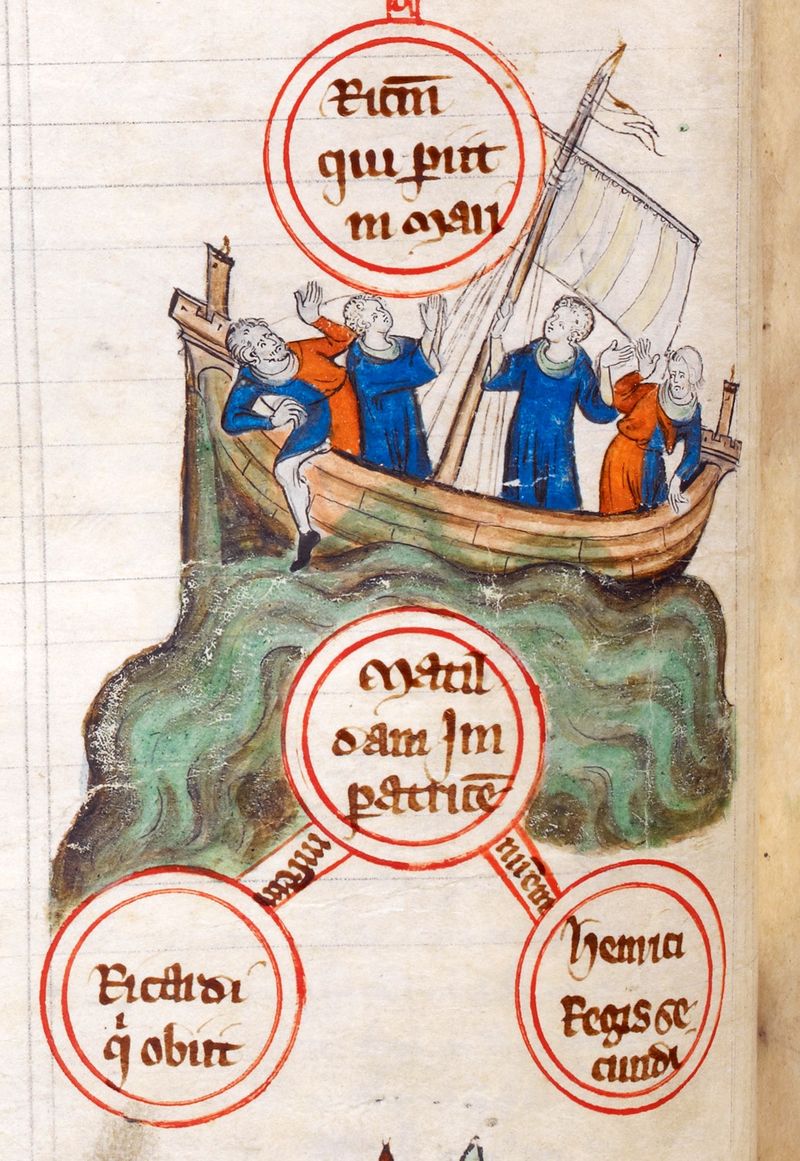
On November 25th, 1120, The White Ship was wrecked in a storm and sank in the English Channel. This terrible accident claimed over 300 lives and turned the course of English medieval history, since one of the victims was William 'the Atheling', seventeen years old and the only legitimate son of King Henry I of England and his queen Matilda, who had died two years before.

The White Ship was a modern vessel, a sturdy cog owned by Thomas FitzStephen, who was also on board, but the channel crossing from Normandy to England is treacherous, especially in winter. Henry's ship had already left Barfleur, on the north-western coast of France, in daylight, but when Fitzstephen's ship eventually sailed, after being loaded with more casks of wine, it was night. Worse, everyone on the ship was drunk. The ship struck a rock off Barfleur off the coast of north-western France and was wrecked. Only a butcher called Berthold from Rouen, on board to chase up payment, survived because the ramskins he was wearing saved him from exposure. Prince William and many of his friends, all young nobles, were drowned. Chroniclers of the time said that Thomas FitzStephen, knowing that Prince William was lost, allowed himself to drown rather than face King Henry.

At court, none of the barons dare tell the king. A child was finally sent with the terrible news. Henry fainted and afterward was said never to smile again.

Henry, stricken with grief, also afraid for his crown. His other legitimate child, named Matilda like her mother, was a daughter and in the Middle Ages women were not thought capable of ruling without male help. The traditional role of a queen was as a help-meet of the king and an intermediary for petitioners seeking mercy from the king. She was not expected to rule alone. Aware of this, King Henry married again within three months of the sinking of The White Ship and the loss of his male heir, but had no further legitimate children.

Henry was terrified of the prospect of no obvious male succession to the English crown, won by his father William of Normandy at the battle of 1066--the more so perhaps because he owed his own title of king to an 'accident' in the New Forest in August 1100 when his older brother, William Rufus, the King of England, was killed by an arrow while out hunting. Accident or assassination? It is still unclear but the younger brother, landless Henry, wasted no time in seizing the royal treasury and securing his position.

The death of William Rufus had favored him but the sinking of The White Ship threw his dynastic aims into turmoil. He attempted to extract promises of loyalty from his barons to his daughter Matilda, but some of the barons favored Henry's favorite nephew Stephen and when King Henry died in 1135, Stephen was crowned king of England in his place.

Matilda and her supporters saw this as a betrayal and both factions fought for their claims over England for over twenty years, a conflict which forms the backdrop for my novel A KNIGHT'S VOW, set in 1138.

Had William not been traveling on The White Ship all those years ago in 1120, if he had lived and succeeded his father, England would have seen a different line of Kings--Anglo-Normans instead of the later Angevins. No Henry II and Eleanor of Aquitaine, no Richard the Lionheart, no King John, all descended from Matilda's marriage to Geoffrey of Anjou.

Lindsay Townsend writes historical romance set in medieval England and the ancient Mediterranean. Her latest is A KNIGHT'S ENCHANTMENT, available now. She lives in Yorkshire with her husband.

27 December 2010

Accidents: Vanishing Manuscript Syndrome

By Anna C. Bowling

One of the greatest disasters known to writerkind can happen in any number of ways. A power outage could do it, or a pet chewing on the extension cord. "Save" and "delete" are only a mouse click apart. There's the dreaded internet virus that brings the blue screen of death. Maybe the files from the old word processing program aren't compatible with the new one and the writer is now looking at a file full of incomprehensible symbols.

Vanishing Manuscript Syndrome has five unique stages (with apologies to Elisabeth Kübler-Ross):

Denial: This can't be real. All that work, all that research, all those characters and their world where the writer lived and breathed for all that time, gone in a blink.

Anger: Family members may rush in upon hearing the animalistic roar that comes from the writer's den. The writer may malign the internet in general, the computer, the computer's power source, or whatever has made off with the best book ever. This isn't fair.

Bargaining: The writer may make appeals to their deity of choice and/or resident techy family member, promising extravagant rewards if the file can be saved.

Depression: What's the use? The book stunk anyway. Maybe this is a sign from the universe. Maybe the writer should forget about writing and go back to alligator wrestling or something less stressful.

Acceptance: Okay, that version is gone and it's not coming back. The writer could give up, but the characters are still there and still want their stories told. The writer searches for backup copies, or requests them from critique partners. Deep breath, beverage of choice, and open a new document. This version will be even better.

Have you ever had Vanishing Manuscript Syndrome? If not, how do you prevent it? How do you deal with recovering from this sort of accident?

Writing historical romances allows Anna C. Bowling to travel through time on a daily basis and make the voices in her head pay rent. Her current release, ORPHANS IN THE STORM, is available from Awe-Struck E-books.

26 December 2010

A PIRATE'S POSSESSION Winner

We have a winner for Michelle Beattie's A PIRATE'S POSSESSION guest blog. A free copy goes to:

D.L.!

Contact Carrie to provide your mailing address. The book must be claimed by next Sunday or another winner will be drawn. Please stop back later to let us know what you thought! Congratulations!

Guest Author: Elizabeth Lane

This week on Unusual Historicals, we're helping contributor Elizabeth Lane launch her special holiday time-travel treat, CHRISTMAS MOON. Stick around to see how you can win a free copy. Here's the blurb:

Pregnant, unwed and down on her luck, history teacher Emma Carlyle is facing the worst Christmas of her life. Needing some research for her master's thesis on legendary Wyoming lawman J.D. McNulty, she makes a Christmas Eve drive to South Pass City, where J.D. was buried. Heading home, she loses her way in a storm. After her car vanishes, she ends up in 1871, half-frozen, on the doorstep of a remote mountain cabin.

When J.D. himself opens the door with a pistol in one hand and a bottle of whiskey in the other...well, let's just say that sparks start flying. These two lost souls are clearly meant for each other. But there's one problem. Emma has studied everything about J.D.--and she knows he has only a few weeks to live.
***

"Five Spurs! This is a marvelous story filled with the spirit of Christmas miracles... The romance between J.D. and Emma evolves from suspicion to amazement to a sizzling, unbridled love. Resolving a time travel romance is always tricky but Elizabeth Lane does a terrific job of making it all work--including that little detail of J.D.'s imminent death. An engaging, intriguing and thoroughly enjoyable story of timeless love." ~ Love Western Romance

***

Tell us about yourself.

I'm a westerner by birth and upbringing. My grandparents lived like pioneers and my great-grandparents were pioneers. I grew up in a small town, in a family of people who loved the outdoors. Maybe that’s why writing Western romance comes so naturally to me. But I can and do write other things. My earliest books were big historical sagas. Then the market changed and I found a new home at Harlequin Historicals. Counting a couple of ghost writing projects, I'm coming up on 35 books. Twenty-eight of those books have been for Harlequin--3 of them contemporaries, the rest historicals. CHRISTMAS MOON is a step in a new direction, my first e-book and my first time travel.

CHRISTMAS MOON is something new for you. How did you come to write it and publish it as an e-book?

I'd written about 30 books for Harlequin and wanted to try something different. I've always loved time travel, and the old West seemed a natural setting for me. My agent encouraged me to add the Christmas element. I loved every page of this book, but we couldn't sell it, not even to Harlequin, because it didn't fit their format. No major publisher wanted a Christmas/western/time travel. My agent has his own e-book publishing venture, E-Reads. We decided to publish it there. The timing couldn't have been better. With the recent boom in e-publishing and plenty of promotion on my part, CHRISTMAS MOON has received a lot of attention. I couldn't be happier. This is a special book, and I wanted to have it read and enjoyed.

What can your readers expect next?

I'd planned to end my "Bride" series with THE HORSEMAN'S BRIDE. Then a stunning, strong-willed woman strode into the last chapter of the book, and I knew I wasn't finished. Those of you who've read, or will read THE HORSEMAN'S BRIDE, will be happy to know that Ruby gets her story. Look for THE WIDOWED BRIDE in March.

After that, I'll be leaving Dutchman's Creek, Colorado for the northern California coast and a haunting post-gold rush story, final title and release date TBD. More news, I've just signed to do two more full length historical westerns and a novella for Harlequin. That should keep me busy for a while.

***

Tis the season, readers, for some Christmas magic. Would you like to like to win a free copy of CHRISTMAS MOON? Leave a comment or question for Elizabeth for your chance. I'll draw a winner at random next Sunday. Void where prohibited. Best of luck, and the best of the season to you!

23 December 2010

Excerpt Thursday: Elizabeth Lane

This week on Unusual Historicals, we're helping contributor Elizabeth Lane launch her special holiday time-travel treat, CHRISTMAS MOON. Join us Sunday when Elizabeth will be here to answer questions about this latest venture, talk about her upcoming projects, and give away a copy of CHRISTMAS MOON. Here's the blurb:

Pregnant, unwed and down on her luck, history teacher Emma Carlyle is facing the worst Christmas of her life. Needing some research for her master's thesis on legendary Wyoming lawman J.D. McNulty, she makes a Christmas Eve drive to South Pass City, where J.D. was buried. Heading home, she loses her way in a storm. After her car vanishes, she ends up in 1871, half-frozen, on the doorstep of a remote mountain cabin.

When J.D. himself opens the door with a pistol in one hand and a bottle of whiskey in the other...well, let's just say that sparks start flying. These two lost souls are clearly meant for each other. But there's one problem. Emma has studied everything about J.D.--and she knows he has only a few weeks to live.
***

The woman on J.D.'s porch looked as if she'd just staggered out of a nightmare. She was wild-eyed and tarnally spooked, gripping a stick of kindling as if she wanted to bash in his face. The fact that she was dressed like some kind of Chinaman, in sagging black trousers and an enormous, puffy green silk coat, only added to J.D.'s befuddlement. What lunatic asylum had this female escaped from?

"Easy, now, lady." J.D. kept the Colt leveled at her collar bone, but mostly for show. "Put that stick down, and I'll take my itchy finger off this trigger."

Slowly and shakily she lowered her arm. He could see now that she was half-dead from cold and exhaustion. Her lips were the color of laundry bluing and her hair was plastered around her face in frozen strings. She was swaying on her feet like a drunkard.

J.D. cursed under his breath. He'd been looking forward to a peaceful night with his books, the old tomcat and a bottle of the finest rotgut whiskey in Glory Gulch. Maybe if he drank enough of the stuff, he might even forget it was Christmas Eve.

Muttering words unfit for a lady's ears, he eased off the hammer and laid the Colt on the bookshelf. "Well don't just stand there. Come on inside. And don't expect any apologies for my state of undress. I wasn't expecting company."

The kindling stick clattered to the porch as she dragged herself across the threshold. She was tall for a woman, with a body that appeared too stout for her heart-shaped face. Her eyes were staring at him as if she'd just seen Abraham Lincoln's ghost.

Her chilled lips worked in an effort to speak. "Where...am I?"

J.D. bolted the door behind her. "Glory Gulch, Wyoming. The upper edge of it, at least. Main part of town's further down the canyon."

"Glory Gulch?" Her eyes widened. "People are living here?"

"A few score, maybe, most of us down on our luck. Not like the old days before the gold played out." J.D. bit down hard on his cheroot as a new thought struck him. "Any other folks out there with you? Any of your family lost in the storm?" He didn't relish searching in a blizzard but if there were other travelers with the woman, he'd rather find them alive tonight than dead tomorrow.

Distrust flickered across her face, and he realized she'd misread him. "Oh, there'll be plenty of people looking for me by morning--police on snowmobiles, maybe even a helicopter or two. As long as they find me safe, there'll be no trouble for you."

J.D. shook his head. The woman was touched for sure. "You're talking gibberish, lady. Sit down and have a whiskey. Maybe it'll bring you around."

"Tell me one thing." She was staring up at him, her wild, scared doe's eyes searching his face. "Who are you? What's your name?"

"McNulty, for whatever it's worth to you. J.D. McNulty."

Her eyes widened for an instant. Then the pupils rolled back in her head and she swayed to one side. J.D. lunged, catching her as she went down in a dead faint.

She was heftier than he'd expected, and her belly, where it pressed his arm, felt as round and solid as a brood mare's. Only then did it dawn on J.D. that under her puffy coat, the lady had company. She was in a family way, and damned near ready to deliver.

A cold knot clenched in J.D.'s gut, jerking tight. Lord almighty, not that. Anything but that!

22 December 2010

Accidents: Oh, the Humanity!

By Delia DeLeest

It was the equivalent of riding in a cruise ship in the air. You could take an airplane if you wanted to, but it was so much more elegant and comfortable taking a dirigible. The most famous dirigibles were made by Zeppelin and its newest ship was called The Hindenburg.

Zeppelin was very proud of its ships safety history. Its flagship, the LZ127 Graf Zeppelin, during its nine year career, traveled 1.5 million miles (590 flights) with a perfect passenger safety record. The Hindenburg had already made its maiden voyage from Frankfurt, Germany to Rio de Janeiro back in March of 1936, and then it was heading to Manchester, New Jersey. It was time to land in its final destination.

It was 7:25pm on May 6, 1937. Though it was capable of handling seventy passengers, it was only half full, with a passenger list of thirty-six people being serviced by a crew of sixty-one. Its return trip was fully booked, with many people were heading to Europe for the coronation of England's new king, George VI. At 803 feet long and 103 feet in diameter, the huge, silver ship was beautiful.

Bad weather, forced the ship to circle the landing field for three hours before it began its final descent. Times were sure different then. Can you imagine the fuss people would make now days if they were forced to circle the airport for three hours before their plane landed? But, then again, The Hindenburg was a whole lot more comfortable than today's 747s.

The crew had finally dropped the mooring lines to the grounds men below when disaster struck. Nobody is sure what exactly happened, though there are many theories, including sabotage, lightning, and incendiary paint. The most common conclusion is that a combination of static electricity, created by the bad weather, and a leak in a cell of hydrogen--the lighter-than-air gas used to float the mighty ship.

The whys and hows don't really matter now. What is known is that at 7:25pm, as it was landing, The Hindenburg burst into flames. The fire started in the rear of the vessel--whether on the port or starboard side is debated, as there were conflicting accounts--and quickly spread through the entire ship. In about thirty-five seconds from start to finish, the entire ship was engulfed in flames and crashed to the ground.

Though hydrogen is relatively harmless on its own, it becomes highly flammable when mixed with oxygen. Within ninety seconds of it igniting, the ship's entire supply had been burned up. The rest of the ship burned for several hours after the crash. With an outer skin of cotton cloth covered with a plasticized lacquer, The Hindenburg was a firebomb looking for a place to happen.

In my eyes, the most fascinating aspect of the entire Hindenburg disaster is the low fatality count. Though it took only about forty-five seconds for the entire crash and burn, only thirteen passengers were killed, with the majority of those seated on the starboard side of the craft. Along with the passengers, there were twenty-two Hindenburg crew members killed and one man on the ground crew--in all, slightly more than one third of the number of people traveling on the Hindenburg, and an unknown number of people on the ground both working as crew and spectators (the landing of the mighty Zeppelin was a big event, even without its subsequent crash).

Though there were at least five moving picture cameras at the scene, none of them was trained on the vessel when it burst into flames. The famous Herbert Morrison radio broadcast is the only live record of the actual event. His commentary later became the first recorded radio news report to be nationally broadcast by NBC. Later, Morrison's poignant report was streamed with video footage of the catastrophe taken both before and after the disaster and makes for some incredibly heart-touching viewing.


So, what really happened to The Hindenburg? No one will probably ever know. But, what we do know is that the tragedy undermined the public's confidence in the huge airships, that along with the development of Pan American Airlines, ushered in the end of the age of huge passenger airships. In 1987, on the fiftieth anniversary of the tragedy, a bronze plaque surrounded by a chain was dedicated at the scene of the crash at Lakehurst Navel Air Station.

Delia DeLeest is fascinated by all things 1920s. She suspects she was once a flapper or, more probably, a bootlegger in a previous life. Her third 1920s era book, NOT LOOKING FOR TROUBLE, is being released from The Wild Rose Press at the end of October.

21 December 2010

Accidents: Accidental Foods

By Jennifer Linforth

Food and the holidays go hand in hand and sometimes we all fall prey to a kitchen mishap or two. Lucky for us, some food accidents turned into everyday culinary delights! Below is a list of some of the more famous....

BEER: Beer began in Mesopotamia totally by mistake when stored grains for bread became wet and began to ferment. Some brave chap tasted the frothy mess and there you have it--the world's first beer.

POPCICLES: These tasty treats were the accident of eleven year old Frank Epperson who, in 1905, left his soda and soda making equipment outside by accident. It dropped below freezing that night and the next day he discovered the stick in which he'd used to stir the flavored powder into the water froze upright in the mixture. Bingo! The "Epsicle" was born. It was not until 1924, that he applied for a patent and redubbed it the "popsicle."

POTATO CHIPS: This one most folks know! It was 1853 and a customer at Saratoga Springs' Moon's Lake House had issues with the batches of fried potatoes served to him. He kept sending them back to the cook, claiming they weren't up to his standards. He liked his potatoes firm and crisp. The angered chef sliced the final batch paper thin, fried them in oil, and tossed a bunch of salt on top. Now it seems we can't eat just one....

CHOCOLATE CHIP COOKIES: Ever hear of the Toll House Inn? Inn keeper Ruth Wakefield ran out of baking chocolate one day and chopped up a bar of semi-sweet chocolate and added to her cookie dough thinking it would melt. However, upon their removal from the oven she noted the chocolate didn't melt but dappled the cookie with chocolate chunks. So in 1930, the chocolate chip cookie was born!

PEANUT BRITTLE: According to legend a woman in 1890 was making a batch of taffy and an ingredient mix-up led her to invent peanut brittle.

CHAMPAGNE: "Brothers come--I am drinking stars!" That apparently was what Benedictine monk Dom Pierre Perignon exclaimed upon his accident... Initially his job was to try to find a way to stop the secondary fermentation of wine. In the process of trying to discover a way to do this, many of the wines began to have bubbles in them. Once he tasted it, what was the point in stopping the fermentation when a drink as wonderful as champagne was born!

SANDWICHES: It was in the 1700s when the Earl of Sandwich couldn't stop gambling long enough to eat. Instead he ordered some food to be piled between two slices of bread...

COCA COLA: This famous drink was invented by a doctor working on a headache cure. He created the syrup, but those inspecting it for approval felt it tasted better than it worked. They added some carbonated water and...the rest is history.

Ever concocted something by accident? Bake a turkey without removing the bag? Add salt to coffee instead of sugar? What food accidents, holiday or otherwise, can you share?

Jennifer Linforth expands the classics by continuing The Phantom of the Opera. MADRIGAL and ABENDLIED are available now. Readers should look for future books based on the classics, in addition to her unique historical romances. "Ms. Linforth's prose is phenomenally beautiful and hauntingly breathtaking." ~ Coffee Time Romance

20 December 2010

Accidents: The Sinking of The Mary Rose

By Anita Davison

In Heartstone, C. J. Sansom's hero, Matthew Shardlake, finds himself aboard King Henry VIII's favourite battleship, The Mary Rose, when it sank in July 1545. He describes in chilling detail the cramped and unhealthy conditions, the complaints of the crew and its part in the battle in the Solent against an invading French navy.

Two theories attach themselves to this famous ship, one is that she was top heavy, carried too many men and ordnance, which made her topple during a fast manoeuvre when positioning to fire at the French. The other is that her hull was holed by a French cannonball and the story was hushed up to salve Henry VIII's pride in his favourite vessel.

Built around 1510, probably in Portsmouth, The Mary Rose is believed to have been named after the King's favourite sister, Mary, and the Tudor emblem, the Rose. In October 1525, she was in Deptford, requiring caulking "from the keel up, both inside and out." She is recorded as being 14 years old and weighing 600 tons, being, "good for the wars or else for the King's pleasure."

On the morning of July 19, 1545, the biggest invasion fleet ever to reach British shores sailed around the eastern side of the Isle of Wight and into the Solent with the intention of capturing the town and naval base of Portsmouth. The French fleet of 200 sail, including 23 gun galleys on loan from the Vatican, had been sent to teach King Henry VIII's newly Protestant England a lesson and quash Henry's claim to the throne of France once and for all.

The English fleet consisted of around 80 ships, gathered in Portsmouth, with more expected from the West Country. The first day of the battle consisted of a long range cannonade in which neither side suffered any real loss. The French had also invaded the Isle of Wight, tangling with the local militia.

That night, Henry dined on the flagship, Henry Grace a Dieu, with the admiral, Viscount Lisle, as well as Sir George Carew, the newly appointed vice-admiral, and his senior captains. Among the artifacts recovered from the Mary Rose were two pewter plates from Lisle's dinner service, marked with his shield of arms encircled with the Garter. (John Dudley, Viscount Lisle was created a Knight of the Garter in 1543.)

At dawn on the 19th July, the French attempted to lure the English within range of their main fleet. The flat calm allowed them to pound the English ships with relative impunity, when much to their delight The Mary Rose heeled over and sank. The French naturally believed they had sunk her.

According to the Imperial ambassador, Van Der Delft, the French fleet appeared while the King was at dinner on the flagship. Henry went ashore and the English fleet was engaged by five galleys. He records that The Mary Rose sank towards evening, drowning almost all the 500 men aboard. A survivors account states: "Was told by a Fleming among the survivors that when she heeled over with the wind the water entered by the lowest row of gun ports which had been left open after firing."

Sir Peter Carew, brother of Sir George Carew, newly appointed Vice Admiral in The Mary Rose, gave his biographer another eyewitness account. He states that The Mary Rose began to heel as soon as the sails were raised. When their uncle, Sir Gawain Carew, sailed past and asked Sir George what the problem was, he answered that "he had the sort of knaves whom he could not rule." Hooker further tells us that:
...This gentleman...had in his ship a hundred mariners, the worst of them being able to be a master in the best ship in the realm; and these so maligned and disdained one another, that refusing to do that which they should do, were careless to do that which was most needful and necessary, and so contending in envy, perished in forwardness.
Neither the vice-admiral, or the captain, Roger Grenville, were among the survivors.

Sir Anthony Browne, Master of the King's horse is on the white horse following behind King Henry VIII who is also mounted. Next to Sir Anthony Browne is Sir Charles Brandon, first Duke of Suffolk, who was commanding the English land forces at Portsmouth.

A number of explanations of the loss of the Mary Rose has been put forward over time, none of which are entirely satisfactory. Sir Walter Raleigh attributed her loss to the gunports being too close to the water line with a gap of only four inches. In which case, The Mary Rose would never have left port because her scuppers would have been submerged! The archaeological evidence indicates that the gunports had close to four feet of clearance.

Peter Carew's account says The Mary Rose started heeling immediately after his brother went aboard and her sails were set. There is no mention of her being engaged with the French galleys, contradicting the French account. Other accounts lay the blame on low gunports and heavy ordnance, further adding that the guns were unbreached. While this was undoubtedly the case, the guns were still held in position by their recoil ropes, there is evidence for only one gun (on the upper deck) having fallen from the port to the starboard side.

The most likely reason is a simple handling error in the heat of the skirmish with the galleys, compounded by confusion or a lack of discipline amongst the crew. The excavation of the ship also revealed that the ballast had shifted to the starboard side, and once the angle of heel was sufficient for water to enter the gunports the fate of the ship was sealed.

The Mary Rose sank through the soft upper sediments at an angle of 60 degrees, coming to rest on the clay below. The hull acted as a silt trap for the Solent currents, and the surviving portion of the hull filled rapidly, leaving the port side to be eroded by marine organisms and mechanical degradation. Almost the entire starboard side survived intact, excluding the bow and a portion of the aftercastle. Internally between half and one third of the orlop, main and upper decks, along with a fragment of the castle deck were intact, as were companionways, stanchions and cabin partitioning. During the 17th and 18th centuries the entire site was covered with a layer of hard gray shelly clay, which minimised further erosion.

A section from The Cowdray Engravings showing the sunken ship in the Solent

The Mary Rose was an important battleship and Henry VIII would have ensured she carried the best available crew of professional sailors and some of these men bravely battled against incoming water when the French [allegedly] blew a hole in her side. Nor did the ship sink because she was caught by a gust of wind while tacking under full sail. The documentary suggests the ship would have rapidly taken water into her hull before she manoeuvred to bring a broadside of guns to bear on the attacking French galleys which caused her to capsize and sink with the loss of more than 400 lives.

Serious attempts to save the ship would have been made, and skeletal remains found in the hold are thought to have been the carpenters desperately working in the dark trying to plug the hole made by the cannonball.

Whatever the truth of it, the loss of The Mary Rose was one of England's great naval tragedies.

Anita Davison is an historical fiction author with a love of 17th century England. DUKING DAYS: REBELLION was released in 2007 and the sequel, DUKING DAYS: REVOLUTION in 2008. TRENCARROW SECRET, a Victorian Gothic romance, will be released in June 2011 by MuseItUp Publishing.

19 December 2010

Anniversary Bash Finale Winner!

The winner of the Anniversay Bash Grand Finale is:

windycindy!

Contact Carrie to provide your mailing address. The books must be claimed by next Sunday or another winner will be drawn. Congratulations!

Guest Author: Michelle Beattie

This week on Unusual Historicals we're welcoming back Michelle Beattie as she celebrates the release of A PIRATE'S POSSESSION, available now from Berkley Sensation. Michelle has become known for adventurous romances set on the high seas of the 17th century--the Age of Sail. Here's the scoop:

Love and gold have one thing in common: they can only be buried for so long...

Abandoned by her father and married to a deceitful man, Claire Gentry fled from her life. Disguised as a man, Claire wagers all she owns in a poker game to locate the treasure her father sought. While her disguise holds, it doesn't protect her when one of her opponents turns out to be the only man she ever gave her heart to.

Nate Carter is no fool. Raised in an orphanage and sailing as the mysterious pirate Sam Steele, Nate is looking to gamble for a map that will lead him to a treasure. But when he looks over his cards, he's reminded of a past he'd rather forget--and the woman who could have given him everything he truly wanted.

After Nate wins the map, Claire has no choice but to accompany her old love on his quest. But running for their lives soon replaced running from the past. And if they survive the bloody battle for the treasure, they may just realize that what they really have been searching for isn't riches--but each other...
***

A PIRATE'S POSSESSION is the third book of your pirate series. How is this one different than the other two?

Unlike WHAT A PIRATE DESIRES and ROMANCING THE PIRATE, most of A PIRATE'S POSSESSION takes place on land. I did that specifically to change things up a bit though of course I have scenes taking place on the ship because it's such an intimate setting. It's hard to avoid each other on a relatively small ship.

What similarities can we expect in this book as compared to the others?

Lots of action, gun battle, sword fights. The lovely, sultry setting of the Caribbean. A strong heroine who can more than hold her own. Villains. I always have a villain and like Sam and Luke from WHAT A PIRATE DESIRES and Blake and Alicia from ROMANCING THE PIRATE, both Nate and Claire have a past to deal with before they can move on.

You mention Luke and Sam, Blake and Alicia. Will we be seeing them again in this latest installment?

Yes. Part of the fun of a series is seeing characters you've fallen in love with come back. They don't steal the show, but you will see them again. They're family. Not all by blood, but this unlikely group of pirates and civilians have become family, so of course it makes sense that you'd see them pop up here and there.

One of the great things in ROMANCING THE PIRATE was the fun camaraderie between Nate, Vincent and Blake. Was that fun to write? And can we expect more of that dynamic in A PIRATE'S POSSESSION?

It was SO much fun to write! I love these men together. They have a real friendship with all the frustration and humour that goes along with it. Writing them together was so easy, it was just a matter of letting them go! You will definitely see much of that continue with Nate and Vincent in this book, and toward the end, when Blake steps in.

What's on your horizon as a writer?

I'm currently switching gears a bit and trying to sell a contemporary that I wrote and have begun another. I'm toying with a few ideas. I really love historical westerns but that market isn't strong right now so I may try a contemporary western. We'll see. First I have to finish this new book.

So no historicals in the future?

For sure! I can't see myself ever NOT writing historicals, but I would like to branch out and write both historicals and contemporaries.

***

Are you ready for some pirates? Leave a comment or question for Michelle to be entered in her contest. I'll draw a winner at random next Sunday, who will receive a copy of A PIRATE'S POSSESSION just in time for the new year! Maybe this question to get you started: Who is your favorite pirate in film or literature, or which is your favorite pirate story? Void where prohibited. Best of luck!

16 December 2010

Excerpt Thursday: Michelle Beattie

This week on Excerpt Thursday we're welcoming back Michelle Beattie as she celebrates the release of A PIRATE'S POSSESSION, available now from Berkley Sensation. Michelle has become known for adventurous romances set on the high seas of the 17th century--the Age of Sail. Join us Sunday when she'll be here to answer questions and give away a copy. Don't miss it!

Love and gold have one thing in common: they can only be buried for so long...

Abandoned by her father and married to a deceitful man, Claire Gentry fled from her life. Disguised as a man, Claire wagers all she owns in a poker game to locate the treasure her father sought. While her disguise holds, it doesn't protect her when one of her opponents turns out to be the only man she ever gave her heart to.

Nate Carter is no fool. Raised in an orphanage and sailing as the mysterious pirate Sam Steele, Nate is looking to gamble for a map that will lead him to a treasure. But when he looks over his cards, he's reminded of a past he'd rather forget--and the woman who could have given him everything he truly wanted.

After Nate wins the map, Claire has no choice but to accompany her old love on his quest. But running for their lives soon replaced running from the past. And if they survive the bloody battle for the treasure, they may just realize that what they really have been searching for isn't riches--but each other...
***

The deck had been quiet then and it was even more so now. Peeking out from under the lifeboat, she couldn't see anyone about at all. Not even Vincent. She slid out from the boat, hesitated. No movement came from the quarter deck. Leaving her bag where it lay, Claire looked around. Vincent wasn't at the bow, she crept toward the stern, couldn't see any shadow or movements there either.

Her heart lurched when she heard whistling and she froze. Logically she knew she was being ridiculous. She wasn't doing anything wrong. Yet.

It took her a moment to realize the whistling wasn't coming from the deck, but rather from the galley below. She breathed a sigh of relief, slowly unclenched her hands. Luck had never been her ally and she hoped that the fact that Vincent was below and Nate was asleep was a sign that her fortune was changing. Not about to waste the chance if that was indeed happening, Claire stole over to the captain's hatch.

Her heart beat quickly with her intent and her palms were suddenly damp. She wiped them on her trousers and grabbed the handle. Biting her lower lip, Claire eased open the hatch. Thankfully Nate kept a well tended ship and the hatch swung open soundlessly.

No light came from below and as she strained to listen, the only sound was that of Vincent's soft whistling and the whisper of wind sliding between the sails. Claire swallowed hard, closed her eyes and said a brief prayer. Opening them again, she stepped onto the ladder.

With each step down she paused to listen. It was only once she'd made it far enough to be able to close the hatch above her that she heard Nate's even and deep breathing. Her shoulders sagged. He was asleep. The hatch closed as silently as it had opened.

Since it had been dim above deck as well, her eyes didn't need time to accustom to the darkness. Recalling where she'd seen everything earlier, Claire crept toward the berth. She'd hoped she'd step on some clothing as it would mean she could simply search through his clothes for the map, but her feet hit nothing but smooth wood.

She only dared breathe in short, shallow breaths. Soon she was at the bedside, her heartbeat thumping loudly in her ears. It seemed as though he'd fallen asleep without meaning to, spread out over the blankets. He hadn't even taken off his jacket.

Claire wiped her quaking hands onto her pants, reminded herself to remain steady. She could do this. She had to do this.

He was sleeping on his back and his large hands were at his sides. His head was turned slightly away from her. The part of her that remembered what they'd meant to each other, or rather what she'd believed they'd meant to each other, wanted to linger. It wanted to trace the arch of his brows and feel the roughness of his beard. It wanted to once again be taken in his arms and to be cherished.

For God's sake, stop it, she scolded herself. The map, remember the map. Remember the lies, the hurt.

To that end, she deliberately kept her gaze off his face. Reaching forward, she slid her hand into the pocket of his jacket. Her fingers brushed against the paper and Claire's heart leapt to her throat. She had it!

She slowly pulled her hand away. When Nate didn't move, Claire exhaled a trembling breath.

She looked at him once more, had a moment when she wished things could have been different. But knowing they weren't, could never be, she backed away from the berth, tucked the folded map into her undershirt and turned for the ladder.

She got as far as the base of it before she was grabbed from behind.

The scream ripped from her throat.

"Goddammit, Claire," he swore as she thrashed to break free.

Her arms flailed wildly, desperate to connect with some part of him that would make him release her. Her elbow struck his chest. Her foot came down hard on his. Growling, he spun her around. Her right knee came racing up.

"No, you don't," he said as he deftly wrapped a large hand around the back of her knee and held it there, a mere breath away from where she'd intended to strike him. His other hand grabbed her left wrist and held it shackled down at her hip.

Luckily Claire was right-handed. Smiling sweetly, she aimed for his jaw.

15 December 2010

Accidents: Tea, From Antiquity to Modern Times

By Jeannie Lin

There are two legends about the discovery of tea: First, that it was discovered accidentally by Shen Nung, the second Emperor of China when leaves from a tea plant accidentally fell into his cup of hot water. He tasted the brew and found that it not only tasted good, but had medicinal properties.

The second legend is more fantastic. A legend dating back to the Tang dynasty states that the Buddhist monk Bodhidharma fell asleep while meditating. When he woke up, he was so upset with himself that he cut off his eyelids and threw them to the ground. Tea plants grew where they landed, providing a beverage that would keep monks and other people refreshed and alert.

In either case, tea has a long and complex history that spans the globe and includes many happy accidents:

Tea was introduced to Europe in the 17th century by Dutch and Portuguese merchants trading in China. It was originally scarce and available only to the aristocracy.

In the 19th century, China remained the sole exporter of tea to the British empire until tea was "rediscovered" also growing naturally in the Assam region of India. In 1823, Robert Bruce, a Scottish explorer traveling through, noted that the local tribespeople would brew a drink from the leaves of a local plant. He sent the leaves to botanical experts for classification and it wasn't until after his death that the verdict was returned: this was indeed a variety of the tea plant previously only found to grow in China.

Indian black tea had a stronger, darker taste than the China green tea. As a result, tea drinking habits evolved to incorporate milk and sugar.

The invention of the tea bag was itself an accident. Thomas Sullivan, a coffee merchant, sent out samples of tea in small silk sachets. He meant for the customers to open the bags and empty the contents into a teapot to steep. Instead people put the entire bag into hot water and the tea bag was born.

The tea trade influenced much of the history of East/West relations. Have you heard of any other tea "accidents" that shaped the world?

Jeannie Lin writes sweeping historical romances set in Tang Dynasty China, featuring sword play, politics, and, above all, honor. Her Golden Heart award winning debut, BUTTERFLY SWORDS, and the linked short story "THE TAMING OF MEI LIN" are currently available from Harlequin Historical.

14 December 2010

Winner Updates

The winner of the A GROOVY CHRISTMAS anthology announced on Saturday is:

VIRGINIA!

In addition, the name selected for Day Five of the Anniversary Bash has not stepped forward. Thus I'm drawing a new name for that awesome paranormal historical prize package:

KANCHB!

Contact Carrie to provide your mailing address. The book must be claimed by next Sunday or another winner will be drawn. Please stop back later to let us know what you thought! Congratulations!

Accidents: The First Train Fatality

By Michelle Styles

September 15, 1830, began in great triumph--a spectacle that few could have imagined only a few short years before. The Manchester-Liverpool Railway opened and the age of the steam engine had truly begun. All the important political figures were there from the aging Duke of Wellington to Robert Peel, the prime minister. Mr William Huskisson the Home Secretary also attended. Mr Peel and Mr Huskisson travelled in the Northumbrian. The Duke of Wellington travelled in a different carriage. Relations between Huskisson and Wellington were known to be strained. And with scenes resembling a pageant of old, the cortage set off with the train being driven by the man fundamental to railway development, George Stephenson.

Unfortunately, at a stop for engine water, Mr Huskisson decided to alight and stretch his legs. As he went to speak to the Duke of Wellington, a warning shout came too late. Although others leapt to safety, Huskisson because of ill health and old age hesitated and was hit. The engine which had won the Rainhill trails, The Rocket crushed his leg. Huskisson said when they found him, "I have met my death."

Heroic efforts were made to save the Member from Liverpool who had long championed the railways, in particular the Manchester to Liverpool line. Newspapers later made great play of the fact that Stephanson had driven the Northumbrian at full throttle covering 15 miles in 25 minutes or a speed of 36 miles per hour in an attempt to deliver Huskisson to hospital in time. The speed was hitherto unknown. However, he died later that night.

And the day that had begun in such triumph ended in tragedy.

Huskisson was considered to be one of the country's leading economists and was one of the main reformers of the Tory Party. He was also a leading proponent of Catholic Emancipation. His loss was a great blow to the country and served to show that with progress can come tragedy.

Author Michelle Styles is fascinated by the early railways and the part that various such self-made men played in their development. Her current Harlequin Historical releases, A QUESTION OF IMPROPRIETY and IMPOVERISHED MISS, CONVENIENT WIFE, explore some of the attempts to develop a working travelling engine.

13 December 2010

Accidents: James Dean

By Lisa Marie Wilkinson

"Along came a Spyder and picked up a rider
Took him down the road to eternity..."
~ Lyric from "James Dean" (by J.D. Souther, Jackson Browne, Glenn Frey, Don Henley)

Nothing secures a place in the land of legends more securely than exceptional talent extinguished by violent, untimely death.

James Dean had accumulated a relatively small but impressive body of work by the time of his tragic death at age 24 as the result of massive injuries sustained in a car crash, including starring roles in three films that have gone on to become recognized as classics: Rebel Without a Cause, East of Eden, and Giant.

A student of the famous Lee Strasberg Actor's Studio, the gifted method actor was a renowned racing enthusiastic, and his racing career ran concurrently with his film projects. He purchased a race-ready MG TD when he secured the part of Cal Trask in East of Eden, and later upgraded to a Porsche 356 Speedster, earning second, third, and fourth placements on the California racing circuit.

While filming Rebel Without a Cause, Dean began searching for the perfect race car, settling on a Porsche 550 Spyder when production on his first choice, the Lotus MK X, was delayed. The level of personal risk associated with racing fast cars was not lost on the Hollywood studios that employed him, and Dean was contractually forbidden to race while filming Giant.

Ironically, once filming was completed, Dean was free to race again, and he died on September 30, 1955 while in route to compete in a car race being staged in Salinas, California. His final film, Giant, was released posthumously in 1956.

The car in which Dean was killed, the Porsche 550 Spyder, has attracted its own share of myths and legends, including rumors that the car was cursed. Dean hired designer George Barris (who would later design the original Batmobile) to add custom touches. The finished version included racing stripes and the moniker "Little Bastard" painted on the car.

As with any tragic event, there are always the eventual "what-ifs" that arise. What if Dean had stuck with his original plan to drive his station wagon and tow the race car, instead of making the last minute decision to drive the racer, in order to become more familiar with the car before the race? What if the other driver, 23-year-old student Donald Turnupseed, had not crossed into Dean's lane when moving to take the fork onto State Route 41 near Cholame, California, hitting Dean's vehicle nearly head on? What if Dean had heeded the warning impulsively offered by actor Alec Guinness? His words to young Dean upon viewing the racer were, "If you get in that car, you will be found dead in it by this time next week."


In a final irony, it was announced in 2010 that the strip of highway known as "Blood Alley" where Dean met his end fifty-five years earlier, will be widened due to its notorious history of fatal car crashes.

Lisa Marie Wilkinson is an IPPY Gold Medal winning author of historical adventure-romance. Her latest novel, STOLEN PROMISE, featuring vibrant Gypsy characters and breath-taking romance, is available now.

12 December 2010

Michelle Styles Trio Winner!

We have a winner for Michelle Styles's guest blog. Free copies of three of Michelle's novels goes to:

Bunny's Mom!

Contact Carrie to provide your mailing address. The book must be claimed by next Sunday or another winner will be drawn. Please stop back later to let us know what you thought! Congratulations!

Anniversary Bash: Finale!

Welcome to the final day of Unusual Historicals' anniversary!

I have to say, this has been one of the best blogging experiences I've had in a long time. The comments all of y'all have provided have often had me rolling with laughter. Definitely the way to start every morning, and even more than that, the best way I can think of to celebrate four years at such an awesome blog. I can't wait to see everyone stick around as we return to normal programming.

Before we get to the really, really good stuff--the extra huge pack of books we have to give away today--I want to take a moment out to thank Carrie Lofty for the work she puts in around here on a regular basis. I've always known she was the one who kept this gig running smoothly, but I never realized until I took over this week exactly what that entailed. A lot. Like, just putting up posts with pictures and silly questions has taken me hours of work. I can't imagine how much time Carrie must put in. Ms. Lofty, I tip my hat to you.

Ok, the books. What have I been holding back for today? Why, really awesome stuff. Twelve books! You read that right, twelve. All stuffed carefully in one box and mailed off to a single lucky winner. Sounds like a wonderful distraction from family and holidays!

Today's winner will get:

Elizabeth Lane:
The Horseman's Bride (signed)


Amanda McIntyre:

The Diary of Cozette; Tortured; The Master & the Muses (all signed)


Hope Tarr:
Vanquished (signed)


Diane Whiteside:
The Devil She Knows (signed and there's a matching keychain)


Lisa Marie Wilkinson:
Fire at Midnight; Stolen Promise (both signed)


Lisa J. Yarde:
On Falcon's Wings


Kate Bridges:
Alaska Bride on the Run; Mail Order Marriages (both signed)


Monica Burns:
Kismet


Seriously people, how can you top that stack? Y'all are lucky the books are actually at Carrie's house. If I had 'em, they'd probably be pre-read before they got to the winners. (Honestly, I've read most of them already. But that's just because I really do love the special zing I get from reading a great historical set somewhere different.)

We've hopefully introduced you to a lot of new Unusual Historicals authors this week. So for today's Grand Prize, tell me which UH author you're most eager to read. The winner will be drawn at random first thing next Sunday morning, just like our usual Sunday giveaways.

The usuals: Void where prohibited. Prizes can only be mailed to the US and Canada. Don't talk to strangers. (Unless they're really cute and rich.)

***

Lorelie Brown's first book, JAZZ BABY, is currently available from Samhain Publishing and will be released 4 January in paperback. Her second romance, an 1880s-set western, will be published by Carina Press in Summer 2011