30 April 2010

Weekly Announcements - 30 Apr 2010

We're welcoming a new author to the ranks of our contributors here at Unusual Historicals. Please say hello to Lila DiPasqua, whose first book comes out in August from Berkley. In AWAKENED BY A KISS, three classic fairy tales are cleverly retold with enough sensual twists to prove wickedly ever after does exist. Here's the blurb:
"Sleeping Beau" Five years ago, notorious rake Adrien d'Aspe, Marquis de Beaulain, was awakened by a sensuous kiss-and experienced a night of raw ecstasy that was branded into his memory. Years later, he spots his mysterious seductress-and this time, he has no intention of letting her go...

"Little Red Writing" Nicolas de Savignac, Comte de Lambelle, has been assigned by the King to uncover the secret identity of the author writing scandalous stories about powerful courtiers. He never expected his investigation would lead to his grandmother's house, or to a ravishing woman who would stir his deepest hunger...

"Bewitching in Boots" Elisabeth de Roussel, daughter of the King, is accustomed to getting what she wants-and she wants Tristan de Tiersonnier, Comte de Saint-Marcel, an ex-commander of the King's private Guard. A recent injury has forced Tristan to leave his distinguished position, but Elisabeth is determined to make him see he's every bit the man he once was-and more than man enough for her...
At age fourteen, Lila's best friend sneaked a romance novel out of her grandmother's house. After devouring it, Lila was hooked on romance novels for life. Today she lives with her real-life hero husband and three children and is a firm believer in the happily-ever-after. She loves history and enjoys traveling. She has been to four continents so far. Weaving in interesting historical facts she discovers during her travels, Lila writes stories about historical alpha-heroes and the heroines who make them lose their hearts. Her next release, THE PRINCESS IN HIS BED, will be released in November.

Welcome aboard, Lila!

***

There's still time to sign up for Carrie Lofty's May 3-17 online workshop, "Snakebite Scenes and Hollywood Plots: Writing Action with Heart," hosted by the Heart of Dixie chapter. Does your story have a sagging middle? Do you fear that your action scenes are tepid? Work with Carrie to fix all of the above, while infusing every story with more emotional punch. Learn more about it and register here.

***

Congratulations to Margaret Mallory, whose debut KNIGHT OF DESIRE (Jul '09) is a Best First Book Finalist in the 2010 Golden Quill Contest, sponsored by Phoenix Desert Rose RWA. Good luck, Margaret!

***

Join us Sunday when Michelle Styles will be here to chat about her four current books, including the US release of her Roman-set A NOBLE CAPTIVE. She'll also be giving away three books to one luck commenter! Be sure to join us then.

***

We'll also draw the winner of "A Night for Miracles" from Cheryl Pierson's guest appearance on Sunday. You still have time to leave a comment or question for your chance to win.

***

Stay with us through the coming weeks when we'll be featuring the best unusual historical authors! Blythe Gifford, Ali Katz, Diane Whiteside, and Isabelle Santiago will be our guests. Join us!

***

Have a good weekend! Remember, you don't have to be an Unusual Historicals contributor to submit good news to the weekend announcements. If it has to do with unusual historicals, we'd love to shout it out to the world! Send announcements to Carrie. See you next week...

29 April 2010

Excerpt Thursday: Michelle Styles

This week on Excerpt Thursday we're featuring Michelle Styles' latest U.S. release, A NOBLE CAPTIVE, set in the Mediterranean in 75BC. It's Roman Empire time! Join us Sunday when Michelle will be here to discuss A NOBLE CAPTIVE and her next two releases: COMPROMISING MISS MILTON and AN IMPULSIVE DEBUTANTE. So much to discuss! You'll also have a chance to win all three of these great books.

75 BC on an island in the Mediterranean, a few miles north of Crete. Helena, the sybil's assistant has problem. Not only has her aunt the sybil collapsed, but also pirates are seeking to further their influence on the island and Helena, masquerading as the sybil was manipulating into allowing captured Roman soldiers to have shelter in the temple while they wait for their ransoms to arrive. And despite her hatred for Rome and all it stands for, Helena finds herself attracted to the tribune Marcus Livius Tullio. Will their passion destroy everything she holds dear?
***

You can read the start of the book here.

In this excerpt, Tullio has arrived at the temple, and Helena discovers her problems are getting worse instead of better...

***

"The sibyl made no mention of this when she returned." Helena tapped the tablet against her mouth. She must say nothing to indicate who was at the quayside. After all that, she could not give into her temper. She had to stay calm. "No mention at all."

The sailor with his gold ring in one ear leaned forward. His finger twisted a strand of his greasy beard. Helena struggled not to recoil in disgust.

"These men are dangerous, my lady. You will need extra help," he said. "See how they seek to defy you. If they could, they would be beating their swords against their shields to signal the start of battle."

"The sibyl would have informed me if she felt in danger," she repeated, disliking the man more with each word he uttered. The good Captain Androceles had set a crude trap, one which she had no intention of blundering into. These Roman soldiers were not going to be a pretext for stationing his armed men within the temple. "We are not without protection."

"I tell the truth, Lady," the seafarer whined. "And as you were not there, will you trust the word of a Roman or the word of your ally?"

"I trust the sibyl's judgment. Kybele guides her." Helena's fingers tightened around the tablet, snapped it in two. The faint crack brought her back to her senses. Any more provocation, she'd start blurting out the whole story.

"But the captain is only thinking of your welfare." Gold Earring continued his protest and the rest of the seafarers echoed his sentiments.

"The lions roam the grounds at night," Helena said as if he had not spoken. "We have our guards during the day. Above all Kybele protects and defends this temple. I doubt the Romans will be foolish enough to abuse our hospitality and risk the wrath of Kybele. Where would they go? All the triremes and boats are guarded. The harbor provides the only way on or off the island."

Her gaze met Tullio's steady one.

How dangerous was he? She remembered his fingers on her hand, the way the tingles dashed up her arm. Her whole body seemed to be aware of him in a way she had not felt before. She offered a prayer up to Kybele that her face showed none of her disquiet.

"The captain's concern is solely for the temple," Gold Earring said, his hand going to where his sword belt normally hung.

"The temple thanks you for your concern." She crossed her arms and squared her jaw. Perhaps she should be grateful to the Romans for showing her Androceles's naked ambition. "But I shall trust the Sibyl's judgment. You have delivered the guests. You may return to your captain."

"Captain Androceles has ordered that we remain as guards, in case the Romans try anything." The seafarer planted his feet firmly and rocked back and forth. The other seafarers bristled. "I must respectfully request for our swords to be returned. We desire to provide the proper protection for the Sibyl."

Helena's arms started to tremble. Androceles's stratagem was obvious to any who had spent time a latrunculi board. If his men became guards at the temple, he would try to dictate the Sibyl's pronouncements, destroy her aunt's carefully built neutrality between rival factions of sailors. All because she had made an error.

"You may thank the good captain from me but when we need assistance, the Sibyl will ask for it." Helena increased the volume of her voice so that it echoed through out the antechamber. She knew the guards in vestibule would here and start their final preparations. Captain Zeno had believed six months ago but would Gold Earring be so gullible? Did she dare take the risk of revealing the true extent of the temple's weakness? "The temple is a place of peaceful contemplation. No arms are allowed to sully that. The Sibyl refuses to allow the Temple to be desecrated."

"I am very grateful to the Sibyl for providing us with lodging as we wait for the tribute," Tullio stepped forward, his metalled sandals ringing out on the mosaic floor.

Helena ignored him. Romans were less a danger than Gold Earring. He had to leave.

"Your job has finished. The guests have been delivered safely. Go," Helena used the same intonations her aunt used when she was declaring what the goddess wanted. Forceful but with no hint of desperation she beginning to feel.

Gold Earring took a step towards the gateway, then hesitated. "Captain Androceles ordered--"

"This is not the captain's ship." She moved towards the main altar. In her mind, she recalled the number of times, Aunt Flavia impressed on her to the need to glide and not run. Gold Earring must have no hint of what was to come. If it taught the Roman with his knowing smile a lesson as well, so much the better. "Perhaps you will believe after a small demonstration but I warn you, Kybele protects her own."

She gave a small clap of her hands and then pulled the curtain cord and allowed the mirrors to show. Instantly temple guards swarmed into the vestibule and stood in line behind Helena, each brandishing a long curved sword. She bit her lip. Hopefully the concealed mirrors and dim light would make Gold Earring think there was twice the number of guards.

"You called, My Lady," the lead guard boomed.

"The seafarer expressed a concern about our ability to look after the Temple properly."

"We have never had any trouble before, Helena."

Tullio took pleasure in watching the pirates shift uncomfortably as Helena stood, head held high in front of her troop of guards. Helena was unexpected. She managed to confront the pirate without flinching. He doubted many women of his acquaintance in Rome would have the courage to do such thing. Most women like his elder sister and his ex-wife would have run screaming before they dared speak back to a man like that.

From where he was standing, he could see the trick she had played with the bronze mirrors. It had been the vogue when he had been a boy and his mother had gone from temple to temple searching in vain for a cure for his younger sister's illness.

The question was whether or not the pirate would know about the trick or would he simply see the images without questioning and leave?

"I had no idea the Temple had that many guards." The pirate uttered before he brought his sandals together and gave an elaborate bow. "Captain Androceles thinks only of your welfare."

"Should the temple be in mortal danger, someone who is of pure heart would blow Neptune's trumpet, and aid would appear." She indicated a large bronze trumpet etched with shells and inlaid with precious stones. "No doubt the good captain has forgotten the legend."

"No doubt." Droplets of sweat shone on the pirate's face.

28 April 2010

News and Media: Paper and the Printing Revolution

By Jeannie Lin

As a Silk Road enthusiast, it's intriguing to track the development of ideas from East to West. In grade school, we were often taught the history of inventions as if they were a single moment of However, the invention of paper and printing techniques is a wonderful opportunity to look at the development of mass media across cultures and periods rather than a single point in time.

The invention of modern papermaking is credited to the eunuch Cai Lun who reported his achievement during the Han Dynasty, circa 125 A.D. However, archaeological evidence has been found that shows paper was in use 200 years earlier in the western regions of China and the Greeks and Egyptian wrote on scrolls and codices made of papyrus as far back as 3000 B.C.

Example of Egyptian papyrus

The availability of a durable and cheap material such as paper or papyrus made it possible to communicate and transmit ideas over long distances as well as record information for future generations. But the act of writing by hand was slow and the knowledge was also limited to only the elite: religious clergy, nobility, and royalty.

First printed newspaper, Mixed News - Tang Dynasty China 712 A.D.

The first printed newspaper, Kaiyun, was started during the Tang Dynasty in 713. In 868, Wang Jie printed a copy of the Diamond Sutra, which is the oldest printed book in existence. By the 11th century, alchemist Bi Sheng, began working with movable type. Printed books replaced scrolls and there's evidence of color printing from China as early as the 14th century.

In the 15th century, Johannes Gutenberg's printing press brought about what is commonly lauded as a communications revolution. But what about the Chinese movable type press which had been invented four hundred years earlier? Some historians believe that inventions such as paper, the compass, and the printing press spread from east to west across the trade routes known as the Silk Road whereas other scholars argue that Gutenberg independently discovered movable type.

More interesting than the question of "who did what" is the examination of why the mass media boom happened in Western Europe during the Renaissance/Reformation period rather than Song Dynasty China in the 11th century, even though comparable technology was available.

Though the Chinese press was indeed a major advancement that allowed the empire to print money and distribute information, the language itself, with its thousands of unique characters, wasn't as suited to mass production. The complex characters couldn't be broken down in any systemic way so molding the characters was inefficient. 400 years later, Gutenberg's press was able to make use of the simpler and systematic Latin alphabet to usher in the communications revolution.

27 April 2010

News and Media: Gossip Sells

By Jennifer Linforth

Newspapers are filled with stories that can be manipulated into all sorts of tales of mystery and intrigue. They are also filled with what so many love best...

...gossip and rumor.

In the 19th century gossip was an art form! It was craved as much back then and it is now. Ladies whispered of it over tea, men debated it over cigars. Lives adhered strictly to etiquette and social standing, so you can well imagine would happen if a tidbit of bad manners or ill morals seeped out to the public. It could ruin a family in a heartbeat! Gossip and rumor truly didn't leak however. Servants were often paid for their loose-lips as were members of society willing to spread untruths to expose their friends. A paper notorious for this was The John Bull, its editor also known to simply make up stories to stir the pot!

Papers reported important political issues and social affairs. By the 19th century journalism's ethics were being established. Papers were a sort of social conscience and many acted in good form. Many others did not and either way a balance was struck between truth and rumor that continues to this day. Scandal sells, and papers of the day quickly understood that, using the aristocracy to pad their pockets. Nothing has changed in this day and age...

Can you imagine a world without gossip rag? Tabloids? People getting their fifteen minutes of fame for whatever the reason? Can you see a world of nothing but facts and full truths? One summer my local news broadcasted nothing but good news once a week. Not gossip, no tragedy, no scandals or politics, just plain old good news.

It didn't last long. Why do you think that is?

26 April 2010

News and Media: True Story of Newsies

By Lorelie Brown

Oh, Christian Bale. He's come a long way, hasn't he, from fresh-faced Jack Kelly in Newsies to the grownup version of himself? Let's take a moment to make a scientific comparison. Yes, that's a good idea. We're all about academic inquiry here at Unusual Historicals.


But did you know that the story of a youth-led strike was based on a true story? The original wasn't nearly cheery enough to have song and dance though, I can promise you that.

In the late 1800s, the newsboys were the lifeblood of the newspaper publishing industry. They were the primary distribution system for almost every newspaper and stood on street corners hawking their wares. Never well received because of their loud screams, they were endured. And they endured as well--crappy as hell living conditions. They were poor. Dirt poor. They usually slept on the streets and often slept right in front of the newspaper offices so they could be the first ones to buy their bundles of papers and get to selling. Thousands upon thousands of them. No coats, no shoes for many of them, and no education.

They weren't allowed to return the bundles of papers they bought. If they didn’t sell them all, they were screwed. Even if they sold every paper they got, their max income was around 30 cents a day.

During the Spanish-American War in 1898, most papers raised the cost for a newsies to buy a bundle to 60 cents. No big deal, because they were moving almost all of them. But then the war ended, and circulation rates returned to normal. But the New York World, owned by Joseph Pulitzer--yeah, that Pulitzer, and New York Morning Journal, owned by William Randolph Hearst, kept their rates the same. Why should they lower the cost? They were making more money and the only ones who paid for it were the newsboys.

In 1899, they’d had enough. The newsies went on strike and refused to sell either the World or the Journal. Rallies were held and gathered more than 5,000 striking newsboys. The most charismatic speaker was Kid Blink, so named because he was blind in one eye, but he was often humiliated in the very papers he was striking against by having his speeches transcribed as a faithful report of his accent and dialect. He was arrested on disorderly conduct charges at least once while leading the strike, but bailed out and continued on.

Though Pulitzer and Hearst never did lower the price of a newspaper bundle back down to 50 cents, they finally did agree to buy back unsold papers. The newsie union disbanded, and as far as I can tell Kid Blink was never heard from again.

25 April 2010

STARLIGHT & PROMISES Winner!

We have a winner for Cat Lindler's STARLIGHT & PROMISES guest blog. A free copy goes to:

Ruth M.!

Contact Carrie to provide your mailing address. The book must be claimed by next Sunday or another winner will be drawn. Please stop back later to let us know what you thought! Congratulations!

Guest Author: Cheryl Pierson

This week on Unusual Historicals we're featuring Cheryl Pierson, author of Western romances. Here's the blurb from her debut, FIRE EYES:

Beaten and wounded by a band of sadistic renegades that rules the borderlands of Indian Territory, U.S. Marshal Kaed Turner understands what the inevitable outcome will be for him: death. But Fate and a war party of Choctaw Indians intervene, delivering him instead to a beautiful angel with the skill to heal him. Jessica Monroe has already lost a husband and a brother to the outlaws who tortured Marshal Turner.

As the rugged lawman lies bleeding on her bed, she faces a difficult decision. Can she afford to gamble with her heart one last time? For when Kaed recovers, he is sworn to join the other Territorial Peace Officers in their battle to wipe out the renegade gang once and for all. When vengeance is done, will Kaed keep riding? Or will he return to claim his future with the beautiful woman the Choctaw call FIRE EYES?
***

Tell us a little about yourself.

I live in Oklahoma City with my husband of over 30 years. I have two grown children, Jessica, who is a wonderful artist, and Casey, my son, who is either always at work or in school. I have a freelance editing business and also teach fiction writing classes in the Oklahoma City metro area to all age groups. I've worked extensively with one of the local school districts in their Indian Education Department as a tutor and fiction writing workshop presenter. I love to talk writing with other writers and readers. I'm a classically trained pianist and used to teach that, too. Now I seldom get to practice like I should. Before I published FIRE EYES this past May, I wrote and published many short stories through Adams Media ("Rocking Chair Reader" series) and Chicken Soup for the Soul. I don't have a pen name. I figure, I've worked hard enough to get to this point, I want people to know my name!

You write romantic tales from the heart. How do you feel about your books and your career so far?

FIRE EYES went on to become an Epic Finalist, and sometimes when I read it I have trouble believing I wrote it. I sometimes get so engrossed in my characters, and what they are saying and doing that I will go back and read over what I've written and actually won't remember parts of it. But I really do love this story, and for it to have become a finalist in the EPIC Competition is just unbelievable for me. Although it didn't win, it was a great honor to be included!

Tell us about TIME PLAINS DRIFTER, your second novel.

TIMES PLAINS DRIFTER is a unique time-travel--and a PNR Paranormal Romance Reviewers Top Pick for November 2009--with ruggedly handsome angels and demons with deadly tricks to twist fate. Substitute teacher Jenni Dalton is flung backward in time 115 years with seven of her students when a comet passes close enough to Earth to rearrange the bands of time. They find themselves in 1895, Indian Territory with no way back to 2010.

U.S. Territorial Marshal Rafe d'Angelico was murdered, along with his brother, sixteen years earlier, in 1879. Now, he finds himself a reluctant angel, brought through time to help Jenni Dalton and her students escape the Dark One who is after one of them. But which one? And for what evil purpose?

Rafe only knows he doesn't want to be an angel, now that he's found the woman he wants to spend his life with. Keeping one step ahead of Satan's man who's teamed up with Rafe's murderer proves to be the hardest thing he's ever faced--until he's forced to choose between saving the woman he loves and spending eternity in a Hell of his own making.

Will love be strong enough to save the Time Plains Drifter?

What inspired you to write this story?

This story came out of a desire to write something that my agent (at the time) would be able to sell. My first western was way too long, and the second one I wrote was shorter, but still not short enough. This book, TIME PLAINS DRIFTER, was an idea that came to me from the desire to write something really different that would be intriguing and different. At the time I started it, I didn't realize how hard it was going to be for a "pantser" like me to make it all come about as it should with the time travel and paranormal elements.

This cover is really special to me because my daughter, Jessica Pierson, was my cover artist. This is the first cover she's ever done for me, and I'm so glad we got to work together on a project. We've talked about it since she was a little girl, and it's one of those "dreams come true."

"Night for Miracles" is a Cactus Rose release for The Wild Rose Press. Tell us about Nick and Angela.

Angela Bentley is a widow in post-Civil War Indian Territory. On a snowy Christmas Eve, just at dusk, she takes in a wounded gunman and three children that are traveling in the raw cold. Nick Dalton, the outlaw, is wounded as much emotionally as he is physically. Angela discovers that things are not always what they seem, and that Christmas Eve will always be "A Night for Miracles."

Your heroes usually need mending by the heroine. What’s the story behind hurting these strong adorable guys?

I'm not really sure what that says about me! I think for me, it's a gambit of putting the hero in a position where he must depend on the heroine. Lord knows, he wouldn't in any other circumstance. My guys are usually so hurt and closed up emotionally that being dependent on the heroine is the catalyst that makes them realize they can find love again--or for the first time.

What are your current projects and works in progress?

Right now I have three things in the works. One is a contemporary romantic suspense involving a drug cartel and two DEA undercover agents, both of whom unknowingly have a connection to the heroine-- and boy, are they in danger every second! The second thing I am working on is another western historical romance, GABRIEL'S LAW. And last but not least, a little short story that would not leave me be until I sat down to write it, "Scarlet Ribbons," which involves a cowboy's bid for redemption when he finds out he's the father of a little girl who's blind. It's a Christmas story with a paranormal element in it, and will be released through Victory Tales Press in one of their Christmas anthologies for 2010.

Where can we visit you online?

I have two blogs that I semi-maintain, one which is mainly about my books and writing, and one which is mainly about the information and history of the old west.

***

Thanks for stopping by today, Cheryl, and best of luck with your career! For readers who'd like a chance to win one of two copies of "A Night for Miracles," please leave a comment or a question. Maybe: Do you fancy the idea of paranormal or time travel elements in your Westerns? We'd be curious to know! I'll draw a winner at random next Sunday. Void where prohibited. Best of luck to everyone!

23 April 2010

Weekly Announcements - 23 Apr 2010

Carrie Lofty now has a shiny brand new Fracebook fan page. Check it out!

***

Congratulations to Lindsay Townsend, whose sweet historical romantic suspense novella SECRET TREASURE, set in the Greek Isles just before WWII, is now available as both an audio book! And paired with Lindsey's "Holiday in Bologna," it's also published as an e-book duo called SUMMER DUET. in Here's the blurb:

The Greek island of Rhodes: luxurious and hot, beloved haunt of the Sun God, steeped in the mysteries of the past. In the late 1930s during the gathering storm-clouds of war, it is a dangerous place to fall in love.

When pretty, passionate Eve Burnett meets the darkly intriguing Julio Falcone, she is torn. As a man, Julio is powerfully attractive. As a policeman, he is bound to be a Fascist. Her brother, David, who is missing, is connected to the Greek Partisans who wish to liberate Rhodes from their Italian overlords.

Now, as David appears at their parents' house soon after Julio makes Eve's acquaintance, Eve is compelled to hide her brother and a mysterious gold statuette. The Fascists are looking for him and this secret treasure. Soon, Eve realizes that she may be forced to choose between the man she loves and the ultimate safety of her family.
***

How many Unusual Historical authors and readers are going to the Romantic Times Booklovers Convention next week? Please check in by letting us know in the comments. And consider stopping by our workshop panel "Beyond Regency and Scotland" on Wednesday, April 28 at 5pm. Moderated by Kristina Cook, who writes Edwardian romances, the panel features Zoe Archer, Blythe Gifford, Jade Lee, Carrie Lofty, Sherry Thomas, and Kensington editor Megan Records. We hope you'll come out to show your support!

***

Join us Sunday when Cheryl Pierson will be here to chat about her Western romances, including FIRE EYES and her holiday-themed short story "A Night for Miracles." If you're in the mood for a good Western, please join us then.

***

We'll also draw the winner of STARLIGHT & PROMISES from Cat Lindler's guest appearance last Sunday. You still have time to leave a comment or question for your chance to win.

***

Stay with us through the coming weeks when we'll be featuring the best unusual historical authors! Michelle Styles, Blythe Gifford, Ali Katz, and Diane Whiteside will be our guests. Join us!

***

Have a good weekend! Remember, you don't have to be an Unusual Historicals contributor to submit good news to the weekend announcements. If it has to do with unusual historicals, we'd love to shout it out to the world! Send announcements to Carrie. See you next week...

22 April 2010

Excerpt Thursday: Cheryl Pierson

This week on Excerpt Thursday we're featuring Cheryl Pierson, author of Western romances. Join us on Sunday when Cheryl will be here to answer questions and give away two copies of her short story "A Night for Miracles." Here's the blurb:

When widow Angela Bentley takes in injured ex-gunhawk Nick Dalton and three orphans on Christmas Eve, she is determined only to lend a hand where needed. But when the children drag in a small, scraggly Christmas tree, Angela finds herself wanting to create a memorable holiday for them. Can these visitors become the family she longs for? For those who believe in miracles, anything is possible--even true love, in the most unlikely circumstances.
***

He spoke first. "What...what's your name?" His voice was raspy with pain, but held an underlying tone of gentleness. As if he were apologizing for putting her to this trouble, she thought. The sound of it comforted her. She didn't know why, and she didn't want to think about it. He'd be leaving soon.

"Angela." She lifted his head and gently pressed the metal cup to his lips. "Angela Bentley."

He took two deep swallows of the water. "Angel," he said, as she drew the cup away and set it on the nightstand. "It fits."

She looked down, unsure of the compliment and suddenly nervous. She walked to the low oak chest to retrieve the bandaging and dishpan. "And you are..."

"Nick Dalton, ma'am." His eyes slid shut as she whirled to face him. A cynical smile touched his lips. "I see...you've heard of me."

A killer. A gunfighter. A ruthless mercenary. What was he doing with these children? She'd heard of him, all right, bits and pieces, whispers at the back fence. Gossip, mainly. And the stories consisted of such variation there was no telling what was true and what wasn't.

She'd heard. She just hadn't expected him to be so handsome. Hadn't expected to see kindness in his eyes. Hadn't expected to have him show up on her doorstep carrying a piece of lead in him, and with three children in tow. She forced herself to respond through stiff lips. "Heard of you? Who hasn't?"

He met her challenging stare. "I mean you no harm."

She remained silent, and he closed his eyes once more. His hands rested on the edge of the sheet, and Angela noticed the traces of blood on his left thumb and index finger. He'd tried to stem the blood flow from his right side as he rode. "I'm only human, it seems, after all," he muttered huskily. "Not a legend tonight. Just a man."

He was too badly injured to be a threat, and somehow, looking into his face, she found herself trusting him despite his fearsome reputation. She kept her expression blank and approached the bed with the dishpan and the bandaging tucked beneath her arm. She fought off the wave of compassion that threatened to engulf her. It was too dangerous. When she spoke, her tone was curt. "A soldier of fortune, from what I hear."

He gave a faint smile. "Things aren't always what they seem, Miss Bentley." From the hint of chiding tolerance in his voice, she knew she wasn't the first to censure him to his face. Nor would she be the last.

21 April 2010

News and Media: Real Life Mad Men

By Anna C. Bowling

The picture below isn't the latest cast photo from the upcoming season of Mad Men, but it's close. From the 1960s-80s, my father made his living in the same field as Mad Men's Don Draper and Darren Stevens of Bewitched. Moments of high drama and wacky hijinx are a given in any high pressure workplace and before the days of Photoshop, digital printing, email and PowerPoint, any commercial art had to be done in a far different manner than we know it today.

Having a father who had an endless supply of paper, pencils, markers and the like that couldn't be found in the five and dime was a treasure trove for an artistically inclined child, even though it was made quite clear those were for Dad's work. To this day, a glimpse of a Pantone color chart brings me back to the days I was allowed to visit his office, always a busy place. Sneaking into his studio at home to pilfer the tools of a hard-working commercial artist gave me an up close look at what real life Mad Men (at least those in the art department) did all day. Many of my father's assignments were for newspaper inserts publicizing the latest that department stores such as Caldor's or Barker's (rivals in some circles) or grocery store chains had to offer for a given week.

Since this was before the computer age, the art had to be done by hand, and photographs were taken on film and developed in darkrooms. Layout was another step, cutting and pasting with actual scissors and glue, tape or fixative to make sure everything fit within the allowed space. The layouts could go through several versions, with several layers of tracing paper to try out different colors, image placements or other variables. Typesetting was its own department, which to my pre-elementary school imagination must have been somewhere between a Guttenberg press and a Xerox machine.

Everything came together in large, clanking printing machines that spit out the colorful advertisements on newsprint or glossy paper, ready at last to be picked over with eagle eyes to ensure that everything was spelled correctly, in the right place, and any special elements such as frames or holiday clip art were only on designated pages. My father's personal favorite lucky save in this department was spotting the "It's Mother's Day; Show Her What She Means To You" banner carried over to the wrong section and applied to a manure spreader when it should have stopped at jewelry and small appliances.

Once approved for release, the next step was to get the items where they needed to be, which could be through mail, courier or even personal delivery. Here again, deadlines were all-important and stress levels could rise dramatically if it looked like something wasn't going to make it on time. Since advertising requires a high degree of creativity, our Mad Men usually found a way to make things work, and inserts arrive on our doorsteps and newsstands, snugly buried in our papers at last.

The mechanics of getting a client's concept out to the masses has gone through a computer revolution, but the real life Mad Men (and women) were expert at putting in long, hard hours and nights of work to keep the wheels of commerce turning, juggling family and social life and often their own artistic pursuits as well.

20 April 2010

News and Media: Town Criers

By Zoe Archer

You want to learn the latest news, not just the gossip from your neighborhood, but royal proclamations, the date of the next market day, and government edicts both local and national. But printed material is hard to come by and expensive. Plus, you can't read. So, how do you find out the news?

The town crier.

Having a person announce the news is an ancient custom, but the tradition in Britain is said to have begun some time after the Norman Invasion, when criers would call, "Oyez, oyez, oyez." In old French, this translates to "Hear ye," cries we hear today in the modern justice system. In order to make sure people knew the news was about to be announced, cries would beat small drums, blow horns or ring bells. At the sound, those nearby would gather around to listen.

The criers were men, and sometimes women, who were well respected in the community. They read from a list of notices, including advertising, and then post the notices on the doorway of an inn or tavern so that those who could read might be able to catch up on the latest intelligence.

In Britain, town criers were protected by the monarchy, so that they could not be heckled or prevented from doing their job, and in other countries, criers received similar protection, thus ensuring that the news was distributed.

Our modern newscasters are always well-dressed to present an air of authority. But the practice didn't begin with the advent of the newsreel and television. Town criers made sure to dress elaborately to give themselves the same impression of authority. The traditional outfit of the red and gold caped rope, tricorn hat, white breeches and black boots dates to the 18th century--with some regional variations--and many criers enjoyed the magnificent, elaborate uniform of their profession. Even today, there are competitions around the world where criers vie not only for the honor of being the best at announcing the news, but also for the title of Best Dressed Town Crier.

Though we now have many more sources for news (including this blog), the town crier still exists and reminds of our past, when we'd take a moment to gather around with our friends and neighbors to listen and catch up on the latest happenings.

19 April 2010

News and Media: Bat Masterson

By Jacquie Rogers
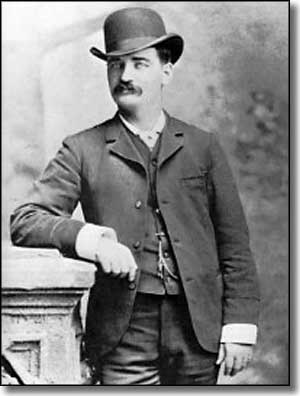
Bat Masterson said he didn't know anybody Wyatt couldn't whip without his guns. A lot of times Wyatt didn't carry guns...because if he carried guns he had to kill somebody--and he would kill somebody--but he didn't want to. He was a very religious man.
When we think of Bat Masterson, most of us envision a lawman, a gunfighter--a man's man in the Old West along side Wyatt Earp, Wild Bill Hickock and Doc Holiday. The television series definitely promoted that image. But did you know that he was also a New York sports writer?

Yep. Not only did he end up being a sports writer, but he wrote for years--as a newspaper reporter and editor as well as for other periodicals--and he'd been doing so since he was a young man. In fact, his ability to write and promote himself is how he pretty much created his own legend.

It all started in Quebec, Canada, on November 26, 1853, when a baby boy named Bartholomew Masterson was born Irish parents. In his teens, the family moved to Wichita, Kansas, and he along with his two of his brothers, Ed and James, went off to seek their fortunes as so many other boys did--buffalo hunting. At age 20, he fought in the Second Battle of Adobe Walls, and then worked for a while as a U.S. Army scout. From 1876 to 1882, he did his gunfight/lawman gig where he rose to notoriety, but our story starts in 1883.

It seems Bat rather enjoyed the sport of boxing. A lot. He was obsessed with fights and was more than fair at pre-fight analysis as well as calling the winners. So good, in fact, that he wrote a sports column for a Denver newspaper called George's Weekly. Newspapermen (and brothers) A.H. and W.E. Lewis had befriended Bat in Kansas City ten years before, and they would play a prominent role in Bat's fame and later success in the East. With their help, he'd honed his writing skills and while he couldn't be called a literary giant, he was pretty good at the craft.

During the years between his gunfighting days and his newspaper career, he mixed a little law enforcement here and there with gambling and writing. He was a professional gambler (called a thoroughbred) and organized boxing matches, acted as referee at times, as bookie, and guard. He never did actually box himself, though. His predictions were often right on, and he was excellent at assessing the fighters, their physical abilities, talent, and motivation.

Bat's life wasn't all roses. He ended up in more than a few altercations when his past reputation would catch up with him, and after a while, also succumbed to the lure of alcohol, although he threw off the demon when he moved to Manhattan. The buzz of New York City suited him just fine and he loved living there. Who would have thought a crusty old gunfighter would take so quickly to city life?

He hooked up with the Lewis brothers again, and he wrote for the New York Morning Telegraph, where he eventually because vice president and secretary. He was close friends with Teddy Roosevelt and other notables, and lived well for the rest of his days.

In 1921, he was writing his column when he had a heart attack and died hunched over his typewriter. The last thing he wrote was, "There are those who argue that everything breaks even in this old dump of a world of ours. I suppose these ginks who argue that way hold that because the rich man gets ice in the summer and the poor man gets it in the winter things are breaking even for both. Maybe so, but I'll swear I can't see it that way."

His last words are evidence that our world really hasn't changed much.

Jacquie

Faery Merry Christmas (a Kindle novella)
Down Home Ever Lovin' Mule Blues (See the Book Video featuring Justin Saragueta)
Jacquie's website * 1st Turning Point * Myspace * Twitter * Facebook
Faery Special Romances * Book Video * Royalties go to Children's Tumor Foundation, ending Neurofibromatosis through Research
Read a book by Jacquie Rogers

18 April 2010

AIMEE'S LOCKET Winner!

We have a winner for PL Parker's AIMEE'S LOCKET guest blog. A free copy goes to:

Laura (Historical Writer/Editor)!

Contact Carrie to provide your mailing address. The book must be claimed by next Sunday or another winner will be drawn. Please stop back later to let us know what you thought! Congratulations!

Guest Author: Cat Lindler

This week on Unusual Historicals we're welcoming Medallion Press author Cat Lindler as she talks about her adventure romance STARLIGHT & PROMISES, set in 1891 Tasmania. How exciting! Here's the blurb:

During a voyage to an uncharted isle in the Furneaux Islands near Tasmania, Lord Richard Colchester finds a living saber-toothed tiger, an animal believed to have been extinct for over ten thousand years. His discovery will astonish the world...that is, if he ever makes it back to England.

When Lady Samantha learns that her Uncle Richard has disappeared under suspicious circumstances, she enlists the help of Professor Christian Badia, a noted zoologist and animal tracker who specializes in wild cats. Not only does she intend to organize the expedition, she plans to join in the treacherous search.

Christian is a hot-tempered man and a notorious recluse, so the last scenario Samantha anticipates is a romantic interlude. But she is drawn unexpectedly into a world of physical passion, and she soon realizes this enigmatic man is her soul mate. When Christian embarks Tasmania abruptly, leaving Samantha behind, she fears she may forever lose her new found love.

Unable to sit idly by and wait for his return, Samantha launches her own investigation—and finds herself in grave danger. Will Christian find her...before it's too late?
***

"Lindler writes in a smooth style, providing evocative descriptions and compelling historical details as well as a satisfying surprise ending." ~ Publisher's Weekly

"The passionate couple and engrossing storyline will stay in your heart for some time" ~ Romantic Times

***

A search for a saber-toothed tiger is a very unusual subject. How did you come up with it?

I'm a zoologist by education, and I've always been fascinated by scientists discovering new species and rediscovering "extinct" species. It seems like every year or so, even large species are being found in poorly explored parts of the world. I thought it to be a perfect quest for a fictional scientist. At first, the animal I chose was the thylacine, the Tasmanian tiger, a marsupial which is thought to have gone extinct in the early Twentieth Century. However, while I was writing this book, thylacines were found in Australia in an undisclosed location. Good for the marsupials, but bad for my plot. So I had to turn to an animal that had no chance whatsoever of being found alive: the Smilodon, the saber-toothed tiger.

Would a scientist of that day have believed that a Smilodon actually existed?

Scientists are the ultimate optimists, and even the remotest possibility that a Smilodon existed would be enough to lure a reluctant scientist out of retirement. We have to look at the state of biological knowledge during the late Victorian and how much of the world scientists had actually explored in detail. Before the modern age, many parts of the world remained unknown and inaccessible. It wasn't quite the "sea monsters be here" days of the Vikings or the "falling off the edge of a flat earth" days of Columbus, but knowledge was limited and selective. Fossils were rare, and means of dating them unreliable. It wasn't until the modern age that we knew the saber-toothed tiger evolved and existed only in the Americas.

What influenced you to set the book in Tasmania? How did you research that area?

I had to think about where a large cat could exist and escape discovery by any means other than accidentally. One area of the world garnered little intense exploration: the thousands of South Sea islands and the wild, dangerous land of Tasmania, for explorers had no hope of finding gold (their primary quarry) or other fabulous wealth--only cannibals, headhunters, and pirates. And exploration was seldom undertaken solely for scientific knowledge. Governments financed expeditions, and they expected a return on their investment.

As for research, I haunt used book stores that stock a large variety of very old books. While on one such trip, I came across a wonderful book, Early Tasmania (1914). At the time, I had no plans to write a book on Tasmania, but I loved the book, which was on the order of a journal and contained amazing hand-drawn maps. I also researched cannibals during that time, flora and fauna, ships, ocean currents, and everything else I needed to know. I use mostly books, for Internet sources can be incorrect, and I also consult the Library of Congress Ask a Librarian service when I have a specific question for which I can't find an answer.

***

Thanks for stopping by, Cat! If you'd like to be entered to win a copy of STARLIGHT & PROMISES, just leave a question or comment for Cat. (I'd like to know why more romances aren't set in colonial Australia and New Zealand, but that may not be something Cat can answer!) I'll draw a winner at random next Sunday. Void where prohibited. Best of luck!

16 April 2010

Weekly Announcements - 16 Apr 2010

Congratulations to Delia DeLeest who has a new 1920s romance coming out in early fall from The Wild Rose Press. Here's the blurb for NOT LOOKING FOR TROUBLE.
How could someone not looking for trouble stumble upon it so easily? Susan Kent wonders this exact thing when she finds the man of her dreams, only to discover that he lives in a nightmare of his own making.

Jake Kelley thought he found the peace and simplicity he'd been looking for all his life. But in bringing Susan into his world, is he only dragging her down instead of pulling himself up?

The dark underworld of gangland Chicago throbs with intrigue, thrills and danger--those who venture there seldom leave intact...if they leave at all.
***

Congratulations to Margaret Mallory whose KNIGHT OF PASSION, the third of her "All the King's Men" trilogy, received a 4 1/2 star "Top Pick" review from Romantic Times. "Mallory raises the genre to a new level." Here's the blurb:
Renowned beauty Lady Linnet is torn between two desires: revenge on those who destroyed her family or marriage to her childhood sweetheart Sir James Rayburn. One fateful night, she makes a misguided choice: she sacrifices Jamie's love for a chance at vengeance.

Jamie Rayburn returns to England in search of a virtuous wife--only to find the lovely Linnet as bewitching as ever. Their reckless affair ignites anew, even hotter than before, although Jamie vows to never again trust her with his heart. Then just as Linnet begins to make amends, she's tempted by one last opportunity to settle old scores. But a final retribution could cost her Jamie's love--this time forever.
***

Debut author Lila DiPasqua's steamy fairy tale collection AWAKENED BY A KISS, set in 17th century France, won't be available until August, but she's holding a contest now! What's up for grabs? Well...she's giving away poison. Check out the details here.

***

Congratulations to Jennifer Linforth, whose MADRIGAL, the first of her novels that continue Gaston Leroux's The Phantom of the Opera, is featured in a contest from Night Owl Reviews. The contest runs through April 23, so check it out!

***

Lorelie Brown's 1920s romance, JAZZ BABY, her March debut from Samhain, received a B+ review from Dear Author. "If Prohibition/Jazz Age is the new Regency, I say bring it on. If readers are looking for something different, and I know I am, I hope they look this way."

***

Join us Sunday when Cat LINDLER will be here to chat about her Medallion debut, STARLIGHT & PROMISES, set 1891 Tasmania. She'll also be giving away a copy. Don't miss it!

***

We'll also draw the winner of AIMEE'S LOCKET from P.L. Parker's guest appearance last Sunday. You still have time to leave a comment or question for your chance to win.

***

Stay with us through the coming weeks when we'll be featuring the best unusual historical authors! Cheryl Pierson, Michelle Styles, Blythe Gifford, and Diane Whiteside will be our guests. Join us!

***

Have a good weekend! Remember, you don't have to be an Unusual Historicals contributor to submit good news to the weekend announcements. If it has to do with unusual historicals, we'd love to shout it out to the world! Send announcements to Carrie. See you next week...

15 April 2010

Excerpt Thursday: Cat Lindler

This week on Excerpt Thursday we're featuring Medallion Press author Cat Lindler's adventure romance STARLIGHT & PROMISES, set in 1891 Tasmania. How exciting! Please join us on Sunday when Cat will be here to answer questions and give away a signed copy. Here's the blurb:

During a voyage to an uncharted isle in the Furneaux Islands near Tasmania, Lord Richard Colchester finds a living saber-toothed tiger, an animal believed to have been extinct for over ten thousand years. His discovery will astonish the world...that is, if he ever makes it back to England.

When Lady Samantha learns that her Uncle Richard has disappeared under suspicious circumstances, she enlists the help of Professor Christian Badia, a noted zoologist and animal tracker who specializes in wild cats. Not only does she intend to organize the expedition, she plans to join in the treacherous search.

Christian is a hot-tempered man and a notorious recluse, so the last scenario Samantha anticipates is a romantic interlude. But she is drawn unexpectedly into a world of physical passion, and she soon realizes this enigmatic man is her soul mate. When Christian embarks Tasmania abruptly, leaving Samantha behind, she fears she may forever lose her newfound love.

Unable to sit idly by and wait for his return, Samantha launches her own investigation—and finds herself in grave danger. Will Christian find her...before it's too late?
***

"Lindler writes in a smooth style, providing evocative descriptions and compelling historical details as well as a satisfying surprise ending." ~ Publisher's Weekly

"The passionate couple and engrossing storyline will stay in your heart for some time" ~ Romantic Times

***

"Conditions, then. First, you'll pay all the expenses incurred."

"That was my intention."

"Next, Lord Stanbury and I will share authorship on any publications resulting from the expedition."

"I agree," she said, surprised his conditions were so reasonable. "Uncle Richard should have no difficulty with coauthorship." The tension lifted from her shoulders.

He grinned like the hare confronting the tortoise prior to the race, his teeth flashing in his tanned face. "Fine. Now for the difficult one. This is to be my expedition. I'll take sole charge, make all the plans, and give all the orders." When she started to speak, he cut her off. "I'll brook no opposition on this. I'm familiar with that part of the world. It's primitive and dangerous, infested with sea pirates, criminals, headhunters, and cannibals. In assuming responsibility for the expedition's safety, I'll tolerate no interference or challenges to my authority."

She controlled her voice with difficulty. "I understand. I realize you have the superior experience. I shall follow your orders." Surely that could not be too difficult. Step here; do not step there; hide behind this tree…

"You had better. You can travel with us to Tasmania. I have friends there who run a respectable boardinghouse. I'll send reports to you when I can."

"No!" She jumped up, and her cup of tea went flying. It splashed across his breeches. "You go too far. I must go to the island with you."

He stood just as abruptly, cursed, pulled himself up to his full height. His cup dropped on the side table with a clatter. The liquid remaining in the cup sloshed out and spilled onto the table. With a handkerchief drawn from his coat, he brushed at the scalding tea on his leg. "You will not!"

"I will!"

His eyes narrowed, darkened. "Not!"

"How will you find the island without me?"

"You will inform me of its location before we reach Tasmania."

Her mouth quirked into a wide smile. Slowly and distinctly, she said, "No…I…will…not."

"Damn it, Sam," he said on an explosive breath. He threw the soaked handkerchief to the floor. "Have you any notion of what you're saying?" Raking a hand through his hair, disheveling it, he stalked away, pacing across the room, his large form seeming to dwarf the space. "The South Seas are treacherous enough for armed men, much less pampered society ladies. I've already mentioned the unsavory human elements we will meet: not might, but . In all likelihood, we'll encounter spiders the size of dinner plates and centipedes over a foot long, whose bite can cause your arm or leg to swell to four times its normal size." He paused, skewering her with his gaze. "Snakes, too. Have you ever heard of the two-step viper?"

"No, but it sounds interesting. What color is it?"

"What color is it?" he sputtered, rumpling his hair again. "This is no joking matter. Its venom is lethal, killing before the victim can take two steps. Even the plants, deceptively beautiful, harbor poisonous spines or sap that strips skin from flesh. And were that not enough, the men I hire will be no gentlemen. You would have no privacy. I cannot afford to make a mistake and risk lives because I'm distracted by playing nurse to you."

Samantha returned his stare. "I have no need of a nurse. I'm far from being a child. I have no fear of your flesh-stripping plants nor two-stepping snakes and headhunting cannibals. I'm not a helpless, pampered female, but a modern woman. I am perfectly capable of taking care of myself in any situation. In fact, I have a reputation as a well-respected amateur herpetologist. I accompanied Uncle Richard on many such expeditions." Her conscience thumped her a bit at the lies. Small lies, but lies nonetheless. "I will not give you the island's location. I shall obey you in all else, but I must go with you. This is my expedition. I have to find Uncle Richard."